Creation Story
Spider-Man almost didn’t happen. Martin Goodman, Marvel’s publisher in 1962, didn’t think a teenage lead would sell. The publishing logic of the day was simple: teens were sidekicks, not headliners. Stan Lee thought that logic was wrong. He’d spent the last year writing flawed, anxious heroes who couldn’t make rent (the Fantastic Four in 1961, the Hulk earlier in 1962), and he wanted to push further by handing the lead to a kid in high school.
Goodman gave him a way to fail quietly. If Lee wanted to try the teenage-hero idea, he could try it in Amazing Fantasy, the anthology Marvel was already planning to kill. Issue #15 would be the last one. If the book flopped, the character flopped with it.
Lee handed the art to Steve Ditko. Ditko’s style was nothing like Jack Kirby’s muscled-up dynamism. Clean, geometric, slightly off, and the mismatch is part of why Spider-Man read so differently from the rest of the Marvel line. Ditko designed the costume in red and black with a full face mask so any teenager picking up the book could see themselves under it. He drew the web-shooters as a science-kid invention rather than an organic power, which made Peter Parker a science prodigy first and a hero second. Kirby pencilled the cover so the issue still looked like a Marvel comic on the rack.
Then it sold. Six months later, The Amazing Spider-Man #1 went to print on the strength of those numbers, and the kid Goodman didn’t want became the biggest character Marvel ever published.
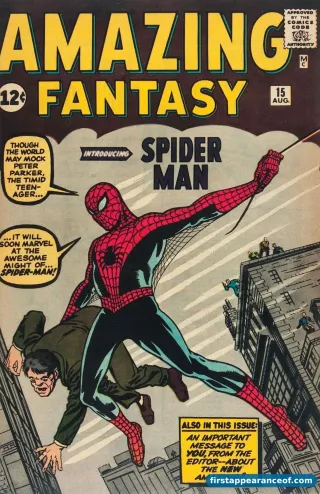
First Appearance and First Cover: Amazing Fantasy #15
Amazing Fantasy #15 came out in August 1962. The cover price was 12 cents. 36 pages, anthology format: an 11-page Spider-Man origin and three filler science-fiction shorts that nobody remembers.
A few facts shape how collectors think about the book. The cover is by Jack Kirby, not Steve Ditko. Ditko didn’t like Kirby’s composition and redrew the Spider-Man figure himself before printing, but Kirby still gets the cover-penciller credit on the original art. The print run was conservative because Amazing Fantasy was already being killed off, so high-grade copies are scarce. The book carries the “Approved by the Comics Code Authority” seal in the top-right corner, which means any unstamped copy is a proof, an international edition, or an error. By auction record, Amazing Fantasy #15 is the most valuable Silver Age comic. A CGC 9.6 sold at Heritage in September 2021 for $3.6 million, the highest price paid for any comic at that point.
The story opens at Midtown High. Peter Parker is the bookish kid getting pushed around by his classmates, Flash Thompson among them. He goes to a public radioactivity demonstration. A spider crosses into the radiation field, the spider bites him on the hand, the spider dies. Peter walks home with proportionate strength, wall-crawling, agility, and a sixth sense for trouble.
His first instinct is to make money. There’s a televised wrestling challenge with a cash prize, and he enters in a mask he designed himself. He wins. He goes home and builds web-shooters in Aunt May and Uncle Ben’s place, gives the act a name, and lands TV bookings. Spider-Man becomes a celebrity inside one story.
The pivot is a single moment backstage. A burglar runs past Peter, a guard yells for help, and Peter lets the burglar go because it isn’t his problem. He gets home that night to police at the door: Uncle Ben has been shot during a robbery. Peter chases the killer in costume and finds out it’s the same man he watched run past him at the studio. The story closes on the caption Lee wrote with no fanfare: “With great power there must also come great responsibility.” It’s now one of the most-quoted lines in the genre.
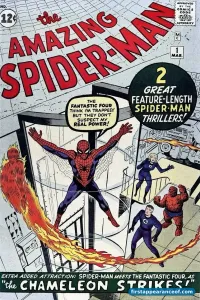
First Solo Title: The Amazing Spider-Man #1
The Amazing Spider-Man #1 has a March 1963 cover date. It hit newsstands in December 1962, six months after Amazing Fantasy #15. 36 pages, 12 cents. The series has stayed in print, with renumbering and imprint resets, for over 60 years. The cover is Kirby pencils with Ditko inks: Spider-Man swinging over a villain. That layout became the template for Spider-Man covers for the next several decades.
The book uses Marvel’s anthology pattern of the era: two stories tied together by the lead character. Story one opens with Peter, riding the post-Amazing-Fantasy wave of TV fame, trying to join the Fantastic Four for a paycheck. They turn him down because they aren’t a paying job, they’re a non-profit research collective. That conversation is the first FF / Spider-Man crossover and the first time Spider-Man shows up in someone else’s continuity, which is what made him part of the shared Marvel universe instead of a standalone property. The story also runs a four-page origin recap, the earliest reprint of the AF #15 origin in any form.
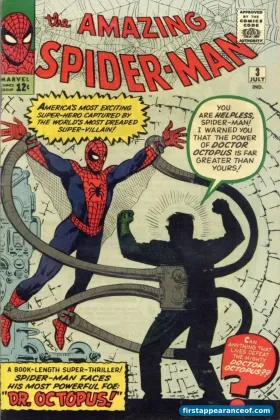
Story two introduces the Chameleon, a Soviet master-of-disguise villain who frames Spider-Man for espionage. The Chameleon is the first recurring Spider-Man rogue and the start of the rogues’ gallery, whose first appearances fill out across the next year: Vulture in #2, Doctor Octopus in #3, Sandman in #4, Lizard in #6. The issue also debuts J. Jonah Jameson, the Daily Bugle editor whose ongoing PR war against Spider-Man becomes a permanent fixture of the book. Jameson’s son, astronaut John Jameson, gets his first appearance in story one as the astronaut-in-peril.
Three things make ASM #1 a collector book. It’s Spider-Man’s second appearance and his first solo title. It’s the first J. Jonah Jameson, who has been adapted across virtually every Spider-Man film and TV series since. And it’s the first Chameleon, which is a minor villain key on its own. High-grade copies have moved up steadily: a CGC 9.8 sold for $1.38 million in January 2024. That is more about scarcity than weight, since small-spine 1963 newsstand books were handled hard by their original 9-year-old owners, and clean copies are uncommon. ASM #1 is the rare second-appearance issue that collectors chase as hard as a debut.