Creation Story
The Venom first-appearance progression is the Copper Age’s cleanest worked example of cameo versus full appearance, which is why the character is cited throughout the True First Appearance guide.
Venom is a product of a long chain of creative decisions that started in 1982 with a fan submission. Marvel was running a Black Costume contest as part of the Secret Wars crossover promotion, soliciting reader designs for a new Spider-Man costume. Randy Schueller, a 22-year-old fan, submitted a black-and-white design showing a form-fitting black suit with a white spider insignia. Marvel purchased the design for 220 dollars, which is notable because Schueller retains no further creator rights despite the design being the visual basis for one of Marvel’s most commercially successful characters.
The black suit debuted in Secret Wars #8 (December 1984) and on Earth in The Amazing Spider-Man #252 (May 1984) and Marvel Team-Up #141 (May 1984). Writer Tom DeFalco and artist Ron Frenz handled the Spider-Man title at the time. The suit was initially presented as an unstable-molecule Kree design. Peter Parker wore it for roughly a year of in-story time across 1984 and 1985 before learning it was a sentient alien symbiote.
The separation sequence in ASM #258 (November 1984), written by Tom DeFalco and pencilled by Ron Frenz, set up the symbiote as a rejected entity: it had bonded with Peter against his conscious will and he used the Fantastic Four’s lab to forcibly remove it. The symbiote, now alone and angry, escaped. Where it went and what it did was left open.
David Michelinie took over The Amazing Spider-Man as writer in 1987 and brought in Todd McFarlane as regular penciller with ASM #298 in March 1988. Michelinie conceived the next phase: the rejected symbiote would find a new host who shared its grudge against Spider-Man. The host Michelinie designed was Eddie Brock, a disgraced investigative journalist from the Daily Globe whose career had been ruined when Spider-Man publicly unmasked the wrong suspect in a Sin-Eater story. Brock’s humiliation drives him to suicide attempts before the symbiote finds him in a church, where the two bond over their shared hatred.
The visual design of Venom as a character (the grotesque oversized teeth, the prehensile tongue, the distorted anatomy) is Todd McFarlane’s contribution. Michelinie’s scripts described Venom as “Spider-Man’s reflection.” McFarlane made that reflection horrific. The design became so iconic that every subsequent Venom artist has worked off McFarlane’s template, including the 2018 and later Tom Hardy film appearances.
First Cameo: The Amazing Spider-Man #298
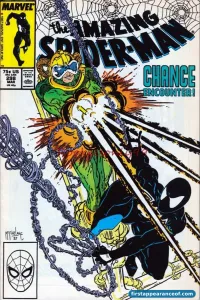
The Amazing Spider-Man #298 is cover-dated March 1988 and was on newsstands in November 1987. This is Todd McFarlane’s first issue as regular Spider-Man artist, and it is the issue that introduces Eddie Brock. The Venom cameo is a single final-page panel showing Venom in shadow from the rear, leaping toward a window. He is not named, not in full view, and does not fight.
The issue’s primary story is about Sin-Eater, a serial-killer character from earlier in the Michelinie run. Eddie Brock appears as a journalist covering the case, and the story reveals that Brock ruined his own reputation by publishing an incorrect Sin-Eater suspect identity based on Peter Parker’s photography. Brock blames Spider-Man for the career destruction and is introduced as a character nursing a specific grievance, which becomes the emotional setup for his Venom transformation.
Collector significance is three-fold. First, this is Eddie Brock’s first appearance, which is a Venom-adjacent key even though Brock is not yet Venom in the issue. Second, this is Todd McFarlane’s first Spider-Man issue, and McFarlane’s subsequent 1988-1991 run is considered a commercial and artistic peak for the title. Third, the Venom cameo itself is a documented collectible first, though it trades at a significant discount to the full appearance in #300. ASM #298 was heavily distributed at the time and print run estimates exceed 300,000 copies. Surviving 9.8 copies are common relative to other Copper Age keys.
Second Cameo: The Amazing Spider-Man #299
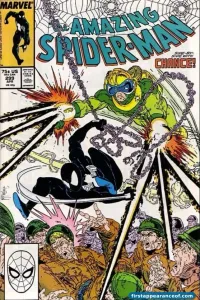
The Amazing Spider-Man #299 is cover-dated April 1988. The Venom cameo here is more substantial than #298 but shorter than #300. It is a two-page sequence where Venom confronts Mary Jane Watson in her apartment. Venom is in full costume and speaks, but the encounter is brief and Spider-Man is not present. Venom leaves as quickly as he arrives.
The significance of #299 for collectors is disputed. Some grading services label it as a “Venom second cameo” while others treat it as a regular issue with an expanded cameo. The market splits the difference: #299 trades at a premium over the surrounding issues (#297, #301) but well below both #298 and #300. For completionist collectors, #299 is required because it is the only issue where Venom appears before the full debut without a Spider-Man confrontation, giving it narrative uniqueness.
The Mary Jane apartment scene is also the first time Venom speaks in costume in the comics. His dialogue in #299 establishes the character’s verbal style (first-person plural, “we” referring to Brock and the symbiote as a unit) which became a signature of the character.
First Full Appearance and First Cover: The Amazing Spider-Man #300
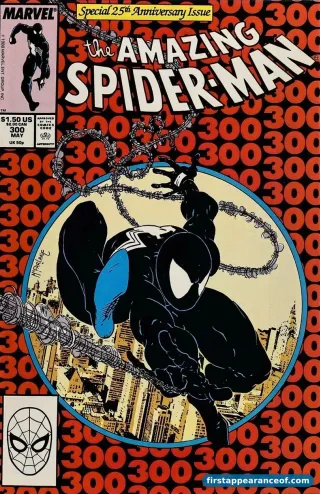
The Amazing Spider-Man #300 is the defining collectible key of the Copper Age and is commonly cited alongside Hulk #181, Giant-Size X-Men #1, and Amazing Fantasy #15 as one of the most important Marvel first appearances of the post-1970 era. Cover-dated May 1988, on newsstands February of that year. The issue is a 25th-anniversary double-sized special at 64 pages, priced at 1.50 dollars.
The cover is by Todd McFarlane. Venom dominates the composition, filling roughly three-quarters of the frame with a close-up hero shot: oversized teeth, extended tongue, distorted hands with claws, and the stylized white spider logo on the chest. Spider-Man in the classic red-and-blue costume swings in from the upper left. The composition established the Venom-as-monster visual grammar that subsequent artists, films, and adaptations have referenced for 35+ years.
The story is written by David Michelinie and pencilled by Todd McFarlane, with inks by Bob McLeod. Venom is the primary antagonist across the full issue. The plot resolves the Eddie Brock origin sequence: Brock is shown being driven out of journalism by the Sin-Eater mishap, the symbiote finds him in a church (rejecting Spider-Man’s reunion bid at the same time via ambient resonance), and the two bond over their shared grievance. Brock in the Venom suit attacks Peter Parker’s home, confronts Mary Jane, fights Spider-Man to a standstill, and is defeated by Peter using a sonic weapon that exploits the symbiote’s vulnerability to sound. The issue also features Peter’s return to the classic red-and-blue costume, which had been retired for narrative reasons since Secret Wars.
Collector significance is built on multiple layered firsts. ASM #300 is Venom’s first full appearance, first cover, first verbal Spider-Man confrontation, and first complete backstory. It is also the first issue showing Eddie Brock as Venom in the bonded form across a full story. It is the first Todd McFarlane cover to feature Venom prominently (his previous Spider-Man covers had other antagonists). The 25th-anniversary framing gives the issue structural weight beyond the Venom debut: it also contains a backup story revisiting Spider-Man’s origin and retrospective editorial commentary.
Print run estimates for ASM #300 exceed 350,000 copies based on Statement of Ownership filings from 1988. Because Venom’s popularity exploded in the early 1990s, many reader copies were heavily circulated before collectors recognized the issue’s long-term significance, which is why genuinely high-grade (9.8 and above) copies are less common than the print run would suggest. A CGC 9.8 copy sold at Heritage Auctions in 2021 for 11,400 dollars. Higher-grade newsstand variants (distinguishable by the UPC barcode format) have sold at multiples of the direct-market equivalents because newsstand distribution represented a small fraction of Copper Age print runs.
ASM #298 vs ASM #300
The compact reference for the debate:
| ASM #298 | ASM #300 | |
|---|---|---|
| Cover date | March 1988 | May 1988 |
| Venom appearance type | Final-page cameo in shadow | Full appearance across a 38-page story |
| On the cover? | No | Yes, dominant composition |
| Venom named or unnamed? | Unnamed | Named, introduced in full |
| Venom fights Spider-Man? | No | Yes, the primary battle of the issue |
| Page count featuring Venom | 1 (final panel) | 38 (full issue primary antagonist) |
| Also contains | Eddie Brock’s first appearance, McFarlane’s first ASM | Return of classic red-and-blue costume, 25th-anniversary framing |
| CGC/CBCS label | ”1st Cameo of Venom" | "1st Full Appearance, 1st Cover” |
| Typical market multiple | 1x baseline | 3-5x ASM #298 at matched grade |
ASM #299 sits between the two, with a 2-page Venom scene that most grading services label “Venom second cameo.” The market treats #299 as a premium over non-Venom Copper Age issues but at roughly half the value of #298 at matched grade.
For completionist collectors, the full progression (#298, #299, #300) is acquired together. For buyers choosing one issue, #300 is the defining key by every editorial and market measure.
First Solo Title: Venom: Lethal Protector #1
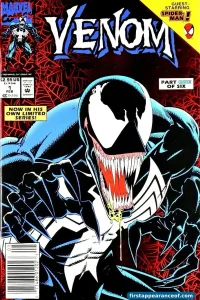
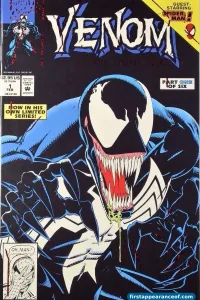
Venom: Lethal Protector #1 is cover-dated February 1993 and was the first issue of a five-part limited series that ran through June 1993. Written by David Michelinie, the character’s co-creator, and pencilled by Mark Bagley, who had taken over as regular Amazing Spider-Man artist after Todd McFarlane’s departure. It is the first time Venom carried a book as the lead, and it is the issue that pivoted the character’s long-term identity from antagonist to anti-hero.
The setup is simple and deliberate. The opening pages stage a truce between Spider-Man and Venom: Eddie Brock agrees to leave Peter Parker alone permanently if Peter does the same in return. Venom then relocates from New York to San Francisco, removing himself from Spider-Man’s orbit entirely. The rest of the mini-series follows Venom protecting an underground community of homeless people from two threats: the Jury, a paramilitary group formed specifically to hunt and execute Venom, and the Life Foundation, a survivalist tech corporation run by Carlton Drake. The homeless-protector framing gave the character his self-assigned title, “lethal protector,” and established the moral grammar that has defined Venom for every subsequent appearance: villain to Peter Parker, hero to the vulnerable, lethal to anyone who threatens the latter.
Lethal Protector #1-5 also contains five notable first appearances. The Life Foundation, led by Carlton Drake, experiments on five captured symbiote offspring extracted from Venom, and those symbiotes debut across the series: Scream (Donna Diego), Phage, Lasher, Riot, and Agony. These are the “five symbiotes” that recur in the 2018 Venom film, in Absolute Carnage, and in the Cates-era relaunch. Lethal Protector #4 contains the first full appearances of all five.
Commercially, the limited series was Marvel’s proof-of-concept that Venom could hold a book. It sold strongly enough to justify a chain of back-to-back Venom mini-series across 1993-95 (The Mace, Funeral Pyre, Carnage Unleashed, Separation Anxiety, Along Came a Spider, The Madness) before Venom finally received an ongoing title in 2003 under Daniel Way.
Variant maze
Lethal Protector #1 is one of the most variant-heavy single issues of the early-1990s foil era. The legitimate cover variants include the standard red-foil direct-market edition, a scarcer gold-foil direct-market variant (the most-collected of the intentional variants), a platinum version, and a newsstand edition. The gold-foil is meaningfully scarcer in high grade than the red-foil.
On top of the intentional variants, the issue is notorious for multiple print-error variants. The most recognizable is a black-cover error where the foil layer was never printed, leaving a mostly-black cover in place of the red-or-gold logo treatment. Other errors across the print run include mis-registered foil, double foil-stamping, and partial-foil misprints. Error copies trade as distinct collectibles with their own CGC census entries. The black (unprinted foil) error is the most-reproduced version in price-guide discussions.
The “anti-hero” framing established here is structurally what separates Venom from characters like Carnage or the Green Goblin. Those are straight villains. Venom, from 1993 forward, is a character with a consistent code: he protects the people he declares innocent, and he destroys anyone who threatens them. The Tom Hardy films, the Donny Cates 2018 run, and virtually every subsequent screen adaptation lean on the Lethal Protector framing rather than the 1988 villain framing. For collectors and readers, Lethal Protector #1 is where the modern Venom starts.