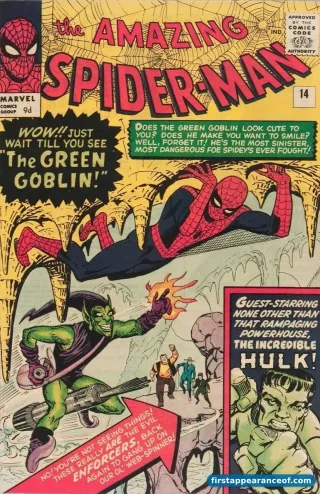
Green Goblin on the cover of Amazing Spider-Man #14 (1964), his first appearance.

1st Appearance and 1st Cover

First Appearance of Green Goblin

The Amazing Spider-Man #14

July 1964 · Marvel · Silver Age

Peter Parker's best friend's father, and the villain responsible for the death that ended the Silver Age of Spider-Man.

Key Issue

Created by Stan Lee · Steve Ditko

By Atomm Updated

The first appearance (1st app) of Green Goblin is The Amazing Spider-Man #14 (July 1964), created by Stan Lee and Steve Ditko. The Goblin's face remains concealed; the secret identity as Norman Osborn is not revealed until Amazing Spider-Man #39 (August 1966), which is the first issue with John Romita Sr. as regular Spider-Man penciller. The character is Spider-Man's single most significant recurring villain, responsible for the deaths of Gwen Stacy, the Green Goblin's own decades of presumed-death storylines, and the modern Dark Reign event.

Quick Facts

Debut
The Amazing Spider-Man #14 (July 1964) as Green Goblin. Amazing Spider-Man #39 (August 1966) as Norman Osborn.
Real name
Norman Osborn
Creators
Stan Lee (script), Steve Ditko (art, original concept and design)
Publisher
Marvel Comics
First enemy
Spider-Man (his defining antagonist)
First ally
None directly. Harry Osborn is his estranged son. Norman's criminal network expands in subsequent appearances.
Team affiliations
Sinister Six, H.A.M.M.E.R. (as director), Dark Avengers (as Iron Patriot)

Firsts Timeline

  1. The Amazing Spider-Man #14 cover
    First Appearance First Cover July 1964

    The Amazing Spider-Man #14

    By Stan Lee, Steve Ditko

    Green Goblin debuts but is not unmasked. Stan Lee script, Steve Ditko art. Goblin's identity as Norman Osborn is not revealed until Amazing Spider-Man #39 (1966). Same issue features the first appearance of the Enforcers and the Hulk's first appearance in ASM.

    Read the full breakdown
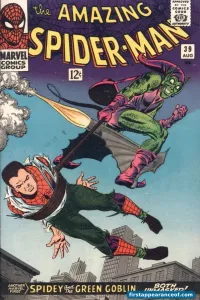
  2. The Amazing Spider-Man #39 cover
    First Appearance as Norman Osborn August 1966

    The Amazing Spider-Man #39

    By Stan Lee, John Romita Sr.

    Green Goblin's secret identity is revealed as Norman Osborn, Harry Osborn's father. John Romita Sr.'s first Spider-Man issue as regular penciller. The unmasking resets the character from one-off villain into recurring personal-stakes antagonist.

    Read the full breakdown

Creation Story

Green Goblin was Steve Ditko’s creation in concept and design. Ditko developed the visual character (green skin, purple costume, goblin-themed goggles, bat-winged glider) during the Spider-Man run and pushed for a costume design with explicitly horror-adjacent imagery rather than the science-fiction villain archetypes the early Spider-Man book had been using. Stan Lee scripted Amazing Spider-Man #14 (July 1964). The debut is the character in full costume attacking Spider-Man without the Goblin’s face revealed; readers see goblin-mask, cape, glider, and the laughing verbal tic, but not the face underneath.

The decision to conceal the identity through multiple appearances was part of the editorial plan. Ditko wanted the reveal to be a specific character readers had already met; Lee wanted the reveal to be more dramatic. The tension between Lee and Ditko over the Goblin’s identity was one of several factors in Ditko’s 1966 departure from Marvel.

John Romita Sr. took over as Spider-Man penciller with Amazing Spider-Man #39 (August 1966) and the issue unmasked the Goblin in the story’s final pages: Norman Osborn, father of Peter Parker’s best friend Harry Osborn. Romita’s first Spider-Man issue is also the Osborn reveal and a secondary Silver Age key.

The death of Gwen Stacy

Amazing Spider-Man #121 (June 1973) by Gerry Conway and Gil Kane is the single most consequential comic book of the Bronze Age. Green Goblin throws Gwen Stacy from the Brooklyn Bridge; Spider-Man catches her; the catch either breaks her neck or the Goblin has already killed her (Conway has gone back and forth in interviews). The issue’s effect on mainstream comics was immediate. Supporting characters in superhero books had not died before. After #121, they could. The assumption of safety that had defined Silver Age Marvel’s supporting-cast physics was gone.

Amazing Spider-Man #122 (July 1973) killed Norman Osborn in the follow-up. Osborn stayed dead for 23 years of publishing time until the Clone Saga (1996) revealed he had survived and was masterminding the entire arc.

The Dark Reign era

Dark Reign (2009) marked Norman Osborn’s ascension to public power. Following the Secret Invasion event, Osborn becomes director of H.A.M.M.E.R. (the post-S.H.I.E.L.D. security apparatus), forms the Dark Avengers (Venom impersonating Spider-Man, Bullseye as Hawkeye, Daken as Wolverine, and Osborn himself in a customized Iron Man armor as Iron Patriot), and operates as the most powerful figure in the Marvel Universe. The arc runs through most of 2009 and concludes in Siege (2010) by Brian Michael Bendis and Olivier Coipel.

Collector context

Amazing Spider-Man #14 is the Green Goblin key and a Silver Age Marvel book with compounded collector demand (first Goblin, first Hulk in ASM, first Enforcers). Amazing Spider-Man #39 (Norman Osborn reveal, Romita’s first) is a secondary key. Amazing Spider-Man #121 (Death of Gwen Stacy) is both a Spider-Man key and a Green Goblin key; it trades as one of the most important Bronze Age Marvel books alongside Giant-Size X-Men #1 and Hulk #181.
Key subsequent appearances

After the debut, these are the issues collectors and historians reach for next.

  1. 1964

    The Amazing Spider-Man #14

    First appearance. Identity concealed.

  2. 1966

    The Amazing Spider-Man #39

    Norman Osborn Revealed

    Identity revealed. Romita Sr.'s first Spider-Man issue.

  3. 1973

    The Amazing Spider-Man #121

    Death of Gwen Stacy

    Gerry Conway and Gil Kane. Green Goblin throws Gwen Stacy from the Brooklyn Bridge. Widely cited as the end of the Silver Age of comics. The most-reproduced death sequence in Marvel.

    The death of Gwen Stacy in Amazing Spider-Man #121 is a structural turning point in mainstream superhero comics. Before #121, major supporting characters did not die in mainstream superhero books. After #121, they could. Gerry Conway's decision to kill Gwen rather than have Spider-Man save her broke the assumption of editorial safety around love interests and supporting cast. The issue is debated for its physics (did Spider-Man break Gwen's neck catching her, or did the Goblin kill her before the fall), but the effect on Marvel's publishing permissions was settled: deaths now carried weight.

  4. 1973

    The Amazing Spider-Man #122

    Death of Green Goblin

    Norman Osborn dies in the sequel issue, impaled by his own goblin-glider. Stays dead for 23 years until Marvel retcons the death in Spider-Man: Revelations (1996).

  5. 1996

    Spider-Man: Revelations

    Return from Death

    The Clone Saga reveals Norman Osborn survived and returns as the mastermind of the entire arc. Ends Peter Parker's confusion with Ben Reilly.

  6. 2010

    Siege #1

    Dark Reign Ends

    Norman Osborn's dark-reign arc concludes. Brian Michael Bendis and Olivier Coipel.

In adaptations

Film, TV, animation, and game appearances.

  1. 2002

    Spider-Man

    Film

    Starring:Willem Dafoe

    Sam Raimi directs. Dafoe's Norman Osborn / Green Goblin is a foundational Spider-Man film performance.

  2. 2014

    The Amazing Spider-Man 2

    Film

    Starring:Dane DeHaan

    Marc Webb directs. DeHaan plays Harry Osborn who becomes Green Goblin. Framing shifted to the son rather than Norman.

  3. 2021

    Spider-Man: No Way Home

    Film

    Starring:Willem Dafoe

    Jon Watts directs. Dafoe returns as Norman Osborn from the Raimi timeline. Grossed $1.9 billion worldwide.

Frequently asked questions

The questions readers and collectors ask most.

What is Green Goblin's first appearance?

Green Goblin's first appearance is The Amazing Spider-Man #14 (July 1964), created by Stan Lee and Steve Ditko. The identity as Norman Osborn is not revealed until Amazing Spider-Man #39 (August 1966). Collectors treat both issues as relevant keys: #14 is the first appearance in costume, and #39 is the first as Norman Osborn.

Is Amazing Spider-Man #14 valuable?

Yes. Amazing Spider-Man #14 is a Silver Age Marvel key. High-grade copies (CGC 9.0 and above) have crossed $50,000 at auction. It is also the first Spider-Man / Hulk meeting and the first appearance of the Enforcers, which compounds its collector demand. The issue has held value through every Spider-Man film adaptation and accelerated with Willem Dafoe's returns in 2021 and subsequent MCU appearances.

Did Gwen Stacy really die?

Yes, permanently for several decades. Gwen's death in Amazing Spider-Man #121 (June 1973) was structured as a permanent character death, and Gerry Conway and Gil Kane's decision to kill her is widely cited as the event that ended the Silver Age of comics by breaking the assumption of supporting-cast safety. Gwen did not return in any meaningful form until decades later (the Spider-Gwen alt-reality introduction in 2014 is a separate character, Gwen of Earth-65).

Is Norman Osborn dead?

Yes and no. Norman Osborn died in Amazing Spider-Man #122 (July 1973), impaled by his goblin-glider. He stayed dead until the Clone Saga (1996), when Marvel revealed he had survived and was masterminding the entire Clone Saga arc. Since 1996, Norman Osborn has been alive in continuity and has been a major Marvel antagonist during Dark Reign (2009), Siege (2010), and subsequent events.

What is the Dark Reign era?

Dark Reign is the 2009 Marvel storyline in which Norman Osborn, following the Secret Invasion event, takes public control of the Marvel Universe's superhero apparatus. He becomes director of S.H.I.E.L.D. replacement H.A.M.M.E.R., forms the Dark Avengers (villains posing as heroes), and operates as the most powerful person on Earth. The arc concludes in Siege (2010).

Is the film Green Goblin Norman or Harry Osborn?

Depends on the film. Sam Raimi's Spider-Man (2002) and No Way Home (2021) feature Willem Dafoe's Norman Osborn. Marc Webb's The Amazing Spider-Man 2 (2014) features Dane DeHaan's Harry Osborn. The comics have both characters (Norman first, Harry as the second Goblin) and the films chose different angles. Norman is the defining character.