Creation Story
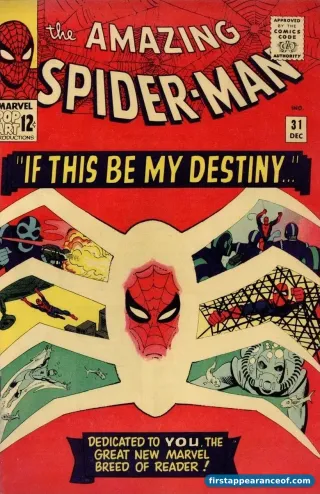
Gwen Stacy was Stan Lee and Steve Ditko’s college-era supporting character for the new chapter of Peter Parker’s life. Amazing Spider-Man #31 (December 1965) is a structural pivot in the Spider-Man book: Peter starts college at Empire State University, and the book’s supporting cast expands significantly. Gwen Stacy and Harry Osborn both debut in this issue as Peter’s new college classmates.
Ditko’s original Gwen Stacy is visually and tonally distinct from the later Romita-era version. Ditko drew her as an intellectually serious, slightly unapproachable character; the pairing with Peter was positioned as academic-rival-to-friend rather than romantic. When John Romita Sr. took over art with Amazing Spider-Man #39 (August 1966), he redesigned Gwen (the iconic black-headband look, the white knee-high boots, the redefined facial design) and shifted her role from supporting academic character to primary romantic interest.
The Romita-era Gwen ran from late 1966 through mid-1973, seven years of publishing time. She was Peter’s primary romantic partner after the Betty Brant relationship ended and before Mary Jane became the focus. Her father Captain George Stacy was a supporting character who died in Amazing Spider-Man #90 (1970), giving Gwen additional emotional weight heading into the early 1970s.
The death
Amazing Spider-Man #121 (June 1973), written by Gerry Conway with pencils by Gil Kane and John Romita Sr., killed Gwen Stacy. The Green Goblin throws her from the Brooklyn Bridge (or, in some readings, the George Washington Bridge, depending on panel interpretation). Spider-Man catches her with a web-line around the ankle. The “SNAP!” sound effect appears. Gwen is dead on arrival at the base of the bridge.
The editorial decision was unprecedented. Major supporting characters in mainstream superhero comics did not die in 1973. Conway had pitched the death as a way to break the book’s romantic stasis and create genuinely permanent consequences. Editor-in-chief Roy Thomas approved. The permanence was deliberate: Gwen did not return as a clone, a robot double, or a restored-from-death rescue. She stayed dead.
The event is widely cited as the end of the Silver Age of comics. Before #121, Marvel and DC operated under an implicit agreement that major supporting characters would not permanently die. After #121, they could. The book’s effect on publishing permissions was immediate and shaped the tonal framing of the entire Bronze Age.
Gwen’s legacy
Gwen Stacy has not been restored to main 616 continuity in any meaningful form. Her death remains a foundational piece of Spider-Man’s character weight, and multiple subsequent arcs have explored Peter’s grief over her loss (Spider-Man: Blue by Jeph Loeb and Tim Sale, 2002). The 2014 Amazing Spider-Man 2 film adapted the Brooklyn Bridge sequence, with Emma Stone in the role.
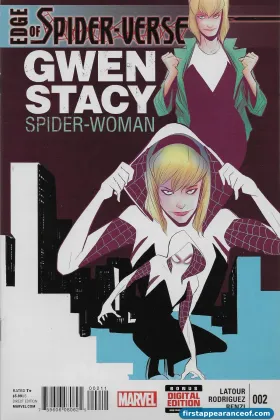
Spider-Gwen, introduced in Edge of Spider-Verse #2 (November 2014), is a separate character: Gwen Stacy of Earth-65, an alternate-reality version who was bitten by the radioactive spider instead of Peter. Spider-Gwen’s commercial success across comics, animation, and the Spider-Verse films represents the closest thing to a cultural return for the Gwen Stacy name, even though the 616 Gwen remains dead.
Collector context
Amazing Spider-Man #31 is the Gwen Stacy key and a dual first-appearance book (Gwen and Harry Osborn). High-grade copies have crossed $10,000 at auction. Amazing Spider-Man #121 is the Death of Gwen Stacy issue and one of the most important Bronze Age Marvel keys. Both books appreciated sharply around the 2014 Amazing Spider-Man 2 film and again with the 2018 Spider-Verse animated feature.
Secondary keys: Amazing Spider-Man #39 (1966) is the Romita-era Gwen redesign. Amazing Spider-Man #90 (1970) is the death of Captain Stacy (her father). Amazing Spider-Man #122 (1973) is the Death of Green Goblin follow-up issue.