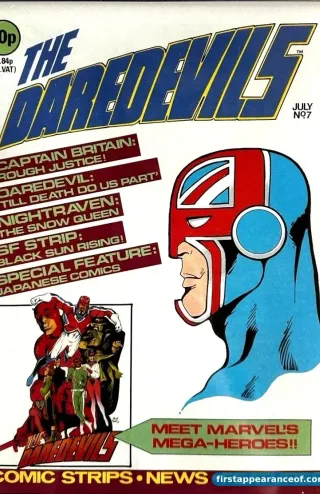
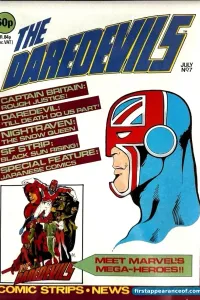
Daredevils #7 (1983). Alan Moore and Alan Davis. The first canonical use of 'Earth-616' as a designation for Marvel's main universe, originally as a joke about the boredom of Captain Britain Corps multiverse cataloging.

1st Use of 'Earth-616'

First Appearance of Earth-616

Daredevils #7

July 1983 · Marvel · Bronze Age

The numerical designation for Marvel's primary publishing continuity. The number is a British in-joke from a 1983 issue of Daredevils that escaped its origins and became one of the most-cited universe identifiers in superhero comics.

Key Issue

Created by Alan Moore · Alan Davis

By Atomm Updated

Marvel Comics Universe Marvel's main universe.

Earth-616 is the canonical designation for Marvel Comics' primary publishing continuity. The number first appears in Daredevils #7 (July 1983), Alan Moore and Alan Davis, originally as a Captain Britain-related joke about the bureaucratic boredom of cataloging the multiverse. The designation escaped its joke origins and was adopted in wider US Marvel editorial use by the late 1980s; Excalibur #1 (October 1988) is the first US Marvel title to use Earth-616 consistently as a canonical reference. The 2005 Official Handbook of the Marvel Universe: Alternate Universes formalized 616 as the primary-continuity number. Nearly every Marvel character readers know from comics or films is from Earth-616, with notable parallel-Earth exceptions like the Ultimate Universe (Earth-1610) and Spider-Gwen's universe (Earth-65).

Firsts Timeline

  1. Daredevils #7 cover
    First Use of 'Earth-616' July 1983

    Daredevils #7

    By Alan Moore, Alan Davis

    Alan Moore writes; Alan Davis pencils. Daredevils was a UK-published Marvel anthology featuring Captain Britain stories. Moore introduced the Earth-616 designation in this issue's Captain Britain feature, originally as a deliberately-mundane number meant to suggest the bureaucratic boredom of cataloging the multiverse. The joke escaped its context. By the late 1980s, Earth-616 was being used in editorial contexts as the canonical number for Marvel's primary publishing universe, which is the role it has played for nearly all of Marvel's published continuity since 1939.

  2. Wider Marvel Adoption October 1988

    Excalibur #1

    By Chris Claremont, Alan Davis

    Claremont writes; Davis pencils. Excalibur is the first US Marvel title to consistently use Earth-616 as the canonical Marvel-Universe designation in editorial framing. Claremont and Davis (the same Davis who drew the original 1983 Daredevils issue) carried the term across the Atlantic, and Excalibur's multiverse-jumping plotlines normalized the use of numbered Earths inside the wider Marvel line.

  3. Multiverse Codification September 2005

    Official Handbook of the Marvel Universe: Alternate Universes 2005

    By Marvel Editorial

    Marvel's reference-handbook codification of the multiverse. The 2005 Alternate Universes handbook formalizes Earth-616 as the official designation for the primary publishing continuity and assigns numbers to dozens of other parallel-Earth concepts (Ultimate Universe is Earth-1610, Spider-Gwen's universe is Earth-65, the 2099 universe is Earth-928, etc). This handbook is the canonical reference for which Earth number applies to which storyline.

What Earth-616 is

Earth-616 is the editorial number Marvel uses to identify the primary publishing universe — the one where almost every Marvel character readers know about lives. Spider-Man’s New York is Earth-616’s New York. The Avengers’ Avengers Tower is on Earth-616. The X-Men’s Krakoa, the Fantastic Four’s Baxter Building, the Hulk’s gamma-bomb New Mexico site, all of it sits in the same numerical universe.

The designation is shorthand. Most Marvel comics never say the number out loud; the readers and the characters do not need to know. Earth-616 only matters when the comic is doing multiverse work, which is the small subset of Marvel storytelling where it becomes important to specify which version of a character is on the page. When Spider-Gwen visits Peter Parker, the dialogue may reference Earth-65 (Gwen’s home) and Earth-616 (Peter’s). When the Ultimate Universe characters cross over with mainline Marvel, the books refer to Earth-1610 and Earth-616 to keep the readers oriented. Most of the time, the number sits in the editorial scaffolding without any reader-facing role.

Why the number is 616

Alan Moore wrote the Captain Britain feature in Daredevils #7 (July 1983) as part of a longer Marvel UK Captain Britain run. The Captain Britain Corps was a multiversal organization with one Captain Britain per parallel Earth, and Moore needed a way to indicate that the version of Earth Captain Britain came from was the same one the rest of Marvel’s published comics took place in. He picked the number 616.

The choice was deliberately mundane. Moore in interviews has framed the decision as a satirical move against the kind of numbering schemes superhero comics had been using to imply cosmic significance. By picking a four-digit-feeling number (well, three-digit) that suggested bureaucratic file numbers rather than mystical resonance, Moore was teasing the convention. There is also a small additional layer: 616 is the alternate-manuscript reading of the Number of the Beast in the Book of Revelation (the 666 reading is the more common one but 616 appears in older Greek manuscripts), and Moore has acknowledged the secondary joke. The designation was meant to be a tossed-off gag in a single comic.

The joke escaped. By the late 1980s, US Marvel editorial was using Earth-616 in Excalibur (Chris Claremont and Alan Davis, the same Davis who drew the 1983 original) to identify Marvel’s primary publishing continuity. The Excalibur run normalized the term inside the broader Marvel line. By the 2005 Official Handbook of the Marvel Universe: Alternate Universes, Earth-616 was Marvel’s official designation for the primary publishing continuity, and the handbook codified the broader numbering system that gives every parallel Earth a number.

How the broader multiverse numbering works

The 2005 handbook system assigns numbers to most major parallel Marvel realities. Some of the most-cited:

The numbering system is not always consistent and has been retconned multiple times across Marvel’s editorial history. Some Earths have multiple numbers; some numbers have been reassigned; some storylines deliberately use designations that contradict the handbook. The Earth-616 designation has stayed stable longer than most other numbers in the system.

The MCU complication

Spider-Man: No Way Home (2021) referred to the MCU as Earth-616 in on-screen dialogue. This was a Marvel Studios choice that contradicted the long-standing comic-book convention of treating the MCU as Earth-199999. The renaming has caused some confusion in collector circles and among long-time readers; subsequent Marvel Studios material has been inconsistent about which designation applies to the MCU.

The cleanest reading is that the comic-book Earth-616 and the MCU are two structurally separate continuities that happen to share the same name in some recent Marvel Studios material. The two universes have different character histories, different first-appearance dates, different events, and different inter-character relationships. They are not the same Earth, even when both are called 616.

Collector context

Daredevils #7 is the canonical first-appearance reference for the Earth-616 designation. The book is a UK-published Marvel anthology from 1983 with a moderate print run. CGC 9.6 trades in the high three to low four figures; CGC 9.8 is rarer and reaches into the four figures. The collector premium has grown as Earth-616 has become a more-cited designation, particularly after MCU multiverse storylines started using the term explicitly.

Excalibur #1 (October 1988), the first US Marvel title to consistently use Earth-616 as canonical editorial reference, trades modestly. CGC 9.8 is in the high two to low three figures. The book is recognized as a Bronze Age launch key but its Earth-616 framing is one of several collector-significant attributes alongside the X-Men spinoff status and Alan Davis art.

The Alan Moore connection adds a separate collector dimension. Moore’s UK Marvel work (Daredevils, Marvel UK’s Captain Britain features, the Warrior anthology) has its own collector subculture that prices these issues higher than their general superhero-key positions would suggest. Daredevils #7 is one of the more-tracked Moore-era UK Marvel issues for collectors who follow Moore’s bibliography.
Frequently asked questions

The questions readers and collectors ask most.

What is Earth-616?

The designation for Marvel Comics' primary publishing continuity. Almost every Marvel character readers recognize from the comics (Spider-Man, Hulk, the Avengers, the X-Men, the Fantastic Four, Daredevil, the Punisher, Captain Marvel, Black Panther, Doctor Strange, etc) is from Earth-616. The number is editorial shorthand used in handbook references, multiverse storylines, and meta-discussion about which version of a character is being referenced.

Why is it 616 and not another number?

Alan Moore picked 616 as a deliberately-boring number when he coined the designation in Daredevils #7 (July 1983). The Captain Britain context of the original issue framed Earth-616 as one entry in a vast bureaucratic catalog, and the specific number was meant to suggest tedium rather than significance. Moore has said in interviews that he picked 616 partly because it is the alternate-manuscript reading of the Number of the Beast (with 666 being the better-known reading), which gave the joke a small additional layer for readers who caught the reference. The designation outlived its joke origins.

Is the MCU Earth-616?

Sort of, but not exactly. The MCU was originally treated as Earth-199999 in Marvel's official multiverse cataloging through the 2010s. Spider-Man: No Way Home (2021) referred to the MCU as Earth-616 in dialogue, which created some confusion among readers who knew Earth-616 as the comic-book primary continuity. Subsequent Marvel Studios material has been inconsistent about which designation applies. The cleanest reading is that the MCU is functionally Marvel's primary screen continuity but is structurally a separate universe from the comic-book Earth-616, even though Marvel Studios and recent comic editorial have sometimes used the names interchangeably.

Is Daredevils #7 valuable?

Modestly. The book is a UK-published Marvel anthology with a moderate print run; high-grade copies in CGC 9.6 to 9.8 trade in the high three to low four figures. The collector premium has grown as Earth-616 has become a more-quoted designation, particularly after the MCU started referencing it explicitly. Excalibur #1 (the first US Marvel title to adopt Earth-616) is the second-tier collectible reference to the designation but trades on Excalibur-launch significance rather than on the Earth-616 reference specifically.

Who created the term Earth-616?

Alan Moore wrote the Daredevils #7 Captain Britain feature where the term first appeared. Alan Davis drew the issue and is a co-creator of the term in the editorial sense, although the Earth-616 wording itself was Moore's. Davis later carried the term to US Marvel via Excalibur. The 2005 Official Handbook of the Marvel Universe: Alternate Universes formalized the designation; the handbook editorial team is responsible for the broader multiverse cataloging system that uses Earth-616 as one entry.