Creation Story
Miles has five distinct firsts spanning the Ultimate Universe debut, the first solo title, the first title carrying his name, and the first Earth-616 appearance after the 2015 line merger. If any part of that sentence is unfamiliar, the True First Appearance guide walks through every category and the logic behind each.
By summer 2011, Brian Michael Bendis had been writing Ultimate Spider-Man for over a decade. The title launched in 2000 as the flagship of Marvel’s Ultimate Universe, a self-contained continuity designed to give new readers an entry point free of forty years of 616 backstory. Bendis wrote every issue. The title was the longest-running Bendis solo run in Marvel history, and by 2010 he was looking for a way to break it open.
He killed Peter Parker. Ultimate Spider-Man #160 (June 2011), the Death of Spider-Man arc, ended with Peter dying in Aunt May’s arms after a confrontation with the Green Goblin. It was a mainstream news event. The comic outsold nearly everything on the shelves that month, and the Ultimate line needed a successor.
Bendis had been thinking about that successor for nearly a year. He pitched editor Axel Alonso on a new character: a Black and Puerto Rican teenager from Brooklyn named Miles Morales, who would inherit the mantle and the symbiotic pressure of being Spider-Man. Alonso greenlit it. Sara Pichelli, the Italian artist Bendis had been collaborating with, designed Miles’s costume — a black-and-red variant that stayed faithful to the spider silhouette while establishing Miles visually as his own character. The result is one of the most distinctive superhero designs of the 2010s.
The character’s debut was engineered as a reveal, not an introduction. Ultimate Fallout was a six-issue miniseries that ran through August 2011, set in the aftermath of Peter Parker’s death. Issue #4 ended with Miles on the final page, swinging in costume for the first time. That single page sold the character.
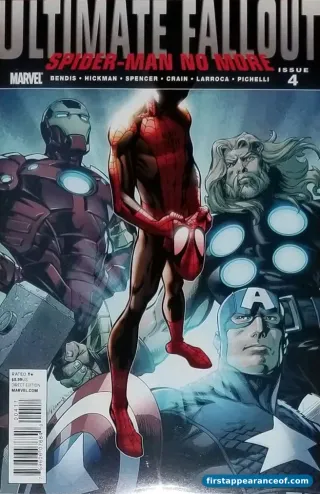
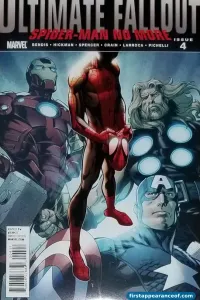
Ultimate Fallout #4 (1st Print, Mark Bagley Cover) — First Appearance and First Cover
Ultimate Fallout #4 shipped August 3, 2011, with a cover by Mark Bagley. Bendis wrote, Sara Pichelli drew the Miles sequence. The reveal is tightly structured: the issue deals with the broader fallout of Peter Parker’s death across the Ultimate line, and Miles only appears in the final pages. A masked figure on a rooftop. The costume is wrong — black-and-red, not classic blue-and-red. He swings. The identity lands.
This is Miles’s only first appearance. Unlike Wolverine, there is no cameo progression. There is no Incredible Hulk #180 equivalent. Ultimate Fallout #4 is, in one issue, both first appearance and first full appearance, with the reveal on the last three pages serving as the complete character introduction.
The print run warning
Only the first print of Ultimate Fallout #4 is the collectible key. Marvel reprinted the issue four times to meet the demand that emerged within a week of release. The reprints use the same Mark Bagley cover art but have distinct indicia identifying them as 2nd, 3rd, or 4th printings. On the secondary market, later prints trade at a small fraction of first-print value.
Before buying a raw copy:
- Check the indicia page (the small-print block near the title/copyright info) for the print statement. First prints do not carry an explicit reprint notice.
- Look at the cover — some reprints have subtly different color balance.
- For high-dollar copies, always buy graded. CGC and CBCS print the printing number directly on the slab label.
For graded copies, the CGC census for first-print 9.8 copies has grown steadily but remains the single largest determinant of price at the high end. High-grade first prints trade strong. Reprints of the same grade trade a fraction.
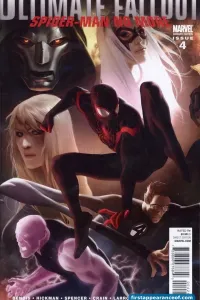
Ultimate Fallout #4 — Marko Djurdjevic 1:25 Variant Cover
Marko Djurdjevic drew a retailer-incentive variant cover for Ultimate Fallout #4 with a 1:25 ratio — meaning retailers had to order twenty-five copies of the standard Mark Bagley cover to qualify to order one copy of the Djurdjevic variant. The ratio is the critical detail: it structurally caps the print run at roughly 4% of the standard cover’s supply. For a book that immediately became a collector key, this ratio transforms the Djurdjevic into the more valuable cover of the two first-print options.
The Djurdjevic image is a full portrait of the character in the black-and-red costume against a textured background, with a much more dramatic atmosphere than Bagley’s classic-comic-cover treatment. Collector preference has generally sided with the Djurdjevic both for rarity and for visual appeal.
CGC census data shows the Djurdjevic population at a small fraction of the standard first-print population, and high-grade copies — particularly CGC 9.8 and 9.9 — command significant premiums over the standard 9.8.
Auction comps and a buyer warning. The Djurdjevic 1:25 variant CGC 9.8 hit its all-time high at $43,200 in a January 2023 auction. That peak tracked the post-pandemic speculation run and has not been revisited. The current average sale for the same grade sits around $9,500. The gap between peak and current average is the important figure for anyone considering this book as an investment: a buyer who paid near the peak is well underwater today, and the book is not back to that level. Treat the 2023 high as a ceiling under specific market conditions, not as a current comp.
Like the standard cover, only the first print of the Djurdjevic variant is the key. A second-print Djurdjevic exists and trades accordingly lower.
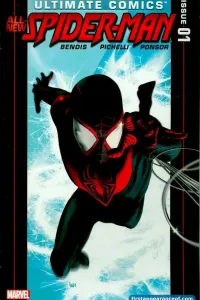
Ultimate Comics Spider-Man #1 (Vol. 2) — First Solo Title
Marvel moved quickly. Ultimate Comics Spider-Man #1 shipped September 14, 2011 — six weeks after Ultimate Fallout #4. Bendis wrote. Sara Pichelli drew. The ongoing told Miles’s origin in detail: the genetically modified spider acquired by his uncle Aaron Davis (the Prowler), the bite, the powers, the initial refusal to become Spider-Man, the eventual decision to wear the mask after Peter’s death.
The title ran 28 issues through 2013 and then was merged into a line-wide continuity event called Cataclysm, after which Marvel relaunched Miles under a new banner.
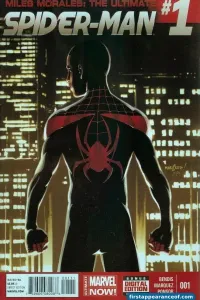
Miles Morales: Ultimate Spider-Man #1 — First Title Named for Miles
April 2014. Bendis and David Marquez. Miles Morales: Ultimate Spider-Man #1 is the first title in Marvel’s history to carry Miles Morales’s name in the title itself — a small but meaningful branding shift. Before this point, Miles had always been an Ultimate Spider-Man; from here forward he was Miles Morales, Ultimate Spider-Man. The distinction matters because it reflects Marvel’s commitment to Miles as a distinct lead rather than as a successor carrying a shared banner.
The title ran twelve issues and was the last Ultimate Universe title for Miles before Secret Wars (2015) collapsed the Ultimate line.
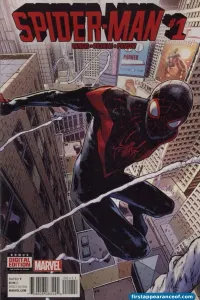
Spider-Man #1 (Vol. 2) — First Appearance in Earth-616
After the Secret Wars (2015) event merged the Ultimate and main Marvel universes, Miles moved from Earth-1610 to Earth-616 as a permanent addition to main Marvel continuity. Spider-Man #1 (Vol. 2) (February 2016) is his first Earth-616 appearance and launches him as the mainline universe’s second Spider-Man alongside Peter Parker.
Bendis and Pichelli remained the creative team. The issue positions Miles as a sixteen-year-old Spider-Man operating in New York City with a distinct identity from Peter’s. The title’s run and Miles’s later ongoing (Miles Morales: Spider-Man launched 2018 under Saladin Ahmed) cemented him as a full-time fixture of 616 continuity.
This is the first appearance type we tag as a universe first in the firsts timeline — the same kind of distinction we use for Harley Quinn’s Batman: Harley Quinn (1999), which is her first appearance in mainstream DC continuity after the DC Animated Universe origin. Miles’s Earth-616 first is a true separate collectible first, not a cameo or a reprint.
Legacy
Spider-Man: Into the Spider-Verse (2018) is the event that pushed Miles from comics-collector territory to household-name status. The Sony Pictures Animation film, directed by Bob Persichetti, Peter Ramsey, and Rodney Rothman and produced by Phil Lord and Chris Miller, won the Academy Award for Best Animated Feature and reframed the Spider-Man franchise around Miles as its emotional center. Across the Spider-Verse (2023) continued that framing. Beyond the Spider-Verse is in production as of this writing.
The PlayStation franchise added another dimension. Marvel’s Spider-Man (PS4) introduced Miles in a post-credits scene as the eventual successor. Marvel’s Spider-Man: Miles Morales (PS5, 2020) gave him a full solo game. Marvel’s Spider-Man 2 (PS5, 2023) made him a co-protagonist with Peter Parker.
For collectors, Miles is the most successful mantle passage of the Modern Age. Ultimate Fallout #4 in either first-print cover — Bagley or Djurdjevic — is the single-issue key. The Djurdjevic is the rarer, higher-dollar chase. The Bagley is the accessible on-ramp. Reprints are not the key. The printing matters.