Who are the Fantastic Four
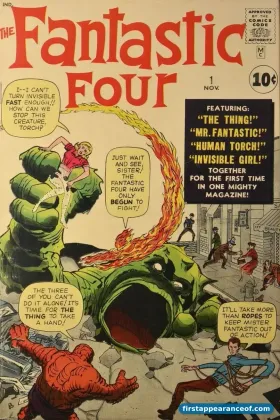
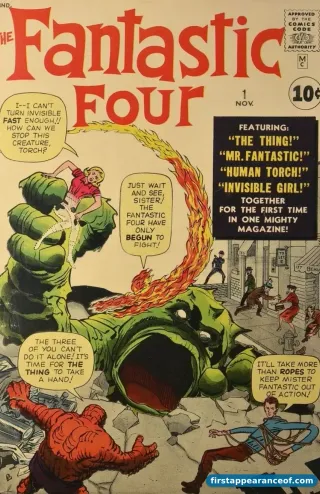
The Fantastic Four started as an order to copy a hit. Martin Goodman saw strong sales on Justice League of America and told his comics editor, Stan Lee, to put out a series about a team of superheroes. Lee and Jack Kirby delivered a team that didn’t dress like one.
In The Fantastic Four #1 the four fight the Mole Man in civilian clothes. Uniforms, along with the Baxter Building headquarters, arrived in #3, after readers wrote in. The lineup comes with ties built in: Sue Storm is Reed Richards’ girlfriend, Johnny Storm is her brother, and Ben Grimm flew the ship.
It was the first superhero team Lee and Kirby created, but not the first at Marvel. The company’s predecessor, Timely Comics, had introduced the All-Winners Squad in All Winners Comics #19 (fall 1946).
The Fantastic Four was, though, Marvel’s first superhero team title of the 1960s, and one of the books behind the company’s Silver Age rise from a small division of a publishing company to a pop culture conglomerate. Marvel editor Tom Brevoort called #1 “the beginning of what would grow into the Marvel Age of Comics.”
Doctor Doom arrives in issue #5
Four issues in, the team met its archenemy. Lee and Kirby introduced Doctor Doom in The Fantastic Four #5, cover-dated July 1962, in “Prisoners of Doctor Doom!”
Issue #5 tells his backstory in outline only. Reed recognizes the voice and thinks back to college, revealing Doom’s real name, Victor von Doom. A flashback shows the experiment, an attempt to contact someone among the dead, slipping out of Doom’s control and burning his face badly. Beyond the name and the accident, #5 gives away little, not even where Victor came from.
The full origin waited two years, for Fantastic Four Annual #2 (1964). In it, Doom is born to a Romani family in Latveria, the country he eventually comes to lead. Later stories revealed who he was trying to reach: his mother.
Doom became the team’s most frequent nemesis, and soon after his debut one of Marvel’s most widely used villains.
The Kirby years (1961 to 1970)
The book reached back before it reached forward. Fantastic Four #4 (May 1962) reintroduced Namor the Sub-Mariner, Bill Everett’s aquatic antihero from Marvel Comics #1 (October 1939).
The Inhumans arrived in stages. Medusa first appeared in #36 (March 1965), in costume as part of the Frightful Four. Gorgon followed in #44, and the Inhumans debuted as a group in #45 (December 1965), the same issue that introduced Crystal.
Then came the Galactus Trilogy, which began in #48 (March 1966) and ran through #50. When Kirby turned in his pencils for the story, he had added a character he and Lee had not discussed: the Silver Surfer, who first appears in #48. Lee recalled in 1995 finding “a nut on some sort of flying surfboard” in the middle of the story. Galactus arrives at the end of #48, his world ship emerging over Manhattan, and takes center stage in #49.
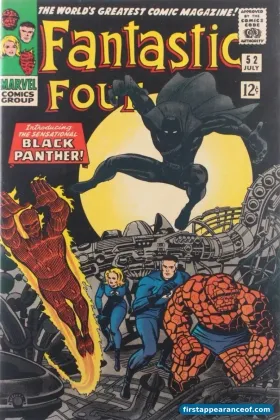
Two issues after the trilogy wrapped, #52 (July 1966) introduced Black Panther, the first Black superhero in American mainstream comic books.
In 1968 Crystal became the first character outside the original four to join the team, taking Sue’s place during her pregnancy. She stayed on after Sue returned.
Kirby drew the first 102 issues, plus an unfinished issue partly published in #108, and left Marvel in mid-1970.
After Kirby
John Byrne joined with #209 (August 1979), doing pencil breakdowns for Joe Sinnott to finish. With #232 (July 1981) he became writer, penciller and inker, and he left after #293 (August 1986).
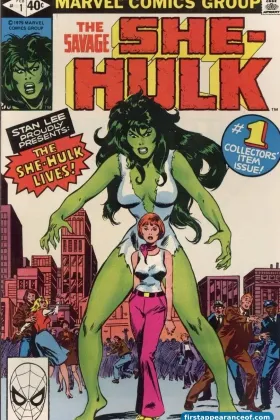
The roster moved during that stretch. At the end of the first Secret Wars miniseries, She-Hulk joined the team in #265 (1984), temporarily replacing the Thing.
She was one of several stand-ins over the years. The founding four stayed the core, with allies filling in as temporary members: Medusa covered for Sue during a family leave, Luke Cage served a turn on the team as Power Man, and Black Panther and Storm temporarily replaced Reed and Sue. After Byrne left, Reed and Sue retired in #308, and Crystal rejoined.
Jonathan Hickman’s run started in 2009 with the Dark Reign: Fantastic Four limited series, and he took over as the regular writer with #570. He introduced the Future Foundation in #579 (July 2010). The storyline “Three” ended in #587 with the Human Torch apparently dead. One issue later the series ended, and in 2011 it relaunched as FF. With the relaunch the team adopted the Future Foundation name, switched to black-and-white costumes and added Spider-Man, a longtime ally, as a member.
From First Steps to Avengers: Doomsday
Matt Shakman’s The Fantastic Four: First Steps opened July 25, 2025, with Pedro Pascal as Reed Richards, Vanessa Kirby as Sue Storm, Joseph Quinn as Johnny Storm and Ebon Moss-Bachrach as Ben Grimm. Ralph Ineson played Galactus, and Julia Garner played the Silver Surfer, in this version Shalla-Bal. It took an estimated $118 million in its first weekend in North American theaters, according to studio figures reported by AP.
All four actors are back for Anthony and Joe Russo’s Avengers: Doomsday, alongside Robert Downey Jr., who played Tony Stark/Iron Man in 10 films and returns in a new role as Victor von Doom. Doomsday arrives December 18, 2026. The Fantastic Four are reported to be set to return in Avengers: Secret Wars on December 17, 2027.
Notable issues
- Fantastic Four #1 (1961): first appearance of the team.
- Fantastic Four #4 (1962): the Sub-Mariner is reintroduced.
- Fantastic Four #5 (1962): first appearance of Doctor Doom.
- Fantastic Four Annual #2 (1964): Doom’s full origin.
- Fantastic Four #45 (1965): the Inhumans debut as a group, with Crystal.
- Fantastic Four #48 (1966): first appearance of the Silver Surfer; Galactus arrives at the end of the issue.
- Fantastic Four #49 (1966): Galactus takes center stage.
- Fantastic Four #52 (1966): first appearance of Black Panther.
- Fantastic Four #265 (1984): She-Hulk joins the team.
For collectors
The keys follow the firsts. Fantastic Four #1 is the team’s debut, and like #2 it was published without formal creator credits: the inks are generally attributed to George Klein, but that attribution is debated. Fantastic Four #5 is the first Doctor Doom.
The Galactus Trilogy splits its key. Issue #48 has the first Silver Surfer and Galactus’s arrival at the end of the issue; #49 is where Galactus takes center stage. Collector writers debate which of the two is his book. Fantastic Four #52 is the first Black Panther.