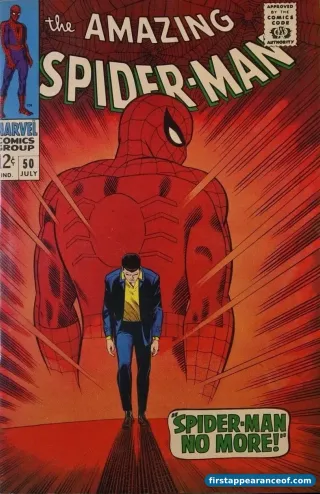
The Amazing Spider-Man #50 (1967) with the 'Spider-Man No More!' cover. Kingpin debuts inside.

1st Appearance

First Appearance of Kingpin

The Amazing Spider-Man #50

July 1967 · Marvel · Silver Age

The crime boss Marvel built to outlast every hero who fights him. Frank Miller's Daredevil nemesis, Vincent D'Onofrio's MCU heavyweight, and the rare Silver Age villain whose power was never cosmic.

Key Issue

Created by Stan Lee · John Romita Sr.

By Atomm Updated

The first appearance (1st app) of Kingpin is The Amazing Spider-Man #50 (July 1967), created by Stan Lee and John Romita Sr. Wilson Fisk debuts inside the famous 'Spider-Man No More!' issue as a new crime boss filling the power vacuum left by earlier Spider-Man antagonists. The character did not appear on the cover of his debut issue; his first cover is The Amazing Spider-Man #51 (August 1967). Kingpin became Marvel's primary street-level crime boss and the defining antagonist of Frank Miller's Daredevil run a decade later.

Quick Facts

Debut
The Amazing Spider-Man #50 (July 1967)
Real name
Wilson Grant Fisk
Creators
Stan Lee (script), John Romita Sr. (plot and art)
Publisher
Marvel Comics
First enemy
Spider-Man (as the debut antagonist, the first hero to oppose Fisk's criminal empire)
First ally
Hammerhead (criminal rivalry turned temporary alliance in later stories)
Team affiliations
Hand (financier), Hydra (briefly), Sinister Six (handler)

Firsts Timeline

  1. The Amazing Spider-Man #50 cover
    First Appearance July 1967

    The Amazing Spider-Man #50

    By Stan Lee, John Romita Sr.

    Kingpin debuts inside the iconic 'Spider-Man No More!' issue. Romita's visual design establishes the bald, cane-wielding, white-suited crime boss template that every subsequent artist works from. Not on the cover despite being the issue's introduction.

    Read the full breakdown
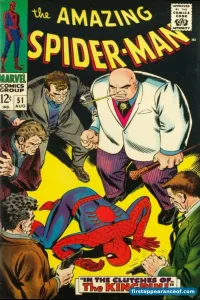
  2. The Amazing Spider-Man #51 cover
    First Cover Appearance August 1967

    The Amazing Spider-Man #51

    By Stan Lee, John Romita Sr.

    Kingpin's first cover, one month after his debut. ASM #51 is the second appearance and the cover-debut issue in a single book.

    Read the full breakdown

Creation Story

Kingpin was Stan Lee and John Romita Sr.’s response to an editorial gap in the Spider-Man book. By 1967, five years into Amazing Spider-Man’s run, the book had exhausted most of its costumed-villain roster. The Green Goblin had been the primary antagonist through the early Lee and Ditko run. Doc Ock, Vulture, Mysterio, Sandman, Kraven, Electro: all established, all recurring. Lee and Romita, who had taken over art from Steve Ditko in 1966, wanted a different kind of antagonist. Not a costumed villain. A crime boss.

Amazing Spider-Man #50 (July 1967) is the result. Wilson Fisk, the Kingpin of Crime, debuts inside the issue that is primarily remembered for its cover: Peter Parker walking away from a trash can holding his discarded Spider-Man costume, under the caption “Spider-Man No More!” The debut is narratively embedded in that crisis; Kingpin is the character who fills the power vacuum Spider-Man’s absence creates in New York’s criminal underworld.

Romita Sr.’s design is almost entirely responsible for the character’s visual identity. The bald head, the heavy frame, the white suit, the walking cane concealing weapons, the rings: all Romita. Stan Lee provided the script and supplied some of the characterization beats, but the visual grammar of the character belongs to Romita and has been largely unchanged for nearly sixty years.

For collectors, Amazing Spider-Man #50 is a compound key. It is both Kingpin’s first appearance and the “Spider-Man No More!” issue, arguably the most recognizable Lee-Romita cover in the run. High-grade copies cross $30,000 at auction; the cover image is one of the most-reproduced in the character’s publishing history.

Why Kingpin became Daredevil’s villain

The character’s first fifteen years were as a Spider-Man antagonist. He recurred consistently across the Lee-Romita and Gerry Conway runs on Amazing Spider-Man but was never the book’s primary villain. The pivot to Daredevil was Frank Miller’s decision and is the most consequential editorial move in Kingpin’s publishing history.

Miller took over Daredevil with issue #168 in January 1981 and within two issues had repositioned Kingpin as Daredevil’s chief antagonist. Miller’s logic: Kingpin’s framing as a New York crime boss with no powers made him a structural mismatch for Spider-Man’s high-flying costumed-villain book but a structural fit for Daredevil’s Hell’s Kitchen street-level tone. Kingpin could plausibly run a criminal empire that Daredevil would spend years dismantling; he could not plausibly threaten a Spider-Man with wall-crawling powers.

The pivot produced the Born Again arc (Daredevil #227 to #233, February to August 1986) by Miller and David Mazzucchelli. Kingpin learns Matt Murdock’s secret identity and methodically destroys his life. The arc is widely considered one of the greatest superhero stories ever published. Every subsequent Kingpin portrayal, including Vincent D’Onofrio’s Netflix performance, draws primarily from Miller’s 1981 to 1986 Daredevil run rather than from the character’s original Spider-Man appearances.

Collector context

Amazing Spider-Man #50 is the single required Kingpin key and a foundational Silver Age Spider-Man book. The book’s value held through decades of adaptations and spiked following Vincent D’Onofrio’s 2015 performance on Netflix Daredevil.

Secondary keys: Amazing Spider-Man #51 (first cover, August 1967) is a related collector target. Daredevil #170 (May 1981) is Miller’s first Daredevil issue as writer and the Miller-era Kingpin starting point. Daredevil #227 (February 1986) is the Born Again #1 and a Copper Age key in its own right.
Key subsequent appearances

After the debut, these are the issues collectors and historians reach for next.

  1. 1967

    The Amazing Spider-Man #51

    First Cover

    First Kingpin cover. Second appearance.

  2. 1981

    Daredevil #170

    Miller Era

    Frank Miller's first issue as Daredevil writer. Kingpin is repositioned as Daredevil's primary antagonist. The reframing that defines Kingpin for the next forty years.

    Frank Miller took over Daredevil with issue #168 (January 1981) and used the run to pivot Kingpin from Spider-Man's villain into Daredevil's. Miller recognized that Kingpin's Sicilian-Italian crime-boss framing, his architectural bulk as a character, and his resistance to super-powered violence worked better in the street-level Hell's Kitchen Daredevil book than in the high-flying Spider-Man title. Kingpin's Daredevil era is where the character's cultural weight lives. Born Again (Daredevil #227 to #233, 1986) is the arc that solidified the Miller-Mazzucchelli Kingpin as the defining version of the character.

  3. 1986

    Daredevil #227

    Born Again

    First issue of the Frank Miller and David Mazzucchelli 'Born Again' arc. Kingpin destroys Matt Murdock's life after learning his secret identity. Widely considered one of the greatest superhero stories ever published.

  4. 1998

    Daredevil #1 (1998)

    Kevin Smith and Joe Quesada's Marvel Knights relaunch. Re-establishes Kingpin in the modern era.

In adaptations

Film, TV, animation, and game appearances.

  1. 2003

    Daredevil

    Film

    Starring:Michael Clarke Duncan

    Mark Steven Johnson directs. Duncan's performance as Kingpin is widely cited as the film's strongest element.

  2. 2015

    Daredevil

    TV

    Starring:Vincent D'Onofrio

    Netflix/Marvel series. D'Onofrio's three-season performance reset the character's cultural visibility and is the reference Echo (2024) and the MCU Hawkeye (2021) built from.

  3. 2018

    Spider-Man: Into the Spider-Verse

    Animated

    Starring:Liev Schreiber

    Schreiber voices Kingpin as the film's primary antagonist. Character design deliberately exaggerated relative to comics.

  4. 2024

    Echo

    TV

    Starring:Vincent D'Onofrio

    D'Onofrio returns to the role in the Disney+ series. Sets up Kingpin's broader MCU presence.

Frequently asked questions

The questions readers and collectors ask most.

What is Kingpin's first appearance?

Kingpin's first appearance is The Amazing Spider-Man #50 (July 1967), written by Stan Lee with art and plot contribution by John Romita Sr. The issue is famous as the 'Spider-Man No More!' issue, which features Peter Parker abandoning the Spider-Man identity. Kingpin debuts inside the issue. He is not on the cover. His first cover appearance is The Amazing Spider-Man #51 (August 1967).

Is Amazing Spider-Man #50 valuable?

Yes. Amazing Spider-Man #50 is one of the defining Silver Age Spider-Man keys. It is both the first appearance of Kingpin and the iconic 'Spider-Man No More!' issue. High-grade copies (CGC 9.0 and above) have crossed $30,000 at auction. The 1967 Romita cover is one of the most-reproduced images in the character's publishing history.

Did Kingpin start as a Daredevil villain?

No. Kingpin debuted as a Spider-Man antagonist in 1967 and continued in that role for roughly fifteen years. Frank Miller repositioned Kingpin as Daredevil's primary villain starting with Daredevil #170 (May 1981), and the character's cultural weight today is almost entirely associated with Daredevil rather than Spider-Man. The pivot was deliberate: Miller believed Kingpin's grounded crime-boss framing fit Daredevil's Hell's Kitchen street-level tone better than Spider-Man's superhero spectacle.

Who designed Kingpin?

John Romita Sr. designed the visual character. The bald head, the heavy-set frame, the white suit, the walking cane with the concealed weapons, and the rings: all Romita. Stan Lee provided the script and some high-level characterization. Modern Marvel credits both as co-creators, though the visual identity is almost entirely Romita's contribution.

Is Vincent D'Onofrio's Kingpin the definitive screen version?

Widely considered yes. D'Onofrio's three-season performance across Marvel's Netflix Daredevil (2015 to 2018) is the most acclaimed screen Kingpin and reset the character's cultural visibility. The performance leans heavily on Frank Miller's 1980s Daredevil framing and on the David Mazzucchelli Born Again arc. D'Onofrio returned to the role in Hawkeye (2021), Echo (2024), and subsequent MCU appearances.

What is Born Again?

Born Again is a seven-issue Daredevil arc by Frank Miller and David Mazzucchelli running across Daredevil #227 to #233 (February to August 1986). It is Kingpin's defining character moment. Kingpin learns Matt Murdock's secret identity and systematically destroys his life: legal career, apartment, bank accounts, relationships. Murdock rebuilds, and the arc ends with Kingpin publicly humiliated and Daredevil restored. Widely considered one of the greatest superhero stories ever published.