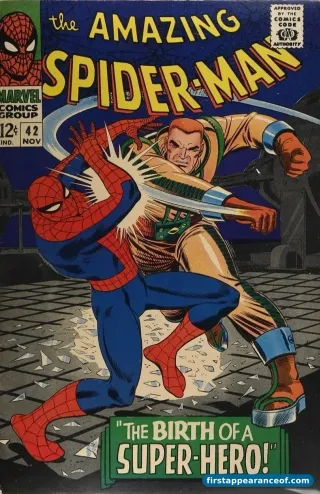
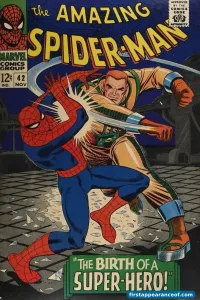
Mary Jane Watson's first full-face appearance on the final page of Amazing Spider-Man #42 (1966).

1st Full Face Appearance

First Appearance of Mary Jane Watson

The Amazing Spider-Man #42

November 1966 · Marvel · Silver Age

The neighbor's niece Aunt May kept pushing Peter Parker to meet, and the character John Romita Sr. drew in one panel to set the standard for romantic supporting cast for the next sixty years.

Key Issue

Created by Stan Lee · John Romita Sr.

By Atomm Updated

Mary Jane Watson's first appearance is a layered cameo. Her first mention and first concealed cameo is The Amazing Spider-Man #25 (June 1965), where her face is deliberately hidden. Her first full-face appearance is The Amazing Spider-Man #42 (November 1966), created by Stan Lee with art by John Romita Sr. The 'Face it, tiger, you just hit the jackpot!' sequence is the defining Mary Jane Watson reveal and one of the most-reproduced panels in Marvel history. Collectors treat #25 and #42 as distinct keys.

Quick Facts

Debut
The Amazing Spider-Man #25 (June 1965) as a concealed cameo. Amazing Spider-Man #42 (November 1966) as her full face.
Real name
Mary Jane Watson
Creators
Stan Lee (script, character concept). Steve Ditko (cameo-era art). John Romita Sr. (full-face reveal art and definitive design).
Publisher
Marvel Comics
First enemy
No direct antagonist. MJ is a supporting character.
First ally
Peter Parker (her longest romantic partner)
Team affiliations
None. Mary Jane is a civilian supporting character.

Firsts Timeline

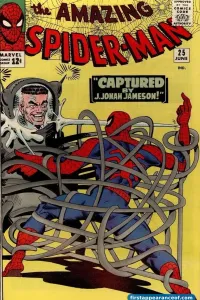
  1. The Amazing Spider-Man #25 cover
    First Cameo (Face Hidden) June 1965

    The Amazing Spider-Man #25

    By Stan Lee, Steve Ditko

    Mary Jane is first mentioned and first appears with her face deliberately hidden (by a potted plant, a piece of furniture, or off-panel). Stan Lee writes; Steve Ditko pencils. A running joke across multiple issues as Aunt May tries to set Peter up on a date with 'Anna Watson's niece.'

    Read the full breakdown
  2. The Amazing Spider-Man #42 cover
    First Full Face Appearance November 1966

    The Amazing Spider-Man #42

    By Stan Lee, John Romita Sr.

    The defining reveal. MJ enters Peter's apartment and delivers the line 'Face it, tiger, you just hit the jackpot!' The sequence is one of the most-reproduced panels in Marvel history. John Romita Sr.'s defining character design.

    Read the full breakdown

Creation Story

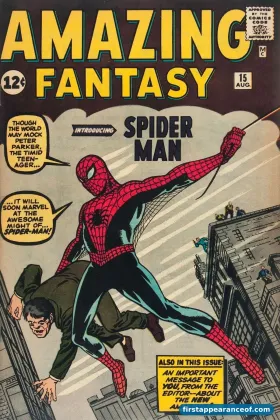
Mary Jane Watson is one of the few Marvel supporting characters whose first-appearance history is structured as a running joke. Stan Lee and Steve Ditko introduced the character as a concept in Amazing Spider-Man #15 (August 1964), when Aunt May first mentions her neighbor Anna Watson’s niece. The physical appearance is delayed across multiple issues. Amazing Spider-Man #25 (June 1965) is her first cameo on-panel, with her face deliberately concealed (by a potted plant, a piece of furniture, or careful panel composition). The running joke was Peter Parker avoiding the meeting despite Aunt May’s constant attempts to set him up with her.

John Romita Sr. took over Spider-Man art with Amazing Spider-Man #39 (August 1966) and had the defining reveal staged in Amazing Spider-Man #42 (November 1966). Mary Jane enters Peter’s apartment for the first blind date Aunt May had been pushing, and Romita’s final page delivers the full-face reveal with the Lee-scripted line “Face it, tiger, you just hit the jackpot!” The panel is one of the most-reproduced images in Marvel’s publishing history and established Mary Jane’s visual identity (red hair, green eyes, specific facial structure) that has been essentially unchanged for six decades.

The choice to delay the reveal for over a year of publishing was a classic Lee-era Marvel technique: build reader anticipation through avoidance, then deliver the payoff with a dramatic Romita full-page. It worked. MJ became one of Marvel’s most-loved supporting characters within a handful of issues of her reveal.

The marriage and the retcon

Peter Parker and Mary Jane’s relationship across the 1960s and 1970s was structured as on-and-off. The death of Gwen Stacy in Amazing Spider-Man #121 (1973) effectively left MJ as Peter’s primary romantic interest, and Amazing Spider-Man Annual #21 (1987) married them. The wedding was one of Marvel’s most-publicized superhero weddings and was treated as canonical for twenty years.

One More Day (Amazing Spider-Man #544 to #545, November 2007 to January 2008) reversed this. Written by J. Michael Straczynski with editorial direction from Joe Quesada, the arc had Peter and MJ make a deal with the demon Mephisto to save Aunt May from a gunshot wound. The price: their marriage erased from existence. The retcon reset Peter to an unmarried state and remains one of the most controversial editorial decisions in Marvel history. Straczynski publicly objected to the direction and requested his name be removed from the final issues.

Subsequent writers have reintroduced Peter and MJ’s relationship across various Marvel eras but the marriage itself has not been restored in main continuity.

Collector context

Amazing Spider-Man #42 (Face It Tiger reveal) is the defining Mary Jane Watson key. Amazing Spider-Man #25 (first cameo) is a secondary key for collectors chasing the technical first. Both trade in the Silver Age Spider-Man tier; #42 substantially more valuable than #25.

Amazing Spider-Man Annual #21 (1987 wedding) is a modern-era key that picked up during the 2000s and spiked around the One More Day retcon as fans invested in preserving the marriage material. Amazing Spider-Man #545 (One More Day) is a controversial modern key and collector demand is bifurcated between readers who want to own the retcon and readers who refuse to.
Key subsequent appearances

After the debut, these are the issues collectors and historians reach for next.

  1. 1965

    The Amazing Spider-Man #25

    Cameo (Face Hidden)

    First cameo. Ditko art, face concealed.

  2. 1966

    The Amazing Spider-Man #42

    Full Face Reveal

    Face it, tiger. Romita Sr.'s defining design.

  3. 1975

    The Amazing Spider-Man #143

    MJ's first full-length romantic arc with Peter as a solo couple after the death of Gwen Stacy. Conway and Andru.

  4. 1978

    The Amazing Spider-Man #182-183

    Proposal

    Peter Parker proposes marriage to Mary Jane. She says no. Sets up the long engagement-and-breakup arc of the 1970s.

  5. 1987

    The Amazing Spider-Man #292

    Engagement

    Peter and MJ re-engage. Setup for the wedding in Amazing Spider-Man Annual #21.

  6. 1987

    The Amazing Spider-Man Annual #21

    Wedding

    Peter Parker and Mary Jane marry. One of Marvel's most-publicized superhero weddings. The marriage was undone by the controversial One More Day storyline in 2007.

  7. 2007

    The Amazing Spider-Man #545

    One More Day

    J. Michael Straczynski and Joe Quesada. Peter and MJ make a deal with Mephisto that erases their marriage. One of the most controversial retcons in Spider-Man history.

In adaptations

Film, TV, animation, and game appearances.

  1. 1977

    The Amazing Spider-Man

    TV

    CBS live-action series. Mary Jane not a primary character.

  2. 1992

    Spider-Man: The Animated Series

    Animated

    Starring:Saratoga Ballantine, Mary Kay Bergman

    Fox Kids animated series. Five-season role as Peter's primary romantic interest.

  3. 2002

    Spider-Man

    Film

    Starring:Kirsten Dunst

    Sam Raimi directs. Dunst plays MJ across the Raimi trilogy.

  4. 2017

    Spider-Man: Homecoming

    Film

    Starring:Zendaya

    Zendaya plays Michelle 'MJ' Jones, an adaptation that takes the MJ name but is a distinct character in the MCU.

Frequently asked questions

The questions readers and collectors ask most.

What is Mary Jane Watson's first appearance?

Mary Jane Watson's first cameo is The Amazing Spider-Man #25 (June 1965), where her face is deliberately concealed. Her first full-face appearance is Amazing Spider-Man #42 (November 1966), created by Stan Lee and John Romita Sr. Collectors chasing the technical first-mention target #25. Collectors chasing the defining visual appearance target #42.

Is Amazing Spider-Man #42 valuable?

Yes. Amazing Spider-Man #42 is a Silver Age Spider-Man key and contains the 'Face it, tiger' sequence that is one of the most-reproduced panels in Marvel history. High-grade copies (CGC 9.0 and above) have crossed $10,000 at auction. The collector weight is entirely tied to the full-face-reveal visual.

Why did Marvel hide MJ's face for over a year?

The running gag of concealing Mary Jane's face was a Stan Lee and Steve Ditko editorial choice. Aunt May tries to set Peter up with 'Anna Watson's niece' for over a year of real-time publishing; Peter avoids the meeting. The reveal in Amazing Spider-Man #42 is structured as a payoff, with Romita Sr.'s dramatic full-face entry and the 'Face it, tiger' line landing as a deliberate anticlimax to Peter's resistance. The technique is a classic Lee-era Marvel device: delay the reveal until the payoff lands.

Was the Peter / MJ marriage really erased?

Yes, and it remains one of the most controversial editorial decisions in Spider-Man history. One More Day (Amazing Spider-Man #544 to #545, November 2007 to January 2008) by J. Michael Straczynski and Joe Quesada had Peter and MJ make a deal with Mephisto to save Aunt May's life; the price was their marriage, which was erased from existence. The retcon reset Peter to a single-and-younger state and undid 21 years of continuity. Subsequent writers have gradually reintroduced Peter and MJ's relationship without restoring the marriage.

Is Zendaya's MJ the same character?

No. Zendaya plays Michelle 'MJ' Jones in the MCU Spider-Man films, an original character who uses the MJ nickname but has a distinct backstory, personality, and relationship with Peter. The MCU chose not to adapt Mary Jane Watson directly; the decision has been explained by Marvel Studios as a creative choice to build a new character rather than attempt to recreate the classic comics MJ.