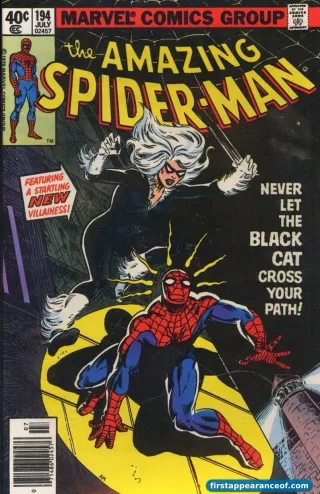
The Amazing Spider-Man #194 (1979). Black Cat debuts. Marv Wolfman writes; Keith Pollard pencils.

1st Appearance and 1st Cover

First Appearance of Black Cat

The Amazing Spider-Man #194

July 1979 · Marvel · Bronze Age

Marv Wolfman and Keith Pollard's Spider-Man Catwoman. The probability-altering thief whose long-running romantic-rival framework with Peter Parker became one of the most-developed extended supporting-character arcs in the Spider-mythology.

Key Issue

Created by Marv Wolfman · Keith Pollard

By Atomm Updated

The first appearance (1st app) of Black Cat is The Amazing Spider-Man #194 (July 1979), created by Marv Wolfman (writer) and Keith Pollard (artist). The issue is both her first appearance and first cover. Felicia Hardy debuts as a Spider-Man-adjacent thief whose probability-altering 'bad luck' powers and morally-flexible operating framework distinguish her from typical Spider-rogues. The character was designed as a Spider-Man romantic antagonist with the structural role typically held by Catwoman in the Bat-mythology.

Quick Facts

Debut
The Amazing Spider-Man #194 (July 1979)
Real name
Felicia Hardy
Creators
Marv Wolfman (writer, co-creator), Keith Pollard (artist, co-creator)
Publisher
Marvel Comics
First enemy
Antagonist herself in early appearances; reforms as Spider-Man's ally and romantic partner.
First ally
Spider-Man / Peter Parker (her on-and-off romantic partner)
Team affiliations
Heroes for Hire (briefly), Defenders (occasional)

First Appearance

  1. The Amazing Spider-Man #194 cover
    First Appearance First Cover July 1979

    The Amazing Spider-Man #194

    By Marv Wolfman, Keith Pollard

    Marv Wolfman writes; Keith Pollard pencils. Felicia Hardy debuts as the Black Cat, a Spider-Man-adjacent thief whose probability-altering 'bad luck' powers and morally-flexible operating framework distinguish her from typical Spider-rogues. The issue is both her first appearance and first cover. The character was deliberately designed as a Spider-Man romantic antagonist with the structural role typically held by Catwoman in the Bat-mythology.

    Read the full breakdown

Creation Story

Black Cat is Marv Wolfman and Keith Pollard’s Bronze Age Spider-Man supporting addition. The Amazing Spider-Man #194 (July 1979) introduces Felicia Hardy as a Spider-Man-adjacent thief whose morally-flexible operating framework distinguishes her from typical Spider-rogues. Wolfman writes; Pollard pencils. The issue is both her first appearance and first cover.

Wolfman has cited the deliberate Catwoman parallel in interviews. The character was designed as a Spider-Man-mythology counterpart to Catwoman in the Bat-mythology: the morally-flexible thief who serves as the protagonist’s long-running romantic-rival, who occasionally operates as an antagonist and occasionally as an ally. The framework was structural; the visual interpretation (cat-themed costume, white hair, athletic build) preserved the broader Catwoman aesthetic register while giving the character distinct Marvel-mythology identity.

Powers manifest

The Amazing Spider-Man #226 (March 1982) by Roger Stern developed Black Cat’s probability-altering “bad luck” powers. The framework was originally absent from the debut: in 1979 the character was theatrical (made her own luck through training and skill); the probability-manipulation powers were a subsequent development that gave her a distinctive Marvel-superhuman register. The powers became canonical and have remained the character’s signature ability since.

The bad-luck framework gave Black Cat narrative weight beyond the typical thief-antagonist register. Targets in her field of effect experience improbable accidents, mishaps, and physical malfunctions; the powers are subtle enough that they don’t override conventional combat but consequential enough that they shift extended encounter outcomes.

The romantic arc

Black Cat’s relationship with Peter Parker / Spider-Man is one of the most-developed extended romantic arcs in the broader Spider-mythology. Across decades of stories, Felicia and Peter have been on-and-off romantic partners, with substantial complications including identity-revelation issues (Black Cat’s reluctance to know Peter’s civilian identity has been a recurring plot point). The framework has continued to feature in modern Spider-Man storytelling.

Adaptations

Spider-Man: The Animated Series (Fox Kids, 1994 to 1998) featured Jennifer Hale’s Black Cat prominently across the show’s run. Erica Lindbeck’s Black Cat in Marvel’s Spider-Man (PS4, 2018) and its The Heist DLC is widely regarded as one of the strongest video-game adaptations of the character.

Collector context

The Amazing Spider-Man #194 is the Black Cat Bronze Age first-appearance key. High-grade CGC 9.8 copies have crossed $1,500 at auction. The book’s value has tracked with Black Cat adaptation cycles.

Secondary keys: The Amazing Spider-Man #226 (March 1982, probability powers manifest). The Amazing Spider-Man #258 (November 1984, recurring romantic-supporting arc established).
Key subsequent appearances

After the debut, these are the issues collectors and historians reach for next.

  1. 1979

    The Amazing Spider-Man #194

    First appearance and first cover.

  2. 1982

    The Amazing Spider-Man #226

    Powers Manifest

    Roger Stern. Black Cat's probability-altering 'bad luck' powers manifest. Establishes the framework that distinguishes her from purely-skilled-thief antagonist register.

  3. 1984

    The Amazing Spider-Man #258

    Black Cat Series Begins

    Tom DeFalco and Ron Frenz. Black Cat positioned as a long-running Spider-Man supporting and romantic character. Sets up subsequent solo limited series.

In adaptations

Film, TV, animation, and game appearances.

  1. 1994

    Spider-Man: The Animated Series

    Animated

    Starring:Jennifer Hale

    Fox Kids series. Hale voices Black Cat across the show's run. The animated portrayal preserves the comics' romantic-rival framework with Spider-Man.

  2. 2018

    Marvel's Spider-Man (PS4)

    Game

    Starring:Erica Lindbeck

    Insomniac Games. Black Cat features prominently in the game's storyline and its The Heist DLC. Lindbeck's performance is widely regarded as one of the strongest video-game adaptations of the character.

  3. 2021

    Spider-Man: No Way Home (cancelled scene)

    Film

    Felicia Hardy was reportedly considered for inclusion in Spider-Man: No Way Home (2021) and its sequel material. No formal casting was confirmed publicly.

Frequently asked questions

The questions readers and collectors ask most.

What is Black Cat's first appearance?

Black Cat's first appearance is The Amazing Spider-Man #194 (July 1979), created by Marv Wolfman (writer) and Keith Pollard (artist). The issue is both her first appearance and first cover. Felicia Hardy debuts as a Spider-Man-adjacent thief.

Is The Amazing Spider-Man #194 valuable?

Yes. The Amazing Spider-Man #194 is a Bronze Age Marvel key with strong recurring-character collector demand. High-grade copies (CGC 9.8) have crossed $1,500 at auction. The book's value has tracked with Black Cat adaptation cycles, particularly the 2018 Marvel's Spider-Man video game and ongoing Sony Spider-Verse film discussions.

Is Black Cat Marvel's Catwoman?

Structurally, yes. Marv Wolfman and Keith Pollard explicitly designed the character as a Spider-Man-mythology counterpart to Catwoman in the Bat-mythology: the morally-flexible thief who serves as the protagonist's long-running romantic-rival, who occasionally operates as an antagonist and occasionally as an ally. The framework was deliberate; Wolfman has cited the Catwoman parallel in interviews. Both characters have evolved substantially since their respective debuts but the structural similarity remains.

What are Black Cat's powers?

Probability manipulation (canonically called 'bad luck' powers): targets in her field of effect experience improbable accidents, mishaps, and physical malfunctions. The framework was developed across The Amazing Spider-Man #226 (March 1982) by Roger Stern and has been the character's signature ability since. The powers were originally theatrical (she made her own luck through training and skill); the probability-manipulation framework was a subsequent development that gave her a distinctive Marvel-superhuman register.

Has Black Cat dated Spider-Man?

Yes, in extended on-and-off canon. Felicia Hardy and Peter Parker have one of the most-developed romantic-relationship arcs in the Spider-mythology, running from the early 1980s through modern continuity. The framework has included multiple breakups, reconciliations, and complications including identity-revelation issues (Black Cat's reluctance to know Peter's civilian identity has been a recurring plot point). The relationship continues to feature in modern Spider-Man storytelling.