Creation Story
Carnage arrived at Marvel three years after Venom as an editorial response to a specific problem: Venom had become a commercial breakout and was being positioned as an anti-hero. Marvel’s writers and editorial team needed a villain Venom could plausibly oppose, someone worse than Venom himself so that Venom’s shift to hero-adjacent work could be supported by contrast. David Michelinie was the Amazing Spider-Man writer who had co-created Venom and understood the symbiote mythology; he designed Carnage as Venom’s offspring: a red symbiote spawned from the Venom symbiote’s reproductive cycle, bonded to a worse host than Eddie Brock.
Cletus Kasady had been introduced earlier as Eddie Brock’s prison cellmate in Amazing Spider-Man #344 (February 1991), a lead-up that let readers meet the character before the symbiote bonding. Kasady is a serial killer with a body count, a nihilistic worldview, and none of Eddie Brock’s moral structure. The bonding with the symbiote fragment produced Carnage: faster, more violent, less controllable, and deliberately harder to write as sympathetic than Venom.
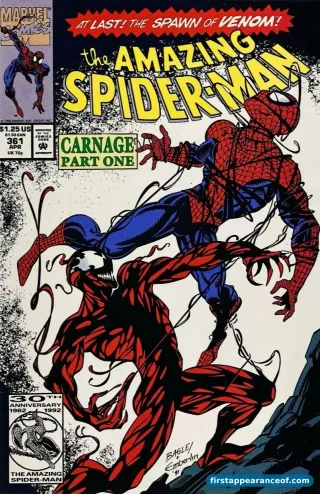
Amazing Spider-Man #361 (April 1993) is Carnage’s full debut. Mark Bagley pencilled the issue; his design of Carnage is the permanent visual identity (red-and-black, claw-and-tendril extensions, distorted facial structure). The cameo in #360 is a setup panel for the following issue. Both books shipped in 1993 at the absolute peak of Marvel’s Copper Age speculator boom; first-print and newsstand copies carry meaningful collector premium in modern trading.
The Maximum Carnage era
Maximum Carnage (June 1993) is the defining Carnage story and the first major Spider-Man crossover event Marvel published as a deliberate merchandising exercise. Fourteen issues across five concurrent Spider-Man titles: Spider-Man Unlimited, Web of Spider-Man, Amazing Spider-Man, Spectacular Spider-Man, and Spider-Man. The arc has Carnage escape, recruit Shriek (the sonic-powered villain who becomes his long-term partner), and assemble a team of lesser-known Marvel villains (Demogoblin, Doppelganger, Carrion) to terrorize New York. Spider-Man assembles an uneasy alliance that includes Venom, Cloak and Dagger, Firestar, Captain America’s erstwhile sidekick Morbius, and others.
The event sold well. Super Nintendo and Sega Genesis video-game adaptations landed in 1994. The arc set the tone for every subsequent Carnage story: the character is at his best when surrounded by other villains, when Spider-Man has to cooperate with Venom to contain him, and when the body count is explicit.
Modern Carnage (Cates era)
Donny Cates and Ryan Stegman’s Venom (2018 onward) repositioned Carnage as a central piece of the modern symbiote mythology. The Absolute Carnage crossover (2019) made Carnage the threat at the center of a Marvel-wide event, with Knull (the symbiote god) as the overarching antagonist. The Cates-era Carnage is more cosmically positioned than the 1993 version; Cletus Kasady becomes a vessel for symbiote-god power rather than a solo serial killer.
Woody Harrelson’s film performance across Venom (2018, mid-credits) and Venom: Let There Be Carnage (2021) drew from both the 1993 and 2019 material, with a focus on the original Kasady-Cletus odd-couple dynamic against Eddie Brock.
Collector context
Amazing Spider-Man #361 is a modern-era Marvel key and one of the most widely-chased 1993 Spider-Man books. High-grade CGC 9.8 copies have crossed $500 at auction; the newsstand variant carries a significant premium over the direct-market edition. Prices moved with Woody Harrelson’s film appearance in 2018, and the newsstand-to-direct-market pricing spread widened as collectors sought the scarcer edition.
Secondary keys: Amazing Spider-Man #360 (cameo first) is a cheaper entry. Amazing Spider-Man #344 (first Cletus Kasady appearance) is a pre-Carnage key. Spider-Man Unlimited #1 (1993) is the Maximum Carnage kickoff. Absolute Carnage #1 (2019) is the Cates-era modern key and remains accessible in high grade.