The name belongs to two different teams
The Guardians of the Galaxy is not a team that got rebooted. It is two different teams with two different rosters, forty years apart on the stands and nine centuries apart in-universe, who happen to share a name. Any collector question about the Guardians has to start with this. There is the original 1969 team and the 2008 revival. They are distinct books to collect and distinct stories to read.
This page walks both. The timeline above lists the four issues that matter: the 1969 debut, the 1990 solo title that finally gave the original team a book, the 2008 Annihilation finale that formed the modern team, and the 2008 ongoing that established the voice everyone knows from the MCU.
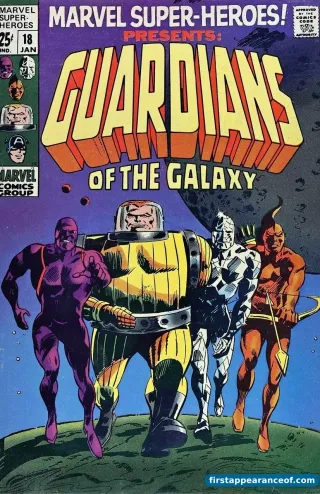
Marvel Super-Heroes #18: the original Guardians
Arnold Drake wrote, Gene Colan pencilled. Cover-dated January 1969. The issue introduces the four-member core of the original team: Vance Astro (Major Victory), a 20th-century astronaut who woke up a thousand years in the future; Charlie-27, a militarized Jovian; Martinex T’Naga, a crystalline Plutonian; and Yondu Udonta, a Centaurian archer from a primitive-futurist alien culture.
The setup is a resistance-cell story. The reptilian Badoon have invaded Earth in the 31st century and scattered humanity. The Guardians are what is left of the resistance. Drake used the 31st-century setting to sidestep Marvel’s main continuity and build a cosmic mythology without touching Avengers or Fantastic Four. The book was positioned as a one-shot try-out and did not produce an ongoing title at the time.
For collectors, Marvel Super-Heroes #18 is the single-issue key for the entire Earth-691 cosmic branch. CGC and CBCS census data shows modest high-grade populations. Prices climbed modestly through the 2000s and 2010s, then spiked after the 2014 film even though the film is about a completely different team. Collectors buying on the strength of the name alone did not always realize they were buying a different team’s debut.
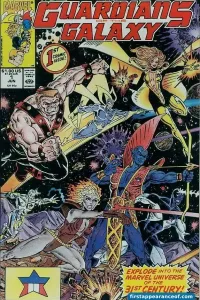
Guardians of the Galaxy #1 (1990): the original team finally gets a book
Jim Valentino wrote and pencilled. Cover-dated June 1990. Twenty-one years after the debut, the original Guardians got their own ongoing series. Valentino’s run expanded the roster (Replica, Hollywood, Talon), introduced 31st-century takes on Marvel classic characters, and built out the Earth-691 timeline into a proper cosmic universe.
Valentino wrote and drew the book until 1993, when he left Marvel to co-found Image Comics as one of the seven original Image partners. The series outlived his departure and ran a total of 62 issues plus an annual through 1995. For original-team collectors, Guardians of the Galaxy #1 (1990) is the secondary key: easier to find in high grade than Marvel Super-Heroes #18, and it carries the prestige of Valentino’s pre-Image run.
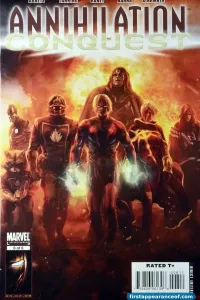
Annihilation: Conquest #6 forms the modern Guardians
Dan Abnett and Andy Lanning wrote. Tom Raney pencilled. Cover-dated April 2008. Annihilation: Conquest was a 2007-to-2008 cosmic Marvel crossover, a direct sequel to the 2006 Annihilation event. Across its run Abnett and Lanning rebuilt Marvel’s cosmic line, the corner of the publisher the 2014 film would later draw from.
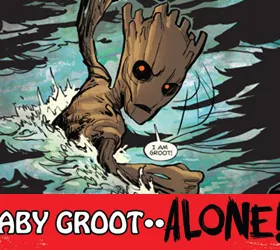
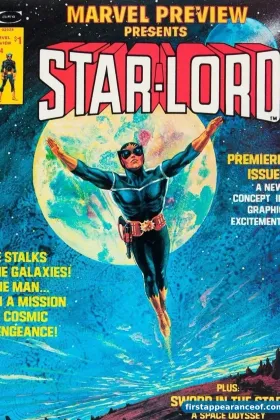
The closing issue formed the modern Guardians team. Peter Quill (Star-Lord) takes the leadership role. The core roster is Rocket Raccoon, Groot, Gamora, Drax the Destroyer, Adam Warlock, Phyla-Vell (Quasar), and Mantis. Vance Astro (as Major Victory) makes a brief appearance as a bridge to the original team, but most of the new roster had no prior Guardians connection.
Abnett and Lanning’s framing is deliberate. The name is chosen as a tribute to a team most of the modern members have never heard of. It is an editorial decision to revive an old Marvel IP at a moment when the publisher was rebuilding its cosmic line, and it works because the new team is fundamentally a different story. The 1969 team is a resistance cell in a dying future. The 2008 team is a group of mercenaries, fugitives, and former villains who agree to work together because no one else is going to hold off the next cosmic threat.
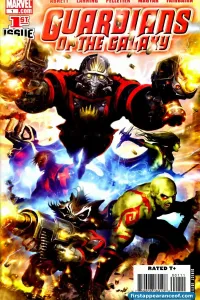
Guardians of the Galaxy #1 (Vol. 2, 2008): the MCU source material
Dan Abnett and Andy Lanning wrote. Paul Pelletier pencilled. Cover-dated May 2008. Volume 2 of Guardians of the Galaxy shipped one month after the Annihilation: Conquest finale and ran 25 issues through 2010.
This is the book. If you have seen any James Gunn Guardians of the Galaxy film and you want to read the source material, this is where you start. The Pelletier run establishes Star-Lord’s voice, Rocket’s tactical leadership, Groot’s minimalist language, and the team’s running comedic dynamic. Gunn has named the run as a primary reference for the 2014 film. Back-issue prices on Guardians of the Galaxy Vol. 2 #1 climbed after the first Gunn film and stayed elevated through the 2017 and 2023 sequels.
For modern-team collectors this is the primary key after Annihilation: Conquest #6. It is widely available in high grade and trades below #6 but with similar cultural weight.
Which team do you collect?
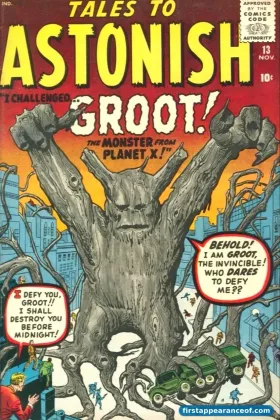
If you came to Guardians through the MCU, you are collecting the 2008 team. Your books are Annihilation: Conquest #6 (the first full team appearance), Guardians of the Galaxy Vol. 2 #1 (the ongoing that defined the voice), and individual-character keys for Rocket, Groot, Gamora, Drax, and Star-Lord across their earlier appearances.
If you came to Guardians through 1970s and 1980s Marvel, through Defenders or Thor or Marvel Two-in-One, you are collecting the 1969 team. Your books are Marvel Super-Heroes #18 (the first appearance), Guardians of the Galaxy #1 (1990) (the first solo title), and the Valentino run in high grade.
Most serious cosmic Marvel collectors end up with both. The teams are related in the way a Marvel Zombies universe is related to the main continuity: connected, occasionally interacting, but telling different stories for different reasons.