Creation Story
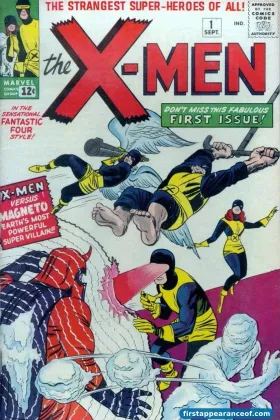
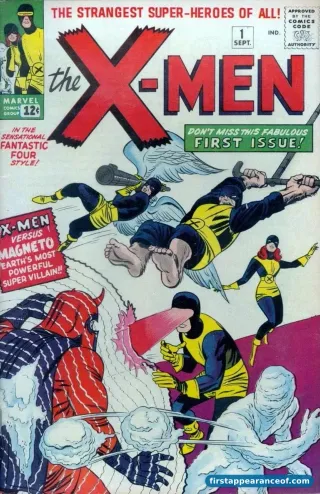
Hank McCoy is one of the few Marvel characters whose collectible first-appearance spans two distinct visual versions. The Stan Lee and Jack Kirby debut in X-Men #1 (September 1963) introduces Beast as a human-proportioned team member with unusually large hands and feet as his mutant feature. Lee’s script positions him as the team’s intellectual; he reads Shakespeare, uses polysyllabic vocabulary, and handles the scientific exposition the book needs. Kirby’s design is specifically restrained compared to his later Marvel characters; Hank is basically a normal-looking human with slightly oversized extremities.
The human-form Beast ran through the original X-Men series (1963 to 1970) and into the cancellation-era reprints. When the book relaunched with Giant-Size X-Men #1 in 1975, Hank was not part of the new team; he had left to work at the Brand Corporation, a biotech company.
The furry transformation
Amazing Adventures #11 (March 1972) is the key that matters most for modern Beast. Gerry Conway wrote; Tom Sutton pencilled. Hank, working at Brand Corporation, develops a mutation-catalyst serum and uses it on himself. The transformation produces the furry, blue-skinned, ape-like form that has been his permanent visual identity since.
The Amazing Adventures run continued Beast’s solo stories through 1973 before he eventually rejoined the Avengers, the Defenders, and eventually the X-Men in various configurations. The furry version is the form most readers recognize and the form adapted in virtually every modern Beast portrayal.
The Avengers membership
The Avengers #137 (July 1975) saw Hank join the Avengers. At the time this was a significant editorial decision: the X-Men and Avengers rosters had been largely separate since Quicksilver and Scarlet Witch’s moves a decade earlier, and Hank’s recruitment set a precedent that would eventually produce decades of cross-team membership. Beast served on the Avengers for years alongside his X-Men work and is one of only three characters in Marvel history (alongside Captain America and Quicksilver) to hold long-term memberships on both flagship teams.
The cat-form Beast
Grant Morrison and Frank Quitely’s New X-Men #114 (2001) introduced a “secondary mutation” that transformed Beast into a more feline-like form. Morrison’s framing was that Hank’s genetics were continuing to shift; the new form emphasized feline rather than ape traits. The cat-form Beast is the version that appears in the early-2000s X-Men films (Kelsey Grammer in X3) and some animated adaptations. Modern Marvel comics continuity has generally returned to the 1972 ape-form Beast, though the cat-form is canonical for the Morrison-era specifically.
Collector context
X-Men #1 is the Silver Age first-appearance key for the human-form Beast. See the Cyclops and Jean Grey pages for the issue’s multi-first-appearance pricing context.
Amazing Adventures #11 is the Bronze Age key for the furry-form Beast, the version most readers know. The book is a less-traded Marvel Bronze Age key than the major X-Men issues but holds collector demand as a character transformation book. Mid-grade copies are accessible; CGC 9.8 copies carry meaningful premiums.
New X-Men #114 (2001) is a Morrison-era key and the cat-form Beast first appearance. Modern Marvel key; accessible in high grade.