Creation Story
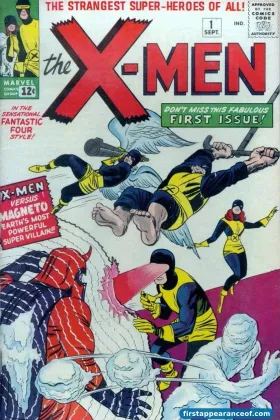
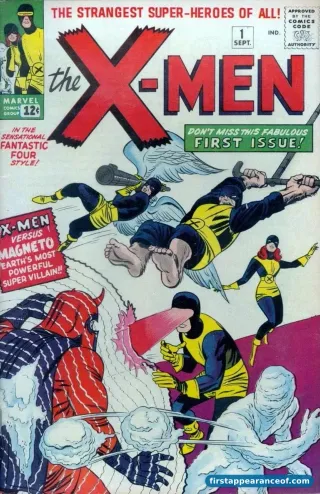
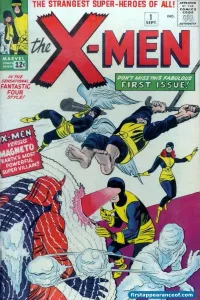
Iceman was Stan Lee and Jack Kirby’s youngest X-Man. X-Men #1 (September 1963) introduces Bobby Drake as a 16-year-old student at Xavier’s School for Gifted Youngsters, the team’s baby brother and comic relief. Kirby’s initial design depicted Bobby’s ice form as a lumpy, snowman-like figure, deliberately softer than the other team members’ more conventional superhero costumes. Across the first year of issues Kirby refined the design into the transparent, angular ice-form that has been Bobby’s visual identity since X-Men #8 (November 1964).
The character’s Silver Age role was structural: Bobby provided a point-of-view entry for young readers, served as the team member most likely to crack jokes, and kept the tone of the book lighter than its X-Men-versus-Magneto stakes would otherwise allow. Chris Claremont’s long X-Men run moved Bobby progressively into more mature territory, but he remained the team’s emotional center for lightness through most of his decades of publication.
The Champions and X-Factor eras
The Champions (1975 to 1978) gave Iceman his first non-X-Men team context. Tony Isabella wrote; the book paired Bobby with Angel, Black Widow, Ghost Rider, and Hercules as a Los Angeles-based superhero team. The book ran seventeen issues and is a cult-classic 1970s Marvel title, not widely remembered but editorially significant because it set the template for off-flagship Marvel teams.
X-Factor #1 (February 1986) reunited Bobby with the other four original X-Men (Cyclops, Jean Grey, Beast, Angel) under a premise that framed them as mutant-hunters-for-hire while secretly being mutants themselves. The book ran 70-plus issues through 1991 and gave Iceman his most substantial character development outside the X-Men flagship.
The coming-out arc
Brian Michael Bendis’s All-New X-Men #40 (June 2015) had the time-displaced teenage Bobby Drake come out as gay. The moment was controversial at the time because adult Bobby Drake had been portrayed as straight across fifty-plus years of publishing history, and the time-displaced-teen version complicated the continuity question. Bendis followed up in Uncanny X-Men #600 (November 2015) with the adult Bobby Drake also coming out, anchoring the reveal as canonical in the current continuity.
Subsequent portrayals, including Sina Grace’s Iceman solo ongoing (2017 to 2018), treat Bobby as openly gay. The ongoing is one of the more commercially successful LGBTQ-lead Marvel titles of the 2010s.
Collector context
X-Men #1 is a Silver Age Marvel key and the most valuable Iceman first-appearance book. See the Cyclops and Jean Grey pages for pricing context; the issue’s multi-first-appearance weight (seven characters) gives it compounded collector demand.
Secondary keys: Iceman #1 (1984) is the first solo limited series. X-Factor #1 (1986) is the original-five reunion. All-New X-Men #40 (2015) is the coming-out key.