Creation Story
Wolverine’s firsts layer across three issues over eight months, which is exactly the situation the True First Appearance guide is built to disambiguate. Cameo, full appearance, first cover, first team appearance, first solo title. Each is a distinct collectible.
Wolverine exists because Marvel’s editor-in-chief in 1974, Roy Thomas, asked writer Len Wein to create a Canadian character. The goal was narrow and practical: Marvel had Canadian readers, Canadian distribution mattered, and Marvel had no character to plant a Canadian flag on. Thomas suggested the name “Wolverine” (the animal is Canadian-coded in a way few other North American predators are), and asked Wein to build a character around it.
Wein brought the concept to artist John Romita Sr., who designed the costume: the yellow-and-blue suit with the flared cowl, the three-clawed gauntlets (the claws were originally intended to be part of the gloves, not retractable from the body. That change came later, in X-Men #98). Romita’s costume sketch is the one that shipped.
Herb Trimpe was the regular Incredible Hulk artist at the time, and Hulk #181 was already scheduled as a Canadian-setting story featuring the Wendigo. Wein and Trimpe used the issue to give Wolverine his full debut. The last-page cameo in Hulk #180 was added at editor Roy Thomas’s direction to get a preceding tease into print, which is why the cameo reads as abrupt: Wolverine walks on panel, names himself, and the issue ends.
At the time of creation, Wolverine was intended as a one-off antagonist. He was built to fight the Hulk, be memorable in the cover image, and likely not return. Chris Claremont’s decision to include him in the relaunched X-Men the following year, over objections from other Marvel staff who considered him forgettable, is what turned the throwaway into a franchise. Wein has said in interviews that if he had known Wolverine would become the most commercially important Marvel character of the following forty years, he would have asked for a better royalty deal.
First Cameo: Incredible Hulk #180
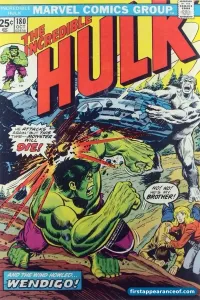
Incredible Hulk #180 is cover-dated October 1974 and was on newsstands in July of that year. The cover features the Hulk fighting the Wendigo in a Canadian forest. The cover is by Herb Trimpe (pencils) and Jack Abel (inks). Wolverine is not on the cover.
The issue runs 32 pages. Wolverine does not appear in any panel until the very last page, where he shows up in a single bottom-tier panel in full costume, claws extended, announcing himself: “Okay, you bozos, you’ve had your fun, and now the fun’s over! Because the Wolverine is here, and it’s time for him to get down to business!” The issue ends on that page. He does not fight, he does not move across panels, and he is not given a name other than “the Wolverine.”
The cameo was added late in production. The original version of the issue ended with the Hulk fighting the Wendigo alone, with Wolverine’s debut saved for #181. Editor-in-chief Roy Thomas asked for the tease to be added to build momentum into the next issue, which was already scheduled as the full debut.
From a collector standpoint, Hulk #180 is the earlier cover date, and therefore the earliest printed appearance of Wolverine in any form. CGC and CBCS both certify it as “Wolverine first appearance (cameo).” Its market value has appreciated steadily since the 1980s, though it has always sold at a discount to #181. In 2022, a CGC 9.8 copy of Hulk #180 sold at Heritage Auctions for $37,800. A CGC 9.8 of Hulk #181 in the same year sold for $117,000.
First Full Appearance and First Cover: Incredible Hulk #181
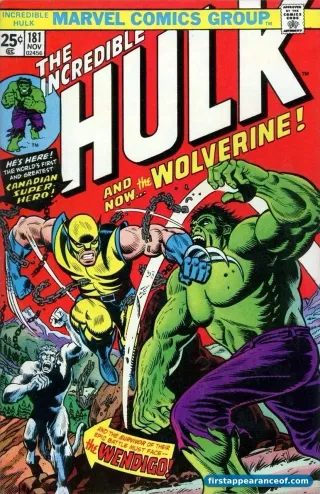
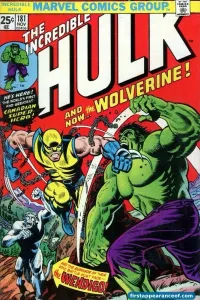
Incredible Hulk #181 is the defining collectible key of the Bronze Age and is widely considered one of the three most important post-1970 Marvel comics, alongside Giant-Size X-Men #1 (1975) and Amazing Spider-Man #129 (1974, first Punisher). Cover-dated November 1974, on newsstands August of that year. 32 pages. Cover price 25 cents.
The cover is by Herb Trimpe, and it is iconic. Wolverine is dead center in costume, claws fully extended, leaping across the composition between the Hulk and the Wendigo. This is the first appearance of the character on any cover anywhere, and it is also the first time the character is seen in his complete costume in action. The composition (three figures in combat, Wolverine in the middle) has been imitated and paid homage to on subsequent Wolverine covers for 50 years.
The story is written by Len Wein, pencilled by Herb Trimpe, inked by Jack Abel. Wolverine appears on 16 of the 32 pages, fights both the Hulk and the Wendigo, saves a civilian, and is identified as a Canadian government operative with orders to subdue the Hulk and return him to American authorities. The issue sets up Wolverine as a capable, volatile, and ambiguously aligned character: not yet a hero, not clearly a villain.
The print run was standard Bronze Age (~200,000 copies based on Statement of Ownership filings from the period), but unlike many Bronze Age keys, Hulk #181 was not widely recognized as significant in its release year. It circulated through newsstands as a normal Hulk issue. This is why high-grade copies are scarcer than contemporaneous keys like GSXM #1: dealers were not pulling copies for safekeeping because the character was not yet famous.
Two additional collector notes matter. First, the Marvel Value Stamp insert: Hulk #181 shipped with a Man-Thing MVS bound into the middle of the book. Reader copies routinely have the stamp cut out, which CGC and CBCS flag as a grade defect. Copies with the intact MVS are graded higher and sell at premiums. Second, the “30-cent price variant”: a small run of the issue was distributed at a test higher price point (30 cents instead of 25). These 30-cent variants are significantly scarcer and trade at 3-5x the price of the 25-cent standard copies in matching grades.
Hulk #181 is the issue that the cameo/full debate revolves around. Every argument in favor of #180 as “the real first appearance” is a technicality about cover date priority. Every argument for #181 is about the character actually being a character in the issue. The market has settled the debate through pricing: #181 consistently trades at 3-5x #180 at matched grade.
Hulk #180 vs Hulk #181
The compact reference for the debate:
| Hulk #180 | Hulk #181 | |
|---|---|---|
| Cover date | October 1974 | November 1974 |
| Appearance type | Single-panel cameo on last page | Full appearance, in costume, across 16 pages |
| On the cover? | No | Yes, center of composition |
| Does Wolverine fight? | No | Yes, both Hulk and Wendigo |
| Named in issue? | Yes (“the Wolverine”) | Yes (Wolverine, Canadian operative) |
| CGC/CBCS label | ”1st Cameo Appearance" | "1st Full Appearance, 1st Cover” |
| Typical market multiple | 1x baseline | 3-5x Hulk #180 |
Both issues are authentic Wolverine first appearances. Collectors buying for authority acquire both. Buyers choosing one typically choose #181 because that is the issue where the character exists as the character. Buyers chasing absolute chronology acquire #180 in addition.
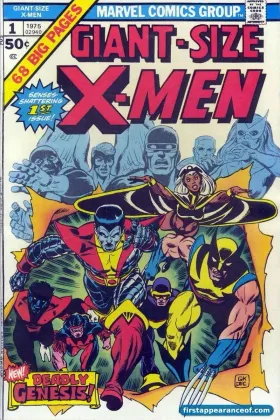
First X-Men Appearance: Giant-Size X-Men #1
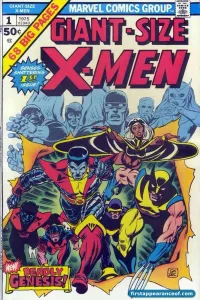
Giant-Size X-Men #1 is cover-dated May 1975 and was on newsstands February. It is the issue that launched the all-new, all-different X-Men. Writer Len Wein assembled a new roster from scratch to replace the original 1960s team: Storm (new), Nightcrawler (new), Colossus (new), Thunderbird (new), Sunfire (imported from existing continuity), Banshee (pulled forward from the 1960s run), and Wolverine.
Wolverine’s presence on the new X-Men was a risk. He had appeared twice at this point (the cameo and the full appearance in Hulk) and had never been established as a hero. The editorial decision was made by Wein (who wrote both the Hulk debut and GSXM #1) and X-Men editor Roy Thomas, who wanted a character with an edge. Wolverine’s volatility was the point.
GSXM #1 is the first appearance of four characters: Storm, Colossus, Nightcrawler, and Thunderbird. It is Wolverine’s first X-Men appearance but not his first appearance overall. The issue set up every subsequent X-Men comic for 50 years.
Collector significance: GSXM #1 is the second-most valuable Bronze Age comic after Hulk #181. The 1975 first print is the one that matters; there are several later reprints with identical or near-identical covers that collectors distinguish by the cover price (25-cent original vs. 50-cent reprint).
First Solo Title: Wolverine #1 (1982 limited series)
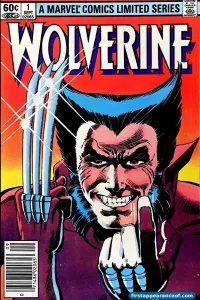
Wolverine #1 is cover-dated September 1982. It is a four-issue limited series (#1 through #4), written by Chris Claremont and pencilled by Frank Miller, with Josef Rubinstein on inks. This is the first time Wolverine carried a book as the solo lead.
The limited series is set in Japan and establishes much of the character mythology that has persisted since: Mariko Yashida as Wolverine’s love interest, Yukio as the chaotic-neutral counterpoint, the honor-vs-savagery internal conflict, the samurai aesthetic threaded through the berserker character. Miller’s visual vocabulary for the series (dynamic paneling, silent action sequences, negative-space fight choreography) became the template for Wolverine’s solo art style in subsequent runs.
The series was a commercial success and led directly to the ongoing Wolverine #1 in November 1988, which Claremont also wrote. The 1988 ongoing ran for 189 issues and remains the reference Wolverine series.
Collector significance: the 1982 Wolverine #1 is the first Wolverine solo appearance and carries the first Wolverine solo title. It is also the first Wolverine comic drawn by Frank Miller, adding crossover appeal from Miller’s Daredevil readership. The issue is a common key for Bronze Age collectors and is meaningfully more accessible than Hulk #181 or GSXM #1 in high grade.