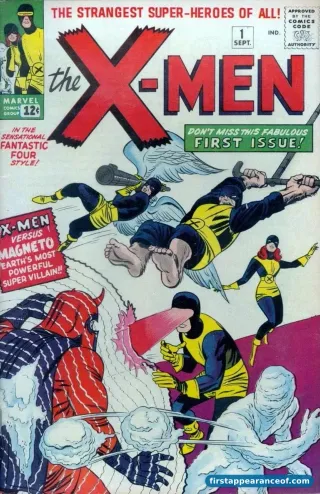
The original X-Men on the cover of X-Men #1 (1963). Professor X directs from his wheelchair.

1st Appearance and 1st Cover

First Appearance of Professor X

X-Men #1

September 1963 · Marvel · Silver Age

The mentor who built a school, a movement, and a sixty-year editorial framework for an entire mutant line.

Key Issue

Created by Stan Lee · Jack Kirby

By Atomm Updated

The first appearance (1st app) of Professor X is X-Men #1 (September 1963), created by Stan Lee and Jack Kirby. Charles Xavier debuts as the founder and mentor of the X-Men, running the Westchester School for Gifted Youngsters from his wheelchair. Same issue is the first appearance of Cyclops, Marvel Girl, Beast, Iceman, Angel, and Magneto. Xavier is the single most important mentor figure in X-Men continuity and the ideological foundation for the civil-rights allegorical framing Chris Claremont built on.

Quick Facts

Debut
X-Men #1 (September 1963)
Real name
Charles Francis Xavier
Creators
Stan Lee (script), Jack Kirby (art)
Publisher
Marvel Comics
First enemy
Magneto (shared X-Men #1 antagonist; Xavier's longstanding ideological opposite)
First ally
The original five X-Men (his students and team)
Team affiliations
X-Men (founder and headmaster), Illuminati, X-Men Gold (emeritus)

First Appearance

  1. X-Men #1 cover
    First Appearance First Cover September 1963

    X-Men #1

    By Stan Lee, Jack Kirby

    Charles Xavier debuts as the founder and mentor of the X-Men, running the Westchester School for Gifted Youngsters from his wheelchair. Stan Lee writes; Jack Kirby designs. Same issue debuts Cyclops, Marvel Girl, Beast, Iceman, Angel, and Magneto.

    Read the full breakdown

Creation Story

Professor X was Stan Lee and Jack Kirby’s answer to an editorial problem: how do you write a superhero team of teenagers without making them feel like sidekicks to an absent adult? The solution was to put an adult mentor at the center of the book. Charles Xavier, the wheelchair-bound telepathic founder of a school for mutant children, gave the original X-Men structural coherence that the more adult teams (Avengers, Fantastic Four) did not need.

X-Men #1 (September 1963) introduces Xavier as a disabled telepath whose paralysis is unexplained in the debut. Kirby’s visual design (bald, seated, composed) was immediate and has been essentially unchanged in sixty years of comics. Patrick Stewart’s film portrayal from 2000 onward draws from the Kirby visual foundation.

The character’s backstory expanded slowly over the Lee and Kirby run and filled out in detail during Chris Claremont’s long tenure (1975 to 1991). Claremont added the confrontation with Lucifer that caused Xavier’s paralysis (X-Men #20, 1966 backstory expanded in X-Men #117, 1979), introduced the Shadow King as his oldest nemesis, and built the civil-rights allegorical framing that elevated Xavier from team-leader-character into ideological spine of the entire X-Men franchise.

The modern complication

Grant Morrison’s New X-Men (2001 to 2004) repositioned Xavier as a more morally compromised figure. Morrison’s Xavier was willing to use psychic manipulation, secret agendas, and selective information-sharing to pursue his goals. The characterization caught on. Subsequent writers, particularly during the House of M (2005), Avengers vs X-Men (2012), and House of X / Powers of X (2019) eras, have treated Xavier as a political actor whose intentions may be sincere but whose methods are often coercive.

Avengers vs X-Men #11 (2012) had Phoenix-possessed Cyclops kill Xavier, the most consequential X-Men death of the 2010s. Xavier remained dead until House of X #1 (2019), when Jonathan Hickman brought him back as the founder of Krakoa, a mutant nation-state. The Krakoan-era Xavier is explicitly political and his ethical ambiguity is a core feature of the books rather than a secret.

Collector context

X-Men #1 is a Silver Age key. See the Cyclops and Jean Grey pages for pricing context; the book’s multi-first-appearance weight (Professor X, Cyclops, Marvel Girl, Beast, Iceman, Angel, Magneto) gives it compounded collector demand.

Secondary keys: X-Men #117 (1979) is the Claremont-era backstory expansion and first Shadow King reference. New X-Men #114 (2001) is the Morrison-era restart. Avengers vs X-Men #11 (2012) is Xavier’s death. House of X #1 (2019) is his return.
Key subsequent appearances

After the debut, these are the issues collectors and historians reach for next.

  1. 1963

    X-Men #1

    First appearance.

  2. 1979

    X-Men #117

    Original Backstory

    Chris Claremont expands Xavier's backstory. First introduction of Amahl Farouk (later Shadow King), Xavier's original nemesis.

  3. 2001

    New X-Men #114

    Morrison Era

    Grant Morrison's New X-Men begins. Xavier publicly comes out as a mutant and the school's framing expands.

  4. 2005

    House of M #1

    Scarlet Witch's reality rewrite. Xavier's role in the event is central to the post-M-Day depowering.

  5. 2012

    Avengers vs X-Men #11

    Xavier's Death

    Phoenix-possessed Cyclops kills Charles Xavier. Most consequential X-Men character death of the 2010s.

  6. 2019

    House of X #1

    Krakoa Era

    Jonathan Hickman launches the Krakoan era. Xavier returns as the founder of a mutant nation.

In adaptations

Film, TV, animation, and game appearances.

  1. 1992

    X-Men: The Animated Series

    Animated

    Starring:Cedric Smith

    Five-season Fox Kids series. Smith's Xavier is the foundational animated version.

  2. 2000

    X-Men

    Film

    Starring:Patrick Stewart

    Bryan Singer directs. Stewart plays Xavier across the original X-Men trilogy and subsequent appearances. The performance that defined the character for a generation of viewers.

  3. 2011

    X-Men: First Class

    Film

    Starring:James McAvoy

    Matthew Vaughn directs. McAvoy plays young Xavier in the prequel trilogy, continuing through Apocalypse (2016) and Dark Phoenix (2019).

  4. 2017

    Logan

    Film

    Starring:Patrick Stewart

    James Mangold directs. Stewart's final film as Xavier in a deliberately stripped-down, aging-and-dying portrayal. Widely considered one of his best performances of the character.

Frequently asked questions

The questions readers and collectors ask most.

What is Professor X's first appearance?

Professor X's first appearance is X-Men #1 (September 1963), created by Stan Lee and Jack Kirby. The same issue is the first appearance of Cyclops, Marvel Girl, Beast, Iceman, Angel, and Magneto.

Is Charles Xavier paralyzed?

Yes, in most continuities. His paralysis is inconsistently framed across sixty years of publishing. The original 1963 framing did not explain the cause. Chris Claremont's X-Men #117 (1979) backstory tied it to a confrontation with the alien Lucifer. Modern continuity has added multiple origin explanations. Xavier has temporarily regained the ability to walk in several storylines and has lost it again in others. Patrick Stewart's film performances maintain the paralysis.

What is Xavier's relationship with Magneto?

Xavier and Erik Lehnsherr (Magneto) were originally close friends and allies who diverged philosophically over how mutants should respond to human persecution. Xavier advocates integration and nonviolent coexistence. Magneto advocates mutant separatism and militancy against human aggressors. The relationship is the ideological spine of the X-Men franchise. The film series and modern comics have explored the relationship's friendship-turned-rivalry extensively.

Is Xavier morally questionable?

Yes, in modern comics. Grant Morrison's New X-Men (2001) repositioned Xavier as a more complicated figure willing to use manipulation and psychic coercion toward his goals. Subsequent writers have treated Xavier's ends-justify-means tendencies as a feature rather than a hidden flaw. Jonathan Hickman's Krakoan-era House of X run (2019) portrays Xavier as functionally a mutant head of state whose agenda is explicitly political.