Who are X-Factor
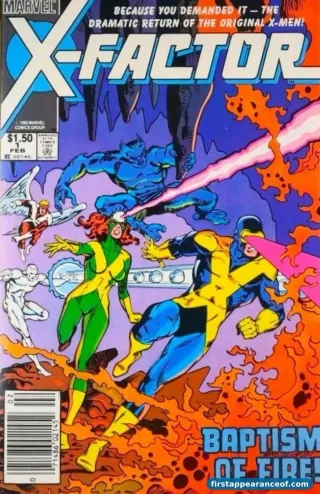
X-Factor is the X-team that keeps changing what kind of book it is. It debuted in X-Factor #1, cover-dated February 1986, by Bob Layton and Jackson Guice. More than most teams, X-Factor is best understood by its three distinct incarnations, so the eras below carry the story.
The original five (1986)
Roster: Cyclops, Marvel Girl, Beast, Angel, and Iceman.
The book existed to solve a continuity problem and turn it into a premise: Jean Grey, dead since the Dark Phoenix Saga, was brought back, which let Marvel reunite all five original X-Men outside the main X-Men book. Their cover story was queasy on purpose, a public mutant-hunting agency that secretly sheltered the mutants it “captured.” X-Factor #6 introduced Apocalypse, the villain the era is remembered for.
The government team (1991)
Roster: Havok, Polaris, Multiple Man, Strong Guy, Wolfsbane, and Quicksilver.
Peter David took over and rebuilt X-Factor as a US-government mutant team, trading the original-five nostalgia for a sharp, funny, character-driven book. This run is the one longtime readers cite, the moment X-Factor became its own thing rather than an X-Men spinoff.
X-Factor Investigations (2005)
Roster: Multiple Man, Strong Guy, Wolfsbane, Siryn, Layla Miller, and others.
David returned to the property in 2005 and turned it into noir: Madrox the Multiple Man running a detective agency in Mutant Town. The book leaned on mystery plotting and a small, sharply written cast, and it ran for years as one of the more distinctive X-titles of its era.
Notable issues
- X-Factor #1 (1986): first appearance of X-Factor; the original five X-Men reunited.
- X-Factor #6 (1986): first full appearance of Apocalypse, after a shadowed cameo in #5.
- X-Factor #71 (1991): Peter David’s first issue; the government-team relaunch.
- X-Factor #1 (2005): X-Factor Investigations, the Madrox detective era.
For collectors
The first-appearance key is X-Factor #1 (1986), but the run’s most valuable book is X-Factor #6 (1986), the first full Apocalypse. The Peter David eras (#71 in 1991 and the 2005 #1) are accessible reader keys rather than high-value back issues.