Creation Story
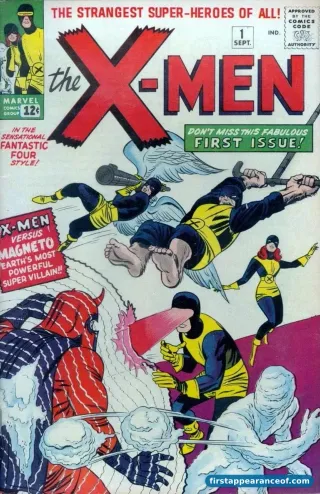
Magneto was created as a straightforward Cold War-era supervillain. X-Men #1 (September 1963) introduces Erik Lehnsherr as a mutant supremacist attempting to take over a NATO missile base. Stan Lee’s script and Jack Kirby’s design established the visual template (purple-and-red costume, helmet, operatic cape) but not the character’s depth. Early Magneto stories framed him as the mutant world’s equivalent of Marvel’s other menacing-world-conqueror archetypes: a Dr. Doom with magnetism.
The character’s transformation into one of the most morally complex figures in superhero comics came from Chris Claremont. Claremont inherited Magneto when he took over X-Men in 1975 and spent years building the backstory. Uncanny X-Men #150 (October 1981) first canonized the Holocaust-survivor origin, reframing Magneto’s anti-human militancy as the rational response of a man who had already lived through the attempted extermination of his people. The retcon was not a softening of the character; it was a recontextualization that made him harder to dismiss.
Claremont extended the framing across his sixteen-year run. Uncanny X-Men #200 (1985) put Magneto on trial for his crimes and began his period as a reformed member of the X-Men. The character’s willingness to work with Xavier, disagree fundamentally about methods, and still commit to the mutant cause made him the most politically complicated figure on Marvel’s roster.
The film and TV era
Ian McKellen’s Magneto in Bryan Singer’s X-Men films (2000, 2003, 2006) is the reference version for most audiences. McKellen’s performance draws directly from Claremont’s Holocaust-survivor framing, with the opening sequence of the 2000 film set in a Nazi concentration camp. Michael Fassbender’s Magneto in the prequel trilogy (2011, 2014, 2016, 2019) extends the same framing into the 1960s civil-rights-era setting. Both performances are widely regarded among the strongest in Marvel film adaptation.
The Krakoa era
Jonathan Hickman’s House of X / Powers of X (2019) reshaped Magneto’s role again. The Krakoan-era Magneto works alongside Xavier to found and govern a mutant nation-state. The positioning frames Magneto not as antihero but as a founding father of an independent people, making his earlier militancy look like consistent ideology rather than villainy. The Krakoa arc ran from 2019 through the X-Men: Inferno event in 2022 and is the most consequential modern X-Men publishing shift.
Collector context
X-Men #1 is the Magneto key and a Silver Age Marvel foundational book. See the Cyclops and Jean Grey pages for pricing context.
Secondary keys: X-Men #4 (1964) is the first Brotherhood of Mutants and first Quicksilver and Scarlet Witch. Uncanny X-Men #150 (1981) is the Holocaust-backstory canonization. X-Men #1 (1991) is the Jim Lee best-selling comic ever. House of X #1 (2019) is Magneto’s modern political pivot.