Creation Story
Deadpool is the product of two creators playing different games in the same issue. Rob Liefeld was the regular penciller on The New Mutants in 1990 and needed an antagonist for an upcoming Cable storyline. He designed a mercenary in a red-and-black mask, two swords on his back, dual handguns, and a utility belt. The visual silhouette was lifted, deliberately, from DC’s Deathstroke (Slade Wilson), a character Liefeld admired from Marv Wolfman and George Pérez’s New Teen Titans run. Liefeld plotted the issue and named the character “Deadpool” as a placeholder.
Fabian Nicieza was the title’s scripter. When Nicieza saw Liefeld’s plot and the character design, his first note was that the silhouette was a Deathstroke riff. His second note, which became the defining creative decision, was to lean into the riff: he named the character Wade Wilson as a direct rhyming-surname play on Slade Wilson. Nicieza then gave Deadpool a voice the character hadn’t had in Liefeld’s plot. Where Liefeld’s plot described a competent mercenary, Nicieza’s script had the mercenary narrating his own fights with sarcastic self-aware commentary. Deadpool’s debut dialogue, particularly his interactions with the New Mutants team during the fight, was Nicieza’s work.
What shipped in The New Mutants #98 was a hybrid. Liefeld’s visual, design sensibility, and placement in the issue. Nicieza’s identity (Wade Wilson), verbal register, and the fourth-wall-adjacent comedy. The character’s commercial durability for the next 35 years came from the voice, which means Nicieza’s contribution was the one that made the property work beyond 1991.
Marvel credits both as co-creators. Liefeld has said publicly that Nicieza’s scripting was what made the character something other than a Deathstroke visual exercise. The creative-credit discussion for Deadpool is unusually amicable for a major Marvel character; neither party has contested the other’s contribution publicly.
The fourth-wall-breaking voice that became the character’s defining feature did not fully emerge in the 1991 debut. In The New Mutants #98, Deadpool is more talkative than typical Marvel villains but not yet the reader-aware narrator he becomes in later stories. The full fourth-wall break is a Joe Kelly 1997 evolution, built on Nicieza’s 1991 voice foundation. The character’s modern tone is a layered creator contribution: Liefeld’s visual, Nicieza’s voice, Kelly’s meta framing.
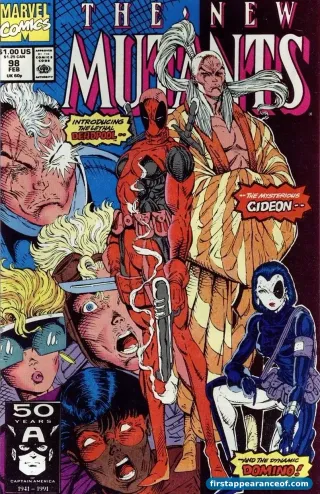
First Appearance and First Cover: The New Mutants #98
The New Mutants #98 is cover-dated February 1991 and was on newsstands in November 1990. The book is 32 pages at the standard 1991 Marvel cover price. Rob Liefeld is credited as plotter and penciller, Fabian Nicieza as scripter, and Joe Rubinstein on inks. The cover, by Liefeld, features the New Mutants team confronting Cable while Deadpool lurks in the upper-right quadrant. This is Deadpool’s first cover appearance.
The story opens with Deadpool breaking into an unidentified facility to pick up a contract. A shadowy figure (later revealed as Mister Tolliver) hires him to neutralize Cable, who has been reshaping the New Mutants into a more militarized team. Deadpool’s character is established quickly: competent, talkative, mercenary, unconcerned with morality framing. He is not yet the comedic fourth-wall-breaking character later Deadpool stories would make canonical.
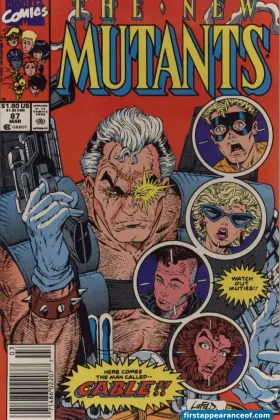
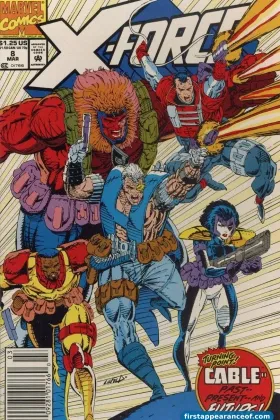
The bulk of the issue is a set-piece action sequence with Deadpool attacking the New Mutants at their training facility. He fights and is defeated, captured by Cable, and left as an unresolved antagonist for future issues. The issue also contains the first appearance of Gideon (another Tolliver operative) and Domino, although the Domino in this issue is later revealed to be Copycat impersonating her, making the “first Domino” credit technically assigned to X-Force #8 (1992) when the real Domino is disambiguated.
The in-universe backstory that later runs fill in: Wade Wilson was a terminal cancer patient subjected to the Weapon X program, the Canadian government’s covert super-soldier lab that also produced Wolverine and Sabretooth. The program grafted Wolverine’s regenerative healing factor onto Wilson’s cancer, which saved his life but caused his cells to mutate chaotically, leaving him with a severely scarred face and an unstable physical form that refuses to stabilize. The healing factor gives Deadpool effective immortality, rapid regeneration from almost any injury, and resistance to most telepaths. The cost is permanent disfigurement and a disintegrating mental state that later writers have used as the running joke underneath the verbal comedy. None of this backstory is stated in New Mutants #98; it is established piecemeal across subsequent appearances and most fully in the Weapon X-adjacent continuity of the 1990s and 2000s.
Collector significance is tied to Deadpool’s subsequent cultural trajectory. The New Mutants #98 was a late-run issue of a soon-to-be-cancelled series (New Mutants would be renumbered as X-Force with issue #100 in August 1991, making #98 two issues from the title’s end) and was not recognized as a major key in 1991. Print runs were high for the period but survival in high grade is constrained by the paperback-style binding of late-era New Mutants issues, which Marvel shifted to matte-cover stock for issues #95 onward. CGC 9.8 copies have sold in the mid four figures; 9.9 copies significantly higher. The book’s appreciation trajectory is one of the clearest examples in modern collecting of a character’s adaptation-driven value curve: each Deadpool film release has correlated with measurable auction-price upticks.
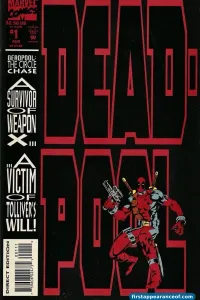
First Solo Title: Deadpool: The Circle Chase #1
Deadpool: The Circle Chase #1 is cover-dated August 1993 and was on newsstands in June 1993. It is the first issue of a four-issue limited series that ran August through November 1993. It is Deadpool’s first title as solo lead, not just his first appearance as a protagonist. Fabian Nicieza, the writer who had scripted Deadpool’s debut in The New Mutants #98 two years earlier, returned as writer on the series. Joe Madureira pencilled, in a career-launching early Marvel assignment (Madureira would become one of the defining Uncanny X-Men artists of the 1990s, but Circle Chase is among his earliest sustained runs).
The story’s framing device is a chase for an inheritance. Tolliver, the mercenary boss who had hired Deadpool to kill Cable in New Mutants #98, has been presumed killed off-panel. Tolliver’s will has been released with a cryptic prize at stake, and a handful of mercenaries learn of it simultaneously and set out in pursuit. Deadpool is one of them. Others include Kane (Deadpool’s X-Force #2 opponent), Slayback (a former Weapon X trainee whose backstory directly intersects with Deadpool’s own), and Copycat (the mutant shapeshifter who had impersonated Domino in New Mutants #98, here in her own form and with her own agenda). The limited series is the first sustained exposure to these three characters as recurring figures in Deadpool’s world.
Structurally, Circle Chase is Marvel’s commercial test of whether Deadpool could carry a book as the lead rather than as an antagonist. The limited-series format was Marvel’s standard proof-of-concept mechanism in the 1990s; a successful four-issue mini would justify a second mini (which Circle Chase did, leading to Deadpool: Sins of the Past in 1994) and eventually an ongoing (which Joe Kelly launched in 1997 and is covered separately below). Deadpool’s commercial trajectory through Circle Chase was strong enough to validate continued investment in the character.
Character-wise, this is the series where Deadpool starts becoming the character he is later known as. Nicieza continues developing the sarcastic-self-aware voice he established in New Mutants #98, and the verbal comedy dials up. The red-bordered word balloons that had marked Deadpool’s dialogue since his debut persist through the Circle Chase run. His antagonistic relationship with Cable and X-Force steps aside; his messier connections with Kane, Slayback, and Copycat become the emotional center of the series.
Collector significance is real but modest. Print run for the 1993 Circle Chase mini was smaller than for New Mutants #98, and the limited-series format was not generally treated as a major collectible in the 1990s when it shipped. Appreciation has tracked the post-2016 Deadpool film cycle but at a lower plateau than the New Mutants #98 curve. Circle Chase #1 is a required completionist entry for any serious Deadpool key run, and the subsequent three issues (#2, #3, #4) are typically collected together since all four are attainable in high grade at modest prices relative to the character’s other keys.
First Ongoing Title: Deadpool #1 (1997)
Deadpool #1, cover-dated January 1997, launched the first ongoing Deadpool series. Joe Kelly wrote, Ed McGuinness pencilled. Unlike the earlier limited series (Circle Chase in 1993, covered above; Sins of the Past in 1994, covered in Key Appearances below), the 1997 book was structured as a continuing title, and it established the modern Deadpool voice more durably than either mini had.
Joe Kelly’s 1997 run is the creative pivot that turned Deadpool from a cult-favorite side character into a commercially durable solo property. Kelly took Nicieza’s sarcastic-self-aware voice from The New Mutants #98 and the Circle Chase mini and pushed it into full fourth-wall break: Deadpool began addressing the reader directly, commenting on his own narrative captions, and referencing the comic as a physical object the reader is holding. Ed McGuinness’s art gave the visual a bounce-pose exaggeration that matched the tonal register. The Kelly / McGuinness run is often cited as one of the most underrated Marvel runs of the 1990s; Kelly himself has said it was the work he’s proudest of.
Deadpool #1 (1997) introduces Blind Al as a recurring character. Al is an elderly blind woman Deadpool keeps captive in his apartment under increasingly comedic circumstances; she becomes the character’s emotional center for the Kelly run. The issue also establishes the Weasel / Weasel’s arms dealership as Deadpool’s supplier, which has remained a fixture of Deadpool stories since. Bob, Agent of HYDRA, debuts a few issues later in the same run as one of the most-referenced comedic supporting characters across the Deadpool mythos.
A distinctive production detail that evolved across Deadpool’s early publishing history is the treatment of his word balloons. From his first appearance in New Mutants #98, Deadpool’s dialogue was rendered with a red-bordered balloon, a small visual flag distinguishing his lines from the rest of the characters on the page. The red-border treatment carried through the early Nicieza stories, including the 1993 Circle Chase limited series. By the time the 1997 Kelly/McGuinness ongoing launched, the balloon had shifted to a yellow fill with a thin black border, which became Deadpool’s signature treatment and has been maintained by most subsequent artists. When later writers expanded the character’s internal voices (the two-voices-in-his-head conceit, sometimes rendered as three), different lettering treatments and balloon colors were used to mark each voice. It is one of the few comic-book visual conventions instantly recognizable as specific to a single character.
Collector significance is moderate by 1997 standards. The issue was direct-market-only with a reasonable print run and high survival in collectible grade. Values have appreciated steadily since the 2016 film but not at the trajectory of The New Mutants #98. The book’s importance is editorial rather than scarcity-driven: it is the starting point for every post-2000 Deadpool story.
The 1997 ongoing ran for 69 issues through 2002, followed by Cable & Deadpool (2004-2008) under Fabian Nicieza, then a new Deadpool (2008-2012) ongoing under Daniel Way, then continuous relaunches since. The character has not been without a solo title for any 12-month stretch since 2004.