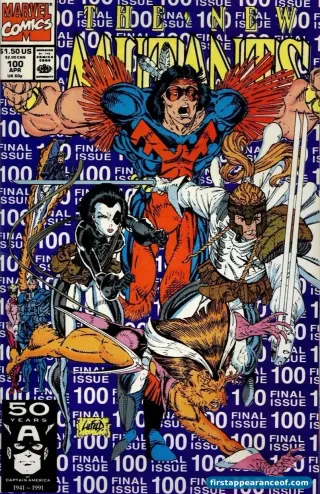
First appearance of X-Force — the cover of New Mutants #100 (1991).

1st Appearance

First Appearance of X-Force

New Mutants #100

April 1991 · Marvel · Copper Age

The New Mutants reborn as a strike team: the harder, more militant X-book, reinvented in three sharply different versions.

Key Issue

Created by Rob Liefeld · Fabian Nicieza

By Atomm Updated

Marvel Comics Copper Age Est. 1991 Earth-616 The militant X-team

X-Force first appeared in New Mutants #100, cover-dated April 1991, by Rob Liefeld and Fabian Nicieza for Marvel, when the New Mutants reorganized as a militant strike team under Cable. The self-titled X-Force #1 followed in August 1991, led by Cable with Cannonball, Domino, Warpath, Shatterstar, Feral, and Boom-Boom, and introduced Stryfe. It sold several million copies and helped define 1990s Marvel. The team was later reinvented as a satire (X-Statix) and as a black-ops kill squad.

Firsts Timeline

  1. New Mutants #100 cover
    First Appearance April 1991

    New Mutants #100

    By Rob Liefeld, Fabian Nicieza

    The New Mutants reorganize as X-Force under Cable in their final issue, leading directly into the relaunch.

    Read the full breakdown
  2. First Title August 1991

    X-Force #1

    By Rob Liefeld, Fabian Nicieza

    Rob Liefeld's solo launch. Cable leads Cannonball, Domino, Warpath, Shatterstar, Feral, and Boom-Boom; first appearance of Stryfe. The issue sold several million copies behind multiple covers and trading-card inserts.

Who are X-Force

X-Force is the militant X-team, the book that exists to be harder-edged than the X-Men. It came out of New Mutants #100, cover-dated April 1991, by Rob Liefeld and Fabian Nicieza, when Xavier’s teen class reorganized under Cable into a strike force. The name has since been handed to wildly different creators, so the eras below track what each made of it.

Liefeld’s X-Force (1991)

Roster: Cable, Cannonball, Domino, Warpath, Shatterstar, Feral, and Boom-Boom.

The relaunch was a phenomenon. X-Force #1 (August 1991) shipped with five collectible covers and a trading-card insert and sold several million copies, one of the best-selling issues of the decade and a centerpiece of the speculator boom. It also introduced Stryfe. The book traded the New Mutants’ school-drama roots for guns, pouches, and paramilitary plots, the template for 1990s Marvel.

X-Statix (2001)

Roster: a media-stunt team, including the Orphan, U-Go Girl, and Doop.

Peter Milligan and Mike Allred took the name in 2001 and made it satire: celebrity superheroes who care more about ratings than survival, with a high body count. It was quickly retitled X-Statix and remains the most stylistically distinct thing the X-Force name ever carried.

The black-ops squad (2008)

Roster: Wolverine, X-23, Warpath, Wolfsbane, and others.

Craig Kyle and Christopher Yost rebuilt X-Force as Cyclops’s secret kill team, the X-Men’s dirty work done off the books by Wolverine. This version leaned into the moral cost of a mutant death squad and ran across several relaunches.

Notable issues

For collectors

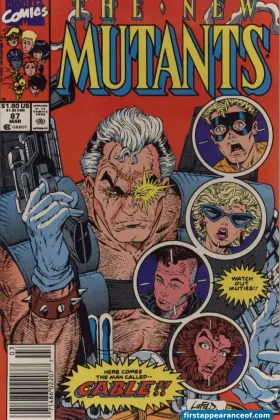
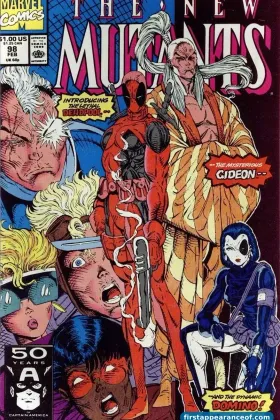
The keys are New Mutants #100 (1991) and X-Force #1 (1991). Both had enormous print runs from the speculator era, so high-grade copies are common and values are modest despite the historical weight. They are read-and-own keys more than scarce ones.
Frequently asked questions

The questions readers and collectors ask most.

What is the first appearance of X-Force?

New Mutants #100 (April 1991), where the New Mutants become X-Force, leading into the self-titled X-Force #1 in August 1991. Both are by Rob Liefeld and Fabian Nicieza.

Who were the original X-Force?

Cable led Cannonball, Domino, Warpath, Shatterstar, Feral, and Boom-Boom. The team was the New Mutants regrouped with a more militant, paramilitary mission.

Why is X-Force #1 (1991) significant?

It sold several million copies behind five collectible covers and a trading-card insert, one of the best-selling single issues of the era. It also carries the first appearance of Stryfe.

Were there other versions of X-Force?

Yes. Peter Milligan and Mike Allred's 2001 X-Force was a media-satire that became X-Statix, and Craig Kyle and Christopher Yost's 2008 X-Force was a black-ops kill team led by Wolverine. The name has swung between extremes.