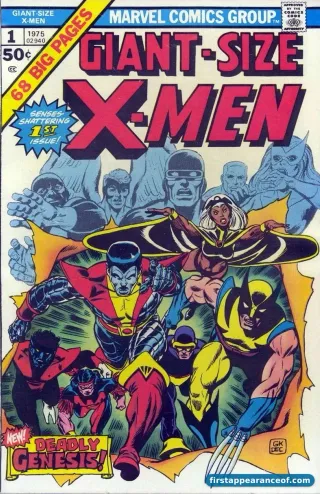
Colossus in organic-steel form on the cover of Giant-Size X-Men #1 (1975).

1st Appearance and 1st Cover

First Appearance of Colossus

Giant-Size X-Men #1

May 1975 · Marvel · Bronze Age

The Russian farm boy who became the X-Men's unbreakable center. Dave Cockrum's organic-steel mutant, and Chris Claremont's quietest protagonist.

Key Issue

Created by Len Wein · Dave Cockrum

By Atomm Updated

The first appearance (1st app) of Colossus is Giant-Size X-Men #1 (May 1975), created by writer Len Wein and artist Dave Cockrum. Piotr Rasputin debuts as one of the all-new all-different X-Men alongside Storm, Nightcrawler, Thunderbird, and Wolverine. Colossus is the X-Men's primary physical powerhouse: his mutant ability is transformation into an organic-steel form with enhanced strength and durability.

Quick Facts

Debut
Giant-Size X-Men #1 (May 1975)
Real name
Piotr Nikolaievitch Rasputin
Creators
Len Wein (writer), Dave Cockrum (character design)
Publisher
Marvel Comics
First enemy
Count Nefaria
First ally
Charles Xavier (recruits him from a Siberian collective farm)
Team affiliations
X-Men (long-serving), Excalibur, Acolytes (briefly), Phoenix Five

First Appearance

  1. Giant-Size X-Men #1 cover
    First Appearance First Cover May 1975

    Giant-Size X-Men #1

    By Len Wein, Dave Cockrum

    Piotr Rasputin debuts as one of the all-new all-different X-Men team. Dave Cockrum designs; Len Wein writes. The issue is a five-character debut alongside Storm, Nightcrawler, Thunderbird, and Wolverine's first team appearance.

    Read the full breakdown

Creation Story

Colossus was part of Dave Cockrum’s all-new X-Men roster for Giant-Size X-Men #1 (May 1975). Cockrum designed the character as a young Russian farmer who transforms into an organic-steel powerhouse when needed. The concept was rooted in Cold War-era cultural framing: a Soviet mutant discovered by the Western-based Charles Xavier and recruited to an American super-team. The farm-boy backstory softened the Soviet association; Piotr Rasputin is politically non-ideological in his debut, which was a deliberate Wein and Cockrum choice.

Chris Claremont developed Colossus across sixteen years of Uncanny X-Men. Claremont’s Colossus is emotionally the quietest of the all-new team: the character is consistently positioned as gentle, family-oriented, artistic (a painter by training), and self-conscious about his destructive power. The Juggernaut bar fight in Uncanny X-Men #183 (July 1984) by Claremont and John Romita Jr. is the defining single-panel-to-sequence that anchors Colossus’s cultural presence: two lines of dialogue, one punch, decades of reproduction as a reference sequence.

The Deadpool-era revival

Tim Miller’s Deadpool (2016) brought Colossus into the MCU-adjacent film continuity as a supporting character. Stefan Kapicic voices and CGI-performs the character across both Deadpool films, and the scenes-of-the-film performance (particularly the taxi conversations and the Ajax confrontation) are widely praised. The film’s Colossus is the most faithful mainstream film adaptation of the character to date.

Collector context

Giant-Size X-Men #1 is the Colossus key. See the Storm, Nightcrawler, and Wolverine pages for the issue’s multi-first-appearance pricing context.

Secondary keys: X-Men #94 (1975) is the Claremont-era restart. Uncanny X-Men #183 (1984) is the Juggernaut bar-fight issue.
Key subsequent appearances

After the debut, these are the issues collectors and historians reach for next.

  1. 1975

    Giant-Size X-Men #1

    First appearance.

  2. 1975

    X-Men #94

    Claremont-era ongoing.

  3. 1984

    Uncanny X-Men #183

    Juggernaut Fight

    Colossus versus the Juggernaut bar fight. Chris Claremont and John Romita Jr. One of the most-reproduced Claremont-era sequences.

  4. 2008

    X-Infernus #1

    Magik (Colossus's sister Illyana) returns from death. Sibling relationship anchors the arc.

  5. 2014

    Amazing X-Men #1

    Return from Death

    Colossus returns after his death in the Fear Itself event.

In adaptations

Film, TV, animation, and game appearances.

  1. 1992

    X-Men: The Animated Series

    Animated

    Starring:Rick Bennett

    Recurring animated role across the Fox Kids series run.

  2. 2016

    Deadpool

    Film

    Starring:Stefan Kapicic

    Tim Miller directs. Colossus is a supporting character in both Deadpool films. Kapicic provides voice; CGI body. Scenes-of-the-film performance widely praised.

Frequently asked questions

The questions readers and collectors ask most.

What is Colossus's first appearance?

Colossus's first appearance is Giant-Size X-Men #1 (May 1975), created by writer Len Wein and artist Dave Cockrum. The issue is a five-character debut.

What are Colossus's powers?

Piotr Rasputin can transform his body into organic steel (a non-iron metallic substance) that provides enhanced strength and near-complete invulnerability to physical damage. In transformed state he is approximately seven feet tall, weighs roughly 500 pounds, and can lift beyond 75 tons. He can switch between human and steel form at will but cannot partially transform.

Is Colossus Russian?

Yes. Piotr Rasputin is a Siberian native, raised on a collective farm. His Russian heritage has been a consistent feature of the character since 1975 and was written specifically to bring non-American diversity to the all-new X-Men team. Chris Claremont extended the backstory significantly across the Claremont era, including his relationship with his sister Illyana (Magik) and his younger brother Mikhail.

Who is Magik?

Magik is Illyana Rasputin, Colossus's younger sister. Originally introduced as a child in Giant-Size X-Men #1 (off-panel, as Colossus's little sister), Magik became a major character during Chris Claremont's New Mutants run. She has her own first-appearance and first-cover stories in the New Mutants title. The sibling relationship is one of the most emotionally consistent threads in Colossus's fifty years of continuity.

Did Colossus really die?

Yes, twice. He died in Uncanny X-Men #390 (2001) during the Legacy Virus arc, sacrificing himself to distribute a cure. He was brought back in Astonishing X-Men #4 (2004). He died again in the Fear Itself event (2011) and was brought back in Amazing X-Men #1 (2014). Neither death was as commercially consequential as Jean Grey's or Xavier's.