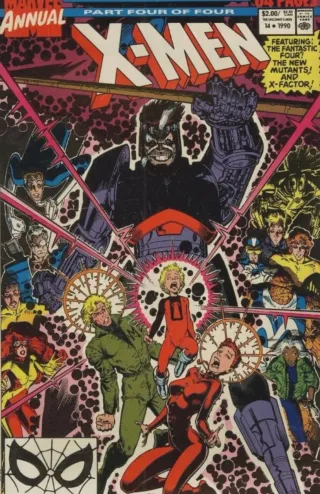
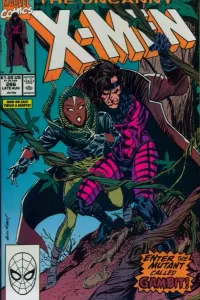
Gambit's first cameo, Uncanny X-Men Annual #14 (1990).

1st Cameo

First Appearance of Gambit

Uncanny X-Men Annual #14

July 1990 · Marvel · Modern Age

The Cajun thief with charged cards and a criminal past. Rogue's long-running romantic partner, and the 1990s X-Men breakout.

Key Issue

Created by Chris Claremont · Art Adams

By Atomm Updated

Gambit has two first-appearance keys. His first cameo is Uncanny X-Men Annual #14 (July 1990), created by Chris Claremont and Art Adams. His first full appearance, first cover, and first named identification is Uncanny X-Men #266 (August 1990), by Claremont and Mike Collins. Remy LeBeau is a Cajun mutant with kinetic-energy manipulation powers, raised in the New Orleans Thieves Guild. His first solo title is Gambit #1 (December 1993).

Quick Facts

Debut
Uncanny X-Men Annual #14 (July 1990) as a cameo. Uncanny X-Men #266 (August 1990) as the first full appearance.
Real name
Remy Etienne LeBeau
Creators
Chris Claremont (script), Art Adams (cameo art), Mike Collins (full-appearance art), Jim Lee (definitive costume redesign)
Publisher
Marvel Comics
First enemy
The Shadow King (Storm-as-child's initial pursuer in the arc that brings Gambit and Storm together)
First ally
Storm (the amnesiac child-form Storm was his first X-Men connection)
Team affiliations
X-Men (long-serving), Marauders (backstory, as a guide), Thieves Guild of New Orleans (birthright)

Firsts Timeline

  1. Uncanny X-Men Annual #14 cover
    First Cameo July 1990

    Uncanny X-Men Annual #14

    By Chris Claremont, Art Adams

    Gambit's first appearance. Chris Claremont scripts; Art Adams pencils. A cameo in the annual; the character's name, powers, and fuller introduction land in Uncanny X-Men #266 the following month.

    Read the full breakdown
  2. Uncanny X-Men #266 cover
    First Full Appearance First Cover August 1990 Newsstand variant

    Uncanny X-Men #266

    By Chris Claremont, Mike Collins

    Gambit's first full appearance, first cover, and first named identification. Chris Claremont writes; Mike Collins pencils. First encounter with Storm and Rogue, setting up the long-running X-Men relationships.

    Read the full breakdown
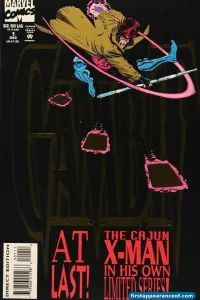
  3. Gambit #1 cover
    First Solo Title December 1993 Newsstand variant

    Gambit #1

    By Howard Mackie, Lee Weeks

    First Gambit solo limited series. Four-issue mini by Howard Mackie and Lee Weeks. Explores the character's pre-X-Men Thieves Guild and Marauders backstory.

    Read the full breakdown

Creation Story

Gambit was built by Chris Claremont across two 1990 issues. The cameo in Uncanny X-Men Annual #14 (July 1990) was a sketch of a character Claremont had been developing internally for some time: a Cajun thief with kinetic-energy powers who would eventually become an X-Men recruit. Art Adams drew the Annual; the cameo is brief and deliberately obscure, positioned as a teaser for the full introduction the following month.

Uncanny X-Men #266 (August 1990) is the full debut. Mike Collins pencils. Gambit meets a de-aged, amnesiac Storm (trapped in child-form during the Siege Perilous arc) and guides her through New Orleans as she searches for her lost memories. The issue establishes his name, his powers, his Thieves Guild backstory, and his morally ambiguous relationship with the X-Men. Rogue appears later in the arc, setting up the thirty-year romantic subplot that became a defining piece of both characters’ stories.

Jim Lee’s 1991 X-Men #1 relaunch redesigned Gambit’s costume, adding the pink-and-purple color accents that became his permanent visual identity. The character was commercially central to the Lee-era X-Men run and to the 1992 animated series that brought him to mass-market audiences.

The Trial of Gambit

Uncanny X-Men #350 (December 1997) is the defining Gambit character moment. Scott Lobdell scripts; Joe Madureira pencils. The issue reveals that Gambit, as a young Thieves Guild operative, had guided the Marauders to the Morlock tunnels in exchange for Mr. Sinister’s help with his kinetic-energy powers. The Mutant Massacre that followed killed hundreds of Morlocks in the 1986 Uncanny X-Men storyline of the same name; Gambit’s complicity was secret for eleven years of publishing until the Trial arc canonized it.

The reveal is one of the most consequential backstory moves Marvel has made on an active X-Men character. Gambit’s morally ambiguous framing runs across every subsequent arc. His relationship with Rogue, the X-Men leadership, and his own self-regard are all shaped by the Morlock guilt.

The Rogue marriage

Mr. and Mrs. X #1 (August 2018) formalized the Rogue-Gambit romance that had been subtextual across decades. Kelly Thompson writes, Oscar Bazaldua pencils, and the limited series treats the marriage as canonical. Modern continuity carries the relationship forward; the couple is now one of Marvel’s most established married pairings.

Collector context

Uncanny X-Men #266 is the defining Gambit key. High-grade CGC 9.8 copies have crossed $1,000 at auction; newsstand variants carry significant premiums. Prices moved with Taylor Kitsch’s 2009 film appearance and spiked again with the 2024 X-Men 97 animated revival.

Uncanny X-Men Annual #14 is the cameo-first key and a cheaper entry for collectors who want the earliest Gambit appearance. Gambit #1 (1993) is the first solo title. X-Men #1 (1991) is the Jim Lee flagship; Gambit’s redesigned costume is the version most fans know.
Key subsequent appearances

After the debut, these are the issues collectors and historians reach for next.

  1. 1990

    Uncanny X-Men Annual #14

    First cameo.

  2. 1990

    Uncanny X-Men #266

    First full appearance and first cover.

    Newsstand variant
  3. 1991

    X-Men #1 (1991)

    Jim Lee's flagship relaunch. Gambit is a core team member. Lee redesigns the costume with the pink-and-purple accents that become the permanent visual identity. Record print run (over eight million across variants).

    Newsstand variant
  4. 1997

    Uncanny X-Men #350

    Trial of Gambit

    Scott Lobdell and Joe Madureira reveal Gambit's connection to the Marauders and the Morlock Massacre. Trial-of-Gambit arc is the defining dark-backstory reveal.

  5. 2018

    Mr. and Mrs. X #1

    Rogue-Gambit Wedding

    Kelly Thompson writes; Oscar Bazaldua pencils. Rogue and Gambit marry. Caps a thirty-year romantic subplot that started with Uncanny X-Men #266.

In adaptations

Film, TV, animation, and game appearances.

  1. 1992

    X-Men: The Animated Series

    Animated

    Starring:Chris Potter (seasons 1-4), Tony Daniels (season 5)

    Fox Kids Saturday morning series. The animated Gambit's Cajun accent and charged-card visual are the reference version for most audiences.

  2. 2009

    X-Men Origins: Wolverine

    Film

    Starring:Taylor Kitsch

    Gavin Hood directs. Kitsch's Gambit is a supporting role. A standalone Gambit film was repeatedly developed through the 2010s but never produced.

  3. 2024

    X-Men 97

    Animated

    Starring:Tony Daniels, A.J. LoCascio

    Disney+ revival of the 1990s animated series. Daniels returns for one episode; LoCascio takes over as the voice for most of the season. Gambit's storyline is the emotional centerpiece of season one.

Frequently asked questions

The questions readers and collectors ask most.

What is Gambit's first appearance?

Gambit has a layered debut. His first cameo is Uncanny X-Men Annual #14 (July 1990). His first full appearance, first cover, and first named identification is Uncanny X-Men #266 (August 1990). Collectors treat both as relevant keys. The Annual is the technical first; #266 is the defining collectible.

Is Uncanny X-Men #266 valuable?

Yes. Uncanny X-Men #266 is a modern-era Marvel key and one of the most traded Gambit books. High-grade copies (CGC 9.8) have crossed $1,000 at auction. Newsstand variants carry a meaningful premium. The book's value spiked after Taylor Kitsch's film appearance in 2009 and again with the 2024 X-Men 97 animated season one.

Who created Gambit?

Chris Claremont is the primary creative force as writer. Art Adams drew the Annual cameo. Mike Collins drew Uncanny X-Men #266. Jim Lee redesigned the costume in the 1991 X-Men relaunch, adding the pink-and-purple color accents that became permanent. Modern Marvel credits Claremont and Lee as co-creators, with Adams and Collins acknowledged for the initial debut art.

What are Gambit's powers?

Remy LeBeau can charge any inanimate object with kinetic energy that explodes on contact. His signature weapon is playing cards, which he charges and throws with precision. He also has hypnotic 'charm' abilities (the power to influence others' emotional states) that Claremont added later in the character's arc, and uses a bo staff in close combat. He is a trained thief and spy.

Is Gambit really in the Marauders?

Historically yes. The Trial of Gambit arc (Uncanny X-Men #350, December 1997) revealed that Gambit, as a young Thieves Guild operative, guided the Marauders to the Morlock tunnels in exchange for Sinister's help with his own powers. The Mutant Massacre that resulted is one of the most consequential events in 1980s X-Men continuity. Gambit's role as the guide has been a recurring moral weight on the character for decades.