Creation Story
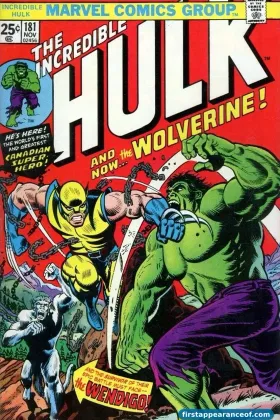
Len Wein and Dave Cockrum built the new X-Men team in 1974 and 1975 as an international roster of seven new mutants. Storm was the African-Egyptian mutant. Nightcrawler was the German. Colossus was the Russian. Banshee was the Irishman. Sunfire was the Japanese. Wolverine was the Canadian carryover from Hulk #181. Thunderbird was the Apache. The geographic spread was the entire premise: the X-Men had been an all-American team for ten years and the relaunch needed to feel like a different book.
The death of Thunderbird two issues into the Claremont run was foreshadowed and editorial. Wein and Claremont both knew the team was too crowded for sustained character development. Claremont, in interviews and convention panels over the years, has said he chose Thunderbird specifically because the character’s combat profile (super-strength, fast healing, brawler temperament) overlapped most closely with Wolverine’s, and Wolverine was the character editorial wanted to develop further. Killing Thunderbird made room for Wolverine.
The death has stayed. Thunderbird is the X-Men’s most-cited example of a mutant death that has not been reversed in 616 continuity. The discipline is unusual for Marvel, where most major character deaths get walked back within five years. Thunderbird has stayed dead for fifty. He has appeared in alternate realities, ghost-form cameos, and afterlife sequences (the Necrosha event resurrected him briefly in 2009 before returning him to dead status), but the canonical 616 Thunderbird remains dead, which gives the X-Men franchise a small but real claim that consequence in their books is meaningful.
His brother James Proudstar took the Thunderbird name briefly in New Mutants #16 (1984) under Chris Claremont and Sal Buscema. James later abandoned the name and became Warpath, a character who has had the longer career across X-Force and other X-Men teams from 1991 to the present. The Thunderbird mantle has been picked up periodically by alternate characters but has never settled on a permanent post-John holder.
The character has not appeared in live-action film or television. The X-Men film series under Fox skipped him entirely. The MCU’s eventual X-Men launch will face the question of whether to include Thunderbird in the team’s first cinematic lineup; if they do, the character will get his first major adaptation fifty years after his comic debut.
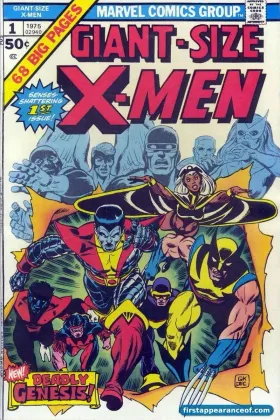
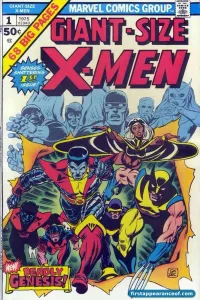
Cockrum’s costume design has aged well. The red-and-yellow color scheme reads as warm. The eagle-feather chest motif is identifiable across artists. The strap details around the shoulders give the figure a martial-arts-meets-tribal aesthetic that distinguishes him from the rest of the new X-Men team. Most collector memory of Thunderbird is the cover of GSX #1, where Cockrum drew him in profile alongside the rest of the new lineup. That single image has done most of the character’s heavy lifting for fifty years.
First Appearance and First Cover: Giant-Size X-Men #1
The book hit stands in February 1975 with a May 1975 cover date. 64 pages, the first oversized X-Men issue. Cover price was 50 cents. The cover is Dave Cockrum, with the new X-Men bursting through what looks like a banner showing the original team. Thunderbird is in the upper right of the new-team layer of the cover, identifiable by the red-yellow costume and his determined expression. Wolverine is in the lower-left corner of the same layer, popping his claws.
Print run was unusually large for a 1975 Marvel anniversary book. The franchise had been struggling (the original X-Men title had been a reprint book since 1970) and Marvel printed GSX #1 in higher-than-usual quantities to support the relaunch. Survival in high grade is reasonable but the print quality of 1970s Marvel paper makes pristine copies relatively rare. CGC 9.6 and above is a few hundred census copies; 9.8 is in the low double digits.
Inside the issue, Thunderbird is recruited by Charles Xavier on an Arizona reservation. He resists initially. Xavier’s pitch (the original X-Men are missing on Krakoa, the new team is the rescue mission) gets him in. The seven new X-Men go to Krakoa, find the original team, free them, defeat Krakoa as a sentient threat. Thunderbird’s role in the action is supporting; he is one of seven new characters who needed introduction in 64 pages, and the book gives each of them a short solo introduction sequence before the team forms.
For pricing, GSX #1 is a top-tier Bronze Age key driven mostly by the Storm and Nightcrawler debuts. CGC 9.6 trades in the high five figures; 9.8 is six figures. Thunderbird’s debut is folded into the book’s overall value with no separable premium. The two follow-up issues (X-Men #94 for first regular-series appearance, X-Men #95 for the death) are recognized Bronze Age keys that trade in the four-to-five figure range at high grade. The character’s collector profile is built almost entirely on those three issues.