Creation Story
Daredevil is a Stan Lee creation finished by a Golden Age artist whose career predated Marvel itself. Bill Everett, who had co-created Namor the Sub-Mariner in 1939 for Marvel’s predecessor Timely Comics, was brought in as the artist on Daredevil #1. Everett’s career was already 25 years old by 1964. The character design (yellow, red, and black costume; horns on the cowl; ornate double-D chest emblem) was his. Stan Lee plotted and scripted the issue, as was his standard practice in the era. Jack Kirby is credited with cover pencils and with some input on the initial costume and concept, particularly the chest emblem and the overall “devil” framing, though the degree of Kirby’s contribution to the final character is unresolved and depends on which interview you read.
The high concept was a Stan Lee favorite: a character with a disability who turns the disability into an advantage. Matt Murdock is blinded as a child in a radioactive-waste accident, but the same accident heightens his four remaining senses to superhuman levels. He gains radar sense, echolocation, and enhanced hearing, smell, and touch. The “handicap becomes superpower” concept had been used in earlier Marvel characters (the Thing’s monstrous appearance, Thor’s mortal Donald Blake identity), but Daredevil made it structurally central: the character’s entire modus operandi depends on being blind.
Matt Murdock’s dual life as a lawyer by day and costumed vigilante by night is a direct inversion of the usual superhero framing. Where most superheroes take the law into their own hands, Daredevil’s day job is the law. The tension between Matt-the-attorney (who defends clients through the legal system) and Daredevil-the-vigilante (who punishes criminals outside the legal system) is the character’s defining internal conflict. Every subsequent writer has leaned on this tension; the Frank Miller 1981-1983 run made it the structural backbone of the book.
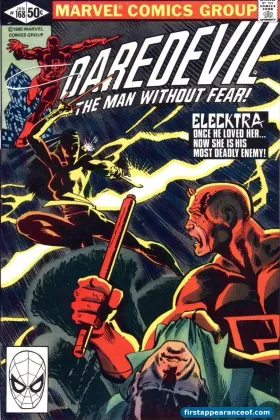
Bill Everett left the title after Daredevil #1 due to health and deadline issues. The book rotated pencillers (Joe Orlando, Wally Wood, Gene Colan) through its first 50 issues before settling into longer creative runs. Wally Wood redesigned the costume to its iconic all-red form in #7; Gene Colan defined the character’s visual vocabulary through a long 1960s-1970s run. The character was a second-tier Marvel property for most of its first 15 years until Frank Miller took over.
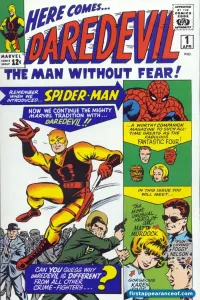
First Appearance, First Cover, First Solo Title, and Origin: Daredevil #1
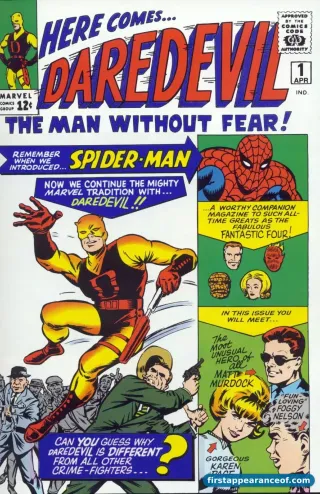
Daredevil #1 is cover-dated April 1964 and was on newsstands in February 1964. The book is 24 pages of story at 12 cents. Writer: Stan Lee. Penciller: Bill Everett, with additional pencils from Jack Kirby on the cover. Inks by Sol Brodsky and Steve Ditko on different pages (Marvel had a rotating inker system at the time). The cover features Daredevil mid-leap across a yellow background, horns visible, yellow-and-red costume prominent.
The story is the complete origin. Matt Murdock is a Hell’s Kitchen boy raised by his widowed father Jack “Battlin’ Jack” Murdock, a washed-up boxer. Jack insists Matt study instead of fight, not realizing Matt has been secretly training in both. On his way home from the library one day, Matt pushes a blind man out of the path of a runaway truck carrying radioactive waste. The truck crashes; radioactive material hits Matt in the face, blinding him. Over the following weeks, he discovers his remaining senses are heightened to superhuman levels: he can hear a heartbeat from across a room, smell traces of tobacco or perfume from hours earlier, and navigate three-dimensional space through a radar-like extension of his heightened hearing. Matt enrolls at Columbia Law School, becomes a lawyer, and joins his best friend Foggy Nelson in founding the Nelson & Murdock law firm. Karen Page, the firm’s secretary, becomes Matt’s first major love interest.
Jack Murdock refuses to throw a fight fixed by crime boss The Fixer. The Fixer has Jack killed. Matt, unable to pursue justice through the law without breaking his secret identity, builds a red-and-yellow costume with horns, calls himself Daredevil, and hunts the Fixer down. The first issue ends with the Fixer’s associates dead, the Fixer himself killed by his own heart attack during the chase, and Matt Murdock beginning his double life as a lawyer-by-day, vigilante-by-night.
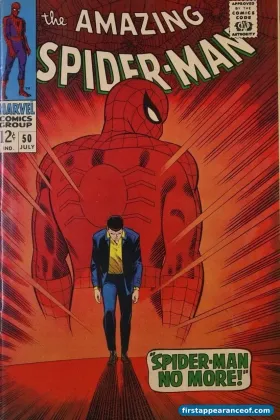
Four character debuts in one issue: Matt Murdock (Daredevil), Foggy Nelson, Karen Page, and the Fixer. The Owl (Leland Owlsley) debuts two issues later in #3 as the first recurring supervillain. Wilson Fisk (the Kingpin) would not appear in Daredevil continuity until much later; he had been a Spider-Man villain in Amazing Spider-Man #50 (1967) before being adopted into Daredevil continuity by Frank Miller in 1981.
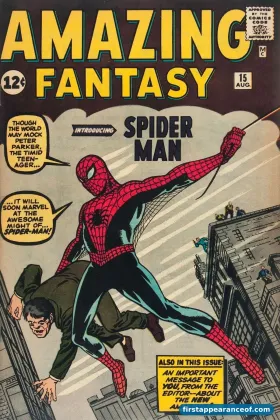
Collector significance is at the highest Silver Age Marvel tier. Daredevil #1 is one of the three defining Marvel Silver Age keys alongside Amazing Fantasy #15 (Spider-Man) and X-Men #1, and it is the only one of those three to carry a quad-fecta claim (first appearance, first cover, first solo title, and origin in a single issue). CGC census data shows approximately 2,750 total graded copies of Daredevil #1 across all grades, with fewer than 100 in grades 9.4 and above. A CGC 9.2 copy sold at Heritage Auctions in 2022 for $240,000. The appreciation curve has tracked the character’s Netflix and Disney+ adaptation cycle closely, with measurable upticks tied to the 2015 Netflix launch and the 2025 Born Again series launch.