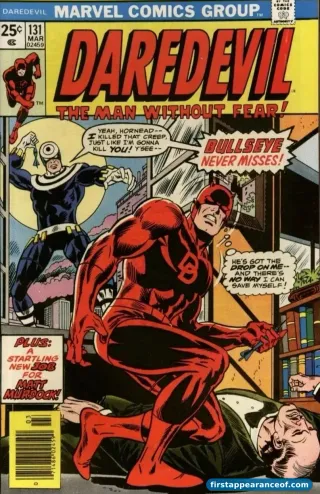
Daredevil #131 (1976). Bullseye debuts. Marv Wolfman writes; John Romita Sr. provides cover art.

1st Appearance and 1st Cover

First Appearance of Bullseye

Daredevil #131

March 1976 · Marvel · Bronze Age

Marv Wolfman's contract assassin with perfect aim. The Daredevil rogue who killed Elektra, joined the Kingpin's stable, and got Colin Farrell's 2003 cameo before Wilson Bethel's much-better Netflix Daredevil portrayal.

Key Issue

Created by Marv Wolfman · John Romita Sr.

By Atomm Updated

The first appearance (1st app) of Bullseye is Daredevil #131 (March 1976), created by Marv Wolfman (writer) and John Romita Sr. (cover) with interior art by Bob Brown. The issue is both his first appearance and first cover. Bullseye debuts as a contract assassin with the canonical ability to make a deadly weapon out of any object. The framework that defines the character across fifty years (unfailing aim, targeted-precision combat, murderous register) is essentially complete in the debut. Frank Miller's subsequent Daredevil run elevated the character to one of the property's defining antagonists.

Quick Facts

Debut
Daredevil #131 (March 1976)
Real name
Lester (canonical first name; surname unrevealed in mainstream continuity)
Creators
Marv Wolfman (writer, co-creator), John Romita Sr. and Bob Brown (artists, co-creators)
Publisher
Marvel Comics
First enemy
Antagonist himself.
First ally
The Kingpin (his most-recurring employer); Norman Osborn (during Dark Reign as Hawkeye)
Team affiliations
Dark Avengers (briefly, as Hawkeye), Thunderbolts (briefly)

First Appearance

  1. Daredevil #131 cover
    First Appearance First Cover March 1976

    Daredevil #131

    By Marv Wolfman, John Romita Sr., Bob Brown

    Marv Wolfman writes; Bob Brown pencils interior; John Romita Sr. provides cover art. Bullseye debuts as a contract assassin with the canonical ability to make a deadly weapon out of any object. The framework that defines the character across fifty years is essentially complete in the debut: the unfailing aim, the targeted-precision combat, the murderous register that distinguished him from typical Bronze Age antagonists.

    Read the full breakdown

Creation Story

Bullseye is Marv Wolfman, John Romita Sr., and Bob Brown’s Bronze Age Daredevil addition. Daredevil #131 (March 1976) introduces him as a contract assassin with the canonical ability to make a deadly weapon out of any object. Wolfman writes; Brown pencils interior; Romita Sr. provides cover art. The issue is both his first appearance and first cover.

The framework that defines the character across fifty years is essentially complete in the debut. Bullseye’s signature traits — the unfailing aim, the willingness to use any object as a deadly projectile, the murderous register that distinguished him from typical Bronze Age gimmick antagonists — are all present in the first appearance. The character was structurally a recurring B-tier Daredevil rogue across his initial post-debut years.

The Frank Miller elevation

Frank Miller’s Daredevil run (1979 to 1983, then again 1986 with Born Again) elevated Bullseye from B-tier rogue to top-tier Daredevil antagonist. The transformation centers on Daredevil #181 (April 1982), in which Miller (writing and pencilling) had Bullseye kill Elektra by impaling her with her own sai. The single-page sequence is widely regarded as one of the strongest individual moments in modern Marvel storytelling.

The Elektra death reframed Bullseye permanently. The character’s psychology shifted from generic-assassin-with-perfect-aim to a more developed murderous-obsessive register; subsequent Daredevil writers preserved the Miller framework. Daredevil #200 (November 1983) capped the post-Elektra Bullseye-Daredevil rivalry framework with an extended anniversary issue.

The Dark Reign era

Dark Avengers #1 (March 2009) by Brian Michael Bendis and Mike Deodato Jr. had Bullseye operate as the Dark Avengers’ Hawkeye during Norman Osborn’s Dark Reign era. The arc is widely regarded as one of the strongest extended Bullseye character work outside the Frank Miller run. The Hawkeye-as-Bullseye framework was eventually unwound when Norman Osborn’s Dark Reign concluded.

Adaptations

Colin Farrell’s Bullseye in Daredevil (2003, Mark Steven Johnson) is widely regarded as a comedic-overplayed performance that didn’t capture the comics character. The film’s broader reception was mixed; Bullseye’s portrayal is one of the most-criticized elements.

Wilson Bethel’s Bullseye in Marvel’s Daredevil (Netflix, season three, 2018) is widely regarded as the definitive screen interpretation. The Netflix character framework adapts directly from the comics’ Lester / Benjamin Poindexter framework and provided the character’s most-developed sustained screen treatment.

Collector context

Daredevil #131 is the Bullseye Bronze Age first-appearance key. High-grade CGC 9.8 copies have crossed $1,500 at auction. The book’s value tracks with Daredevil adaptation cycles.

Secondary keys: Daredevil #181 (April 1982, Death of Elektra). Daredevil #200 (November 1983, anniversary issue). Dark Avengers #1 (March 2009, Dark Reign Hawkeye).
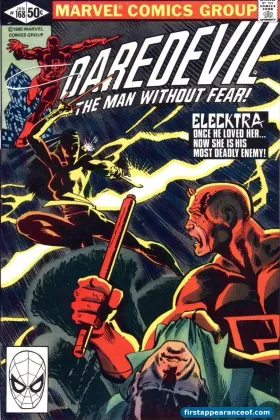
Key subsequent appearances

After the debut, these are the issues collectors and historians reach for next.

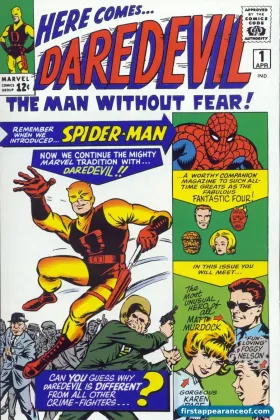
  1. 1976

    Daredevil #131

    First appearance and first cover.

  2. 1982

    Daredevil #181

    Death of Elektra

    Frank Miller writes and pencils. Bullseye kills Elektra in the climactic single-page sequence widely regarded as one of the strongest individual moments in modern Marvel storytelling. The arc reframed Bullseye as a top-tier Daredevil antagonist.

  3. 1983

    Daredevil #200

    Anniversary Issue

    Denny O'Neil and William Johnson. Anniversary issue with substantial Bullseye material. Caps the post-Elektra Bullseye-Daredevil rivalry framework.

  4. 2009

    Dark Avengers #1

    Dark Reign Hawkeye

    Brian Michael Bendis writes; Mike Deodato Jr. pencils. Bullseye operates as the Dark Avengers' Hawkeye during Norman Osborn's Dark Reign era. The arc is widely regarded as one of the strongest extended Bullseye character work outside the Frank Miller run.

In adaptations

Film, TV, animation, and game appearances.

  1. 2003

    Daredevil

    Film

    Starring:Colin Farrell

    Mark Steven Johnson directs. Farrell's Bullseye is widely regarded as a comedic-overplayed performance that didn't capture the comics character. The film's broader critical and commercial reception was mixed; Bullseye's portrayal is one of the most-criticized elements.

  2. 2018

    Marvel's Daredevil

    TV

    Starring:Wilson Bethel

    Netflix Marvel Television series. Bethel plays Benjamin Poindexter / Dex / Bullseye across season three. Widely regarded as the definitive screen interpretation. The Netflix character framework adapts directly from the comics' Lester/Poindexter framework.

Frequently asked questions

The questions readers and collectors ask most.

What is Bullseye's first appearance?

Bullseye's first appearance is Daredevil #131 (March 1976), created by Marv Wolfman (writer) and John Romita Sr. (cover) with interior art by Bob Brown. The issue is both his first appearance and first cover. Bullseye debuts as a contract assassin with the canonical ability to make a deadly weapon out of any object.

Is Daredevil #131 valuable?

Yes. Daredevil #131 is a Bronze Age Marvel key with strong adaptation-driven collector demand. High-grade copies (CGC 9.8) have crossed $1,500 at auction. The book's value tracks with Daredevil adaptation cycles, particularly the Frank Miller run reprints, the 2003 film, and the Netflix Marvel Television series.

Did Bullseye really kill Elektra?

Yes. Daredevil #181 (April 1982), written and pencilled by Frank Miller, contains the climactic single-page sequence in which Bullseye kills Elektra by impaling her with her own sai. The death is widely regarded as one of the strongest individual moments in modern Marvel storytelling. The arc reframed Bullseye as a top-tier Daredevil antagonist (he had been a recurring B-tier rogue prior to the Miller run). Elektra has been resurrected multiple times in subsequent decades, but the original 1982 death held in canon for years.

What is Bullseye's real name?

Canonically just 'Lester.' The character has been associated with various surnames across continuities (Benjamin Poindexter is the most-cited alternative, particularly in the Netflix Daredevil adaptation), but mainstream Marvel continuity has consistently kept his full name unrevealed. The framework is deliberate: Bullseye's identity as a man without ordinary connections (no family, no canonical surname, no established backstory) is part of his character architecture.

Was Bullseye really Hawkeye in the Dark Avengers?

Yes. Brian Michael Bendis's Dark Avengers #1 (March 2009) had Norman Osborn assemble the Dark Avengers as a public-facing replacement for the disbanded mainstream Avengers. Bullseye operated as the team's Hawkeye, wearing a Hawkeye costume. The arc is widely regarded as one of the strongest extended Bullseye character work outside the Frank Miller run. The Hawkeye-as-Bullseye framework was eventually unwound when Norman Osborn's Dark Reign concluded.