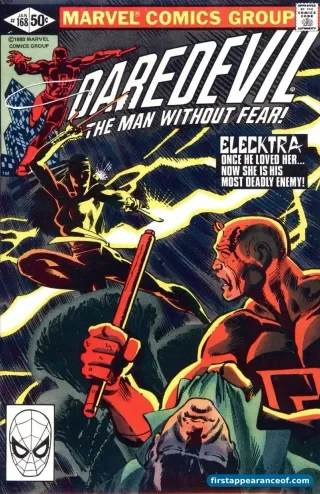
Elektra on the cover of Daredevil #168 (on sale 1981, cover-dated January 1982), her first appearance and first cover.

1st Appearance and 1st Cover

First Appearance of Elektra

Daredevil #168

1981 · Marvel · Copper Age

Frank Miller's ninja assassin, Matt Murdock's old flame, and the Marvel character whose death and resurrection rewrote what supporting characters could do in 1982.

Key Issue

Created by Frank Miller

By Atomm Updated

The first appearance (1st app) of Elektra is Daredevil #168, which went on sale in late 1981 with a January 1982 cover date (you will see both years cited). Created solo by Frank Miller, the issue is both her first appearance and first cover. Miller writes and pencils. Elektra debuts as Matt Murdock's former college lover, now a ninja assassin working for the Hand. She is killed by Bullseye in Daredevil #181 (1982) but returns to life in subsequent arcs. Her first solo title is Elektra: Assassin #1 (1986).

Quick Facts

Debut
Daredevil #168 (on sale 1981, cover-dated January 1982)
Real name
Elektra Natchios
Creators
Frank Miller (writer and artist, solo creator)
Publisher
Marvel Comics
First enemy
Bullseye (her defining antagonist; kills her in Daredevil #181, 1982)
First ally
Matt Murdock (Daredevil; her college lover and complicated romantic counterpart)
Team affiliations
The Hand (origin), S.H.I.E.L.D. (briefly), Thunderbolts (briefly)

Firsts Timeline

  1. Daredevil #168 cover
    First Appearance First Cover 1981

    Daredevil #168

    By Frank Miller

    Frank Miller writes and pencils. Elektra debuts as Matt Murdock's former college lover, returned years later as a ninja assassin working for the Hand. The issue is both her first appearance and first cover, and Miller's first solo issue as writer-penciller on Daredevil. Note the date: the book went on sale in late 1981 but carries a January 1982 cover date, so you will see both years cited.

    Read the full breakdown
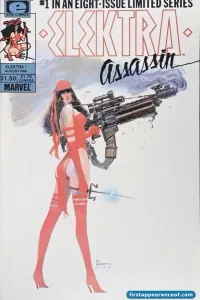
  2. Elektra: Assassin #1 cover
    First Solo Title August 1986

    Elektra: Assassin #1

    By Frank Miller, Bill Sienkiewicz

    Eight-issue limited series. Frank Miller writes; Bill Sienkiewicz pencils. The book is drawn in a deliberately experimental style and is one of the most visually ambitious Marvel projects of the 1980s.

    Read the full breakdown

Creation Story

Elektra is Frank Miller’s character in the most complete sense: he wrote and drew her debut, solo-wrote her first limited series, and controlled her development across more than fifteen years of Marvel work. Daredevil #168 (January 1982) is Miller’s first solo issue as writer-penciller on the Daredevil ongoing; he had been pencilling the book under writer Roger McKenzie for three years before the editorial team gave him full creative control.

The debut issue is structurally a Matt Murdock flashback. Matt recognizes Elektra in present-day New York, and the issue flashes back to their college relationship: her father is killed in a political incident, she disappears, and she resurfaces as a ninja assassin trained by the Hand. Miller’s design (red ninja costume, sai weapons, a mix of Japanese-martial-arts visual grammar and classical-Greek framing via Elektra’s family name) established the complete character in one issue.

The Miller run that followed took Daredevil into harder, noir-inflected territory than any Marvel superhero book had previously operated in. Elektra was central. Daredevil #181 (April 1982) killed her in one of the most-reproduced death sequences of the Bronze Age: Bullseye impales Elektra on one of her own sai. The death had editorial weight at the time; Marvel was committed to it as permanent. Readers wrote in. Miller himself has said he considered the death definitive.

The resurrection and what it did

Daredevil #190 (January 1983) resurrected Elektra. The Hand performs mystical rites and restores her. The resurrection arc was forced partly by editorial pressure and partly by Miller’s own narrative interest in the mystical-martial-arts framing. Miller has publicly expressed regret about the resurrection, saying the death should have stayed permanent to preserve its narrative weight.

The resurrection nonetheless set a template: Elektra’s relationship to death is explicitly cyclical. She dies and returns across decades of subsequent comics. Modern writers treat the death-and-resurrection pattern as a character feature rather than a continuity violation.

Elektra: Assassin

Elektra: Assassin (1986 to 1987) is Miller’s second major Elektra work, a creator-driven eight-issue limited series with Bill Sienkiewicz on art. Sienkiewicz’s painted-and-mixed-media approach is deliberately experimental: photo-collage pages, painted panels, unconventional layouts that break traditional comics grammar. The story is a political thriller; Elektra is an assassin trying to prevent a Manchurian-Candidate-style presidential hijacking.

The book is widely regarded as one of the most visually ambitious Marvel projects of the 1980s. It is a required reference point for any serious Elektra reader and a foundational text for later experimental Marvel publishing (Daredevil: Born Again, Hellboy’s tonal descendants, the Vertigo imprint’s aesthetic debt to Sienkiewicz).

Collector context

Daredevil #168 is the Elektra key and a Copper Age Marvel book with compounded value (first Elektra + start of Miller’s solo Daredevil run). High-grade CGC 9.8 copies have crossed $5,000 at auction.

Daredevil #181 (Elektra’s death) is a secondary Copper Age key and one of the most-traded Miller-era Daredevil issues. Elektra: Assassin #1 (1986) is the first solo title and a Sienkiewicz-era collector target.
Key subsequent appearances

After the debut, these are the issues collectors and historians reach for next.

  1. 1981

    Daredevil #168

    First appearance and first cover (on sale 1981, cover-dated January 1982).

  2. 1982

    Daredevil #181

    Death

    Bullseye kills Elektra. One of the most-reproduced death sequences in Bronze Age Marvel. Foundational for Miller's Daredevil run.

  3. 1983

    Daredevil #190

    Resurrection

    Elektra is resurrected by the Hand. Complicated return that becomes a recurring Daredevil subplot.

  4. 1986

    Elektra: Assassin #1

    First solo limited series. Miller and Sienkiewicz.

  5. 2001

    Elektra #1 (2001)

    Brian Michael Bendis and Chuck Austen's ongoing. Eight-issue run.

  6. 2011

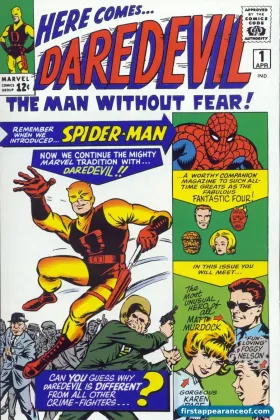
    Daredevil #1 (2011)

    Waid Era

    Mark Waid and Marcos Martin's relaunch. Elektra in supporting role across Waid's forty-issue run.

In adaptations

Film, TV, animation, and game appearances.

  1. 2003

    Daredevil

    Film

    Starring:Jennifer Garner

    Mark Steven Johnson directs. Garner's Elektra is a supporting character. The performance launched her spin-off solo film.

  2. 2005

    Elektra

    Film

    Starring:Jennifer Garner

    Rob Bowman directs. Spin-off solo film. Commercial and critical failure.

  3. 2016

    Daredevil

    TV

    Starring:Elodie Yung

    Netflix/Marvel series season 2. Yung's Elektra is widely regarded as the season's strongest supporting performance and the most faithful screen adaptation of the character.

  4. 2024

    Deadpool & Wolverine

    Film

    Starring:Jennifer Garner

    Shawn Levy directs. Garner returns to the role twenty years after her first appearance. MCU debut.

Frequently asked questions

The questions readers and collectors ask most.

What is Elektra's first appearance?

Elektra's first appearance is Daredevil #168, which went on sale in late 1981 carrying a January 1982 cover date, which is why you will see the book cited as both 1981 and 1982. It was created solo by Frank Miller as writer and penciller. The issue is also her first cover and Miller's first solo issue as writer-penciller on the Daredevil ongoing. Before #168, Miller had been pencilling the book under writer Roger McKenzie since Daredevil #158.

Is Daredevil #168 valuable?

Yes. Daredevil #168 is one of the most important Copper Age Marvel keys. High-grade copies (CGC 9.0 and above) have crossed $5,000 at auction. The book's value has accelerated steadily since the 1990s because it is both the first Elektra and the beginning of Miller's solo Daredevil run (which produced the Elektra death arc, the Kingpin repositioning, and the Born Again arc).

Who created Elektra?

Frank Miller, solo. Miller had been pencilling Daredevil for three years under writer Roger McKenzie and took over as writer with Daredevil #168. Elektra is entirely his design: the name, the red ninja costume with the sash and sai weapons, the backstory as Matt Murdock's college lover, and the Hand-assassin framing. Miller credited his interest in Japanese ninja films and manga as visual influences.

Did Elektra really die?

Yes, and she came back. Bullseye kills Elektra in Daredevil #181 (April 1982) by impaling her on one of her own sai. The death sequence is one of the most-reproduced in Bronze Age Marvel. She was resurrected by the Hand in Daredevil #190 (January 1983) through mystical rites. The resurrection was controversial at the time because it undermined the weight of her death, and Miller himself has expressed regret about the return. Later writers have killed and resurrected Elektra multiple times; the character's relationship to death is explicitly cyclical in modern continuity.

Why is Elektra: Assassin significant?

Elektra: Assassin (August 1986 to March 1987) is an eight-issue limited series by Frank Miller and Bill Sienkiewicz. Miller scripts; Sienkiewicz pencils in a deliberately experimental mixed-media style (photo-collage, painted pages, unconventional panel layouts). The book is one of the most visually ambitious Marvel projects of the 1980s and is often cited as an early example of what Marvel was willing to publish when given creator-driven latitude. The story is a political thriller with Elektra as an assassin trying to prevent a presidential assassination.