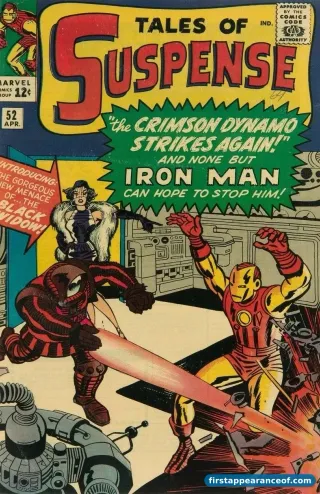
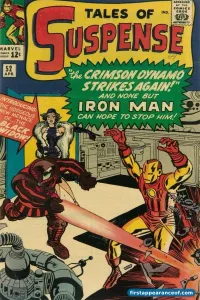
Black Widow on the cover of Tales of Suspense #52 (1964), her first appearance.

1st Appearance

First Appearance of Black Widow

Tales of Suspense #52

April 1964 · Marvel · Silver Age

The Soviet spy who defected, the Avenger who stayed, and the Marvel superhero who spent six years out of costume before Romita Sr. gave her one.

Key Issue

Created by Stan Lee · Don Rico · Don Heck

By Atomm Updated

The first appearance (1st app) of Black Widow is Tales of Suspense #52 (April 1964), created by Stan Lee, Don Rico, and Don Heck. Natasha Romanova debuts as a Soviet spy in civilian attire without superhero framing. Her first appearance in costume (the black outfit with the hourglass insignia) is The Amazing Spider-Man #86 (July 1970), designed by John Romita Sr. Her first solo title is Black Widow #1 (June 1999) by Devin Grayson and J.G. Jones.

Quick Facts

Debut
Tales of Suspense #52 (April 1964) as Soviet spy. Amazing Spider-Man #86 (July 1970) in costume.
Real name
Natalia Alianovna Romanova
Creators
Stan Lee (plot), Don Rico (script), Don Heck (art). Costume redesign by John Romita Sr. (ASM #86, 1970).
Publisher
Marvel Comics
First enemy
Iron Man (her initial antagonist in the Tales of Suspense debut)
First ally
Hawkeye (her recurring partner, first introduced as a villain she recruited)
Team affiliations
Avengers (long-serving), S.H.I.E.L.D., Champions (classic), Thunderbolts, Red Room (origin)

Firsts Timeline

  1. Tales of Suspense #52 cover
    First Appearance April 1964

    Tales of Suspense #52

    By Stan Lee, Don Rico, Don Heck

    Natasha Romanova debuts as a Soviet spy in civilian attire, without the costume or superhero framing. Don Rico writes; Don Heck pencils. She is introduced as an Iron Man antagonist.

    Read the full breakdown
  2. First Appearance in Costume July 1970

    The Amazing Spider-Man #86

    By Stan Lee, John Romita Sr., Gil Kane

    Black Widow debuts her now-iconic black costume with the hourglass insignia. John Romita Sr. designs the visual. The redesign pivots the character from spy antagonist to superhero-adjacent operator.

    Read the full breakdown
  3. First Solo Title June 1999

    Black Widow #1

    By Devin Grayson, J.G. Jones

    First Black Widow self-titled limited series. Devin Grayson writes; J.G. Jones pencils. Three-issue mini-series.

    Read the full breakdown

Creation Story

Black Widow was built as an Iron Man antagonist for the Tales of Suspense anthology. Stan Lee plotted, Don Rico scripted, and Don Heck pencilled Tales of Suspense #52 (April 1964). Natasha Romanova debuts as a Soviet spy sent to attack Iron Man’s weapons work for Stark Industries. She is in civilian attire (an evening gown, a spy-appropriate dress), has no superhero framing, and is explicitly positioned as a Cold War antagonist.

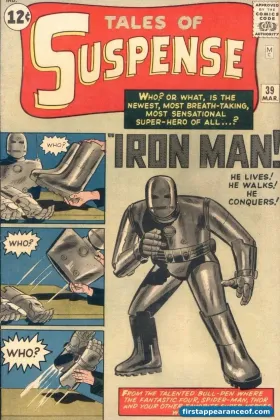
The character worked as a recurring Iron Man foil for several years. Tales of Suspense #57 (September 1964) introduced Hawkeye (Clint Barton) as a second antagonist she recruits. The two characters would eventually become partners, initially as antagonists and later as allies, establishing one of Marvel’s longest-running team-up pairings.

Natasha’s pivot from antagonist to Avengers-adjacent hero happened across the late 1960s. She defected from the Soviet Union in the comics narrative, worked with S.H.I.E.L.D., and joined the Avengers-orbit as a supporting figure. John Romita Sr. redesigned her visually in The Amazing Spider-Man #86 (July 1970), introducing the black catsuit with the hourglass insignia that became her permanent costume. The redesign pivoted the character from civilian-spy aesthetic to superhero-adjacent operator.

The MCU era

Scarlett Johansson’s Black Widow debuted in Iron Man 2 (2010) and continued across twelve years of MCU appearances, from Iron Man 2 through Avengers: Endgame (2019) and the posthumously-released Black Widow solo film (2021). The performance reset the character’s cultural visibility at scale. Before Johansson, Black Widow was a Marvel supporting character with a niche collector base. After Johansson, she was a flagship Marvel hero.

The MCU’s framing drew primarily from the post-2000s comics (Paul Cornell, Marjorie Liu, Nathan Edmondson) rather than from the 1964 Tales of Suspense debut. The modern Marvel Comics Black Widow is closer to Johansson’s cinematic version than to the original Soviet-spy framing.

Collector context

Tales of Suspense #52 is the primary Black Widow key and a Silver Age Marvel book. High-grade CGC 9.0+ copies have crossed $20,000 at auction. The book’s value accelerated with Johansson’s casting and held through the MCU run.

Tales of Suspense #57 (first Hawkeye) is a closely adjacent Silver Age key. The Amazing Spider-Man #86 (costume debut) is a Silver Age key in its own right. Black Widow #1 (1999) is the first solo title and a modern key.
Key subsequent appearances

After the debut, these are the issues collectors and historians reach for next.

  1. 1964

    Tales of Suspense #52

    First appearance as Soviet spy, civilian attire.

  2. 1964

    Tales of Suspense #57

    First Hawkeye

    First appearance of Hawkeye, whom Black Widow recruits to help her attack Iron Man. The book that sets up the Black Widow-Hawkeye partnership.

  3. 1970

    The Amazing Spider-Man #86

    Costume Debut

    First appearance in the black costume with hourglass insignia. John Romita Sr. redesign.

  4. 1973

    The Avengers #111

    First appearance as a full Avengers member. Prior Avengers-adjacent appearances; #111 is the formal recruitment.

  5. 1999

    Black Widow #1 (1999)

    First Black Widow solo limited series.

In adaptations

Film, TV, animation, and game appearances.

  1. 2010

    Iron Man 2

    Film

    Starring:Scarlett Johansson

    Jon Favreau directs. Johansson's Black Widow debuts in a supporting role. The performance that established her twelve-year MCU tenure.

  2. 2012

    The Avengers

    Film

    Starring:Scarlett Johansson

    Joss Whedon directs. Johansson's first appearance as a full Avengers team member. The Loki-interrogation scene is widely regarded as the performance's best showcase.

  3. 2021

    Black Widow

    Film

    Starring:Scarlett Johansson

    Cate Shortland directs. Johansson's solo film, released after her character's death in Avengers: Endgame (2019). Grossed $379M worldwide in a pandemic-era release.

Frequently asked questions

The questions readers and collectors ask most.

What is Black Widow's first appearance?

Black Widow's first appearance is Tales of Suspense #52 (April 1964), created by Stan Lee, Don Rico, and Don Heck. She debuts as a Soviet spy in civilian attire, without the superhero costume. Her first appearance in the iconic black costume with the hourglass insignia is The Amazing Spider-Man #86 (July 1970), redesigned by John Romita Sr.

Is Tales of Suspense #52 valuable?

Yes. Tales of Suspense #52 is a Silver Age Marvel key. High-grade copies (CGC 9.0 and above) have crossed $20,000 at auction. The book's value accelerated with Scarlett Johansson's 2010 MCU debut and held through her twelve-year film tenure. Tales of Suspense #57 (first Hawkeye, September 1964) is a closely adjacent key worth knowing.

Who created Black Widow?

Stan Lee (plot), Don Rico (script), and Don Heck (art) co-created the character for Tales of Suspense #52. Rico's script and Heck's art established the Soviet-spy framing. John Romita Sr. designed the costume redesign in The Amazing Spider-Man #86 (1970), which is the defining visual version of the character. Modern Marvel credits Lee, Rico, and Heck as creators; Romita is acknowledged for the iconic costume design.

Why did Natasha take six years to get a costume?

The original 1964 Tales of Suspense Black Widow was designed as a spy antagonist rather than a superhero. She wore civilian attire (evening gowns, spy-appropriate dresses) across her early appearances. The 1970 redesign by John Romita Sr. pivoted the character from Iron Man antagonist to hero-adjacent operator, and the black costume with the hourglass insignia became her permanent identity. The pivot coincided with Natasha's shift from Soviet spy to Avengers recruit.

What is the Red Room?

The Red Room is Natasha's origin backstory: a Soviet training program that raised young women as assassins and spies. The program's scope and nature have been expanded across decades of retcons; the 2021 Black Widow film draws heavily on the modernized Red Room backstory. Natasha's complicated moral history with the Red Room is a defining piece of her character arc from the 1970s onward.