First Appearance

First Appearance of Black Panther

Fantastic Four #52 (1966). The first Black superhero in mainstream American comics, and the king who made Wakanda one of the most important fictional nations in pop culture.

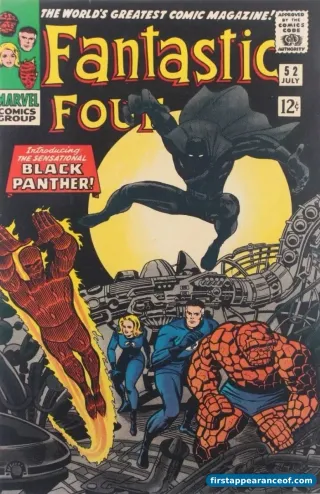
The Black Panther leaping at the Fantastic Four on the cover of Fantastic Four #52 (1966)

Firsts Timeline

  1. The Black Panther leaping at the Fantastic Four on the cover of Fantastic Four #52 (1966)
    First Appearance and First Cover July 1966

    Fantastic Four #52

    By Stan Lee, Jack Kirby

    The first Black superhero in mainstream American comics. Debuts as a mysterious king who summons the Fantastic Four to the technologically advanced nation of Wakanda. Predates the Black Panther Party by three months.

    Read the full breakdown
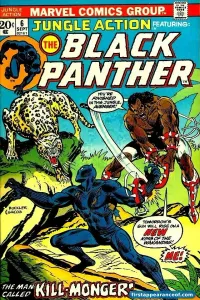
  2. Jungle Action #6 cover
    First Solo Series September 1973

    Jungle Action #6

    By Don McGregor, Rich Buckler

    The first time a Black superhero headlined an ongoing series run. Launches the multi-year 'Panther's Rage' storyline, widely considered one of the most historically and critically important runs of the Bronze Age.

    Read the full breakdown
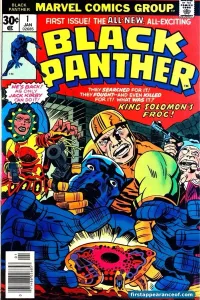
  3. Black Panther #1 cover
    First Self-Titled Series January 1977

    Black Panther #1

    By Jack Kirby

    Kirby's return to Marvel launches the first title carrying the character's name. Distinct in tone from the McGregor Jungle Action run; Kirby writes his own standalone Wakandan mythology.

    Read the full breakdown

Quick Facts

Debut
Fantastic Four #52 (July 1966)
Real name
T'Challa
Creators
Stan Lee (writer), Jack Kirby (penciller and co-creator)
Publisher
Marvel Comics
First villain
Klaw (Ulysses Klaue), who killed T'Challa's father T'Chaka. Klaw debuts in the same issue sequence as part of Black Panther's origin.
First ally
The Fantastic Four, whom T'Challa initially tests and then allies with across the debut arc.
Team affiliations
Avengers, Fantastic Four (temporary), Illuminati, Fantastic Force, Ultimates (2015 vol.)

The first appearance (1st app) of Black Panther is Fantastic Four #52 (July 1966), created by Stan Lee and Jack Kirby. T'Challa, King of Wakanda, debuts as the first Black superhero in mainstream American comics, predating the founding of the Black Panther Party (October 1966) by three months. His first cover, first full appearance, and origin all land in the same issue. His first solo series run is Jungle Action #5 to #24 (1973 to 1976), the Don McGregor "Panther's Rage" arc. His first self-titled series is Black Panther #1 (January 1977) by Jack Kirby.

Creation Story

Stan Lee and Jack Kirby were approaching the peak of their creative run at Marvel when they began developing the character who would become Black Panther. By 1966, the Lee/Kirby Fantastic Four had been running for five years and had already produced the Silver Surfer, Galactus, the Inhumans, and the Watcher. The title was effectively the proving ground for new Marvel concepts.

Kirby’s initial sketch, from early 1966, designed the character as a warrior-king with a sleek black costume and no visible skin. The full-face mask was practical (it read clearly on newsprint) and thematic (it concealed the king’s identity, making him both T’Challa and the impersonal office of the Panther). Lee and Kirby debated whether the character should be explicitly African or kept racially ambiguous; Kirby insisted on African, specifically envisioning a technologically advanced hidden African nation that would challenge the pulp-era “primitive Africa” trope most American comics had perpetuated.

The resulting fictional nation was Wakanda: hidden in central Africa, self-governed, and the world’s only source of Vibranium. The technology premise inverted the expected racial framing of the era. Wakanda was not the beneficiary of Western aid; it was a century ahead of the West in materials science, energy production, and bioengineering. T’Challa was not a cultural ambassador to be domesticated; he was a head of state who chose when and whether to engage with the outside world.

Fantastic Four #52 was published in April 1966 with a cover date of July 1966, three months before the founding of the Oakland-based Black Panther Party for Self-Defense in October 1966. The similar naming is coincidental: Kirby had chosen “Black Panther” well before the Party existed. In the early 1970s Marvel briefly renamed the character “The Black Leopard” to avoid political confusion, but reader feedback restored the original name within the year.

Fantastic Four #52 (1966) — First Appearance and First Cover

The issue opens with the Fantastic Four receiving a mysterious invitation: a personal jet arrives at the Baxter Building as a gift from an unnamed African king. The team accepts and flies to Wakanda. On arrival, they are attacked by the Black Panther, who tests their capabilities in a technologically sophisticated hunt through the jungle.

The visual design is all Kirby. Sleek black-on-black costume with silver claws, a full-face feline mask, a lithe and athletic silhouette distinct from Marvel’s usual super-strong hero proportions. The character moves like a fighter, not a brawler. Kirby draws the hunt sequences with unusual kinetic intensity, the Panther leaping between trees and over the team with the speed and grace of the animal.

The second half of the issue reveals the Panther’s identity: T’Challa, King of Wakanda, son of T’Chaka. The follow-up issue (Fantastic Four #53, August 1966) provides the full origin: T’Chaka was killed by Klaw (Ulysses Klaue), a Belgian arms dealer who sought to extract Wakanda’s Vibranium by force. T’Challa’s childhood was shaped by this trauma. The Black Panther identity is both a hereditary office and T’Challa’s personal answer to his father’s murder.

Fantastic Four #52 is a Silver Age Lee/Kirby key that trades in the mid-five figures in CGC 9.2 and above. A CGC 9.8 copy is extremely rare in the census; each one that trades at auction sets a new price. The book’s pre-MCU valuation was strong; the 2018 Black Panther film pushed it into a different tier entirely, and the 2022 Wakanda Forever sequel reinforced that demand.

Jungle Action #5 to #24 (1973 to 1976) — First Solo Series: Panther's Rage

In 1973, Marvel relaunched the dormant Jungle Action title as a Black Panther solo feature. Don McGregor wrote, Rich Buckler drew the early issues (later replaced by Billy Graham for the bulk of the run). The arc ran from Jungle Action #6 (September 1973) through Jungle Action #18 (November 1975) under the title “Panther’s Rage,” with additional Panther material in #19 through #24.

“Panther’s Rage” is historically significant for two reasons. It was one of the first Marvel stories with an all-Black cast, set entirely within Wakanda with no white supporting characters. And it was an early Marvel long-form serialized narrative, telling a single 13-issue saga at a time when most Marvel titles ran 1-to-3-issue arcs. The structure (exiled king returns to find his nation fractured, faces a charismatic challenger who claims moral grievance, earns the throne through a combination of physical combat and moral reckoning) became the template Ryan Coogler adapted for the 2018 Black Panther film.

Erik Killmonger debuts in Jungle Action #6 as the arc’s primary antagonist. Killmonger is arguably the most important supporting-cast introduction of McGregor’s run. His characterization in “Panther’s Rage” is the foundation for Michael B. Jordan’s Oscar-nominated portrayal in the 2018 film.

Jungle Action #6 is a Bronze Age key in its own right. CGC 9.8 populations are in the double digits and sales have climbed as the McGregor run’s critical reputation has grown.

Black Panther #1 (1977) — First Self-Titled Series

January 1977. Jack Kirby returned to Marvel after his extended run at DC (New Gods, Kamandi, OMAC) and was given his pick of properties. He chose to launch a Black Panther solo title, writing and drawing himself. Black Panther #1 is the character’s first title carrying his name.

Kirby’s Black Panther run is stylistically very different from McGregor’s Jungle Action work. Kirby is a bold-strokes cosmic storyteller; his Panther battles alien cosmic entities and travels through time rather than defending Wakanda from internal rebellion. The run ran 12 issues through 1979. It is widely considered one of Kirby’s lesser Marvel returns, but Black Panther #1 remains a key because of its status as the character’s first self-titled book and Kirby’s late-career contribution to the mythology.

CGC 9.8 copies of Black Panther #1 (1977) are readily available but command steady premiums as the character’s MCU profile continues to drive demand for every BP key.

Legacy

Chadwick Boseman’s performance in Black Panther (2018) was a cultural event beyond the film’s commercial success. The $1.3 billion box office and three Academy Awards were significant; the cultural reception was more so. The film’s release became a mobilization moment for Black audiences in particular, with group-viewing events, cosplay, and critical attention that moved far beyond standard comics-adaptation coverage.

Boseman’s death in 2020 reshaped the franchise. Wakanda Forever (2022) addressed his loss on-screen, passing the Panther mantle to Shuri (Letitia Wright). Angela Bassett’s performance as Queen Ramonda earned an Academy Award nomination. The film did not achieve the cultural singularity of the first, but reinforced Wakanda’s place in Marvel’s screen universe.

For collectors, the Black Panther progression is unusually legible: FF #52 is the flagship Silver Age key, Jungle Action #6 is the critically essential Bronze Age key, Black Panther #1 (1977) is the first self-titled book, and the Christopher Priest (1998) and Ta-Nehisi Coates (2016) ongoing relaunches are modern entry points. The character’s collecting base grew substantially after the 2018 film and has remained strong through the 2022 sequel and subsequent animated series.
Key subsequent appearances

After the debut, these are the issues collectors and historians reach for next.

  1. 1966

    Fantastic Four #52

    Debut

    First appearance, first cover, origin. Lee and Kirby set the Wakanda mythology that defines the character for the next sixty years.

  2. 1966

    Fantastic Four #53

    Second appearance and the full origin flashback. T'Chaka's death, Klaw's assault, T'Challa's assumption of the Panther mantle.

  3. 1968

    Avengers #52

    Joins the Avengers as the first Black member of the team. Significant for the diversification of Marvel's flagship super-team.

  4. 1973

    Jungle Action #5

    First Black Panther solo feature in a series. Launches the McGregor run that redefines the character.

  5. 1973

    Jungle Action #6

    Panther's Rage

    First chapter of Don McGregor's 'Panther's Rage.' One of the first Marvel stories with an all-Black cast. Serves as the template for Ryan Coogler's 2018 film adaptation.

    Don McGregor and Rich Buckler launched "Panther's Rage" in Jungle Action #6 with the unusual mandate to tell a full multi-part saga inside a Marvel book at a time when most Marvel stories were one-and-done. The arc ran 13 issues through Jungle Action #18, told entirely in Wakanda, with an all-Black supporting cast. Erik Killmonger debuts as the antagonist. The story structure (exiled king returns, faces challenger who claims moral grievance, earns the throne through both combat and moral reckoning) is the direct template Ryan Coogler adapted for the 2018 Black Panther film.

  6. 1977

    Black Panther #1 (1977)

    First Self-Titled

    Kirby's self-titled BP series #1. First time the character headlines a title carrying his name.

  7. 1998

    Black Panther #1 (1998)

    Priest Era

    Christopher Priest's Marvel Knights relaunch. Reframed the character as a diplomatic operator. Widely considered the definitive modern take.

  8. 2016

    Black Panther #1 (2016)

    Ta-Nehisi Coates writes his first comic. Timed with the 2018 film build-up. Chris Sprouse on interior art.

In adaptations

Film, TV, animation, and game appearances.

  1. 2010

    Black Panther (animated)

    Animated

    Starring:Djimon Hounsou

    Six-part BET miniseries adapting the Reginald Hudlin run. First major animated adaptation.

  2. 2016

    Captain America: Civil War

    Film

    Starring:Chadwick Boseman

    Boseman's MCU debut. Black Panther is introduced as a supporting character in Joe and Anthony Russo's film.

  3. 2018

    Black Panther

    Film

    Starring:Chadwick Boseman

    Ryan Coogler's film. Grossed over $1.3 billion. Won three Academy Awards including Best Original Score and Best Costume Design. The first Marvel Studios film nominated for Best Picture.

  4. 2022

    Black Panther: Wakanda Forever

    Film

    Starring:Letitia Wright

    Coogler's sequel, following Chadwick Boseman's death. Shuri takes the Panther mantle. Angela Bassett nominated for an Academy Award for her performance as Queen Ramonda.

  5. 2024

    Eyes of Wakanda

    Animated

    Starring:Various

    Disney+ animated series exploring the history of Wakanda across multiple eras.

Frequently asked questions

The questions readers and collectors ask most.

What is Black Panther's first appearance?

Fantastic Four #52, published July 1966 by Marvel Comics. Created by Stan Lee and Jack Kirby. T'Challa debuts as the King of Wakanda and the first Black superhero in mainstream American comics.

Did Black Panther come before or after the Black Panther Party?

Before, by three months. Fantastic Four #52 was on newsstands in April 1966 (July cover date). The Black Panther Party for Self-Defense was founded by Huey P. Newton and Bobby Seale in October 1966. The two are not connected; the similarity in naming is coincidental. Marvel briefly rebranded the character as 'The Black Leopard' in the early 1970s to avoid political association, then restored the Black Panther name within a year.

Who created Black Panther?

Stan Lee (writer) and Jack Kirby (penciller and co-creator). Kirby did the design and the bulk of the creative conception; Lee wrote the dialogue and plotted alongside him in the Marvel Method of the era. The character is one of the last major Marvel creations from the Lee/Kirby partnership before Kirby left for DC in 1970.

What is Wakanda?

A fictional African nation in the Marvel universe, set somewhere in East Africa (the exact geography has shifted across eras). Wakanda is the only source of Vibranium, a near-indestructible meteoric metal, and has used Vibranium wealth to develop technology far beyond the rest of the world while maintaining strict isolation. The Black Panther is the hereditary protector of Wakanda and, in most eras, its king.

Is Black Panther the first Black superhero?

Yes in the mainstream American comics context. Earlier Black characters existed in the industry, including the African jungle hero Lion Man in All-Negro Comics #1 (1947, a short-lived Black-owned publisher). But Black Panther is the first Black superhero published by a major US publisher (Marvel). The distinction is commonly stated as 'first Black superhero in mainstream American comics,' which is the formulation the character's publishers and most historians use.

Why is Fantastic Four #52 a key issue?

Three reasons. It is the first appearance and first cover of Black Panther, who became one of the most culturally significant Marvel characters of the 2010s and 2020s on the strength of the MCU films. It is a Silver Age Lee/Kirby Marvel issue, which is a premium category regardless of character. And it is a genre first, introducing the first Black superhero in mainstream American comics. High-grade CGC 9.2 copies trade in the mid-five figures; a restored census 9.8 would be a landmark sale.

Related characters