Creation Story
Jerry Siegel and Joe Shuster were two seventeen-year-olds in Cleveland, Ohio, when they started developing the character that would become Superman. The first version, sketched in 1933, was a bald telepathic villain named “The Superman.” The protagonist version (the Kryptonian hero in blue tights and a red cape) emerged over the next five years of unsuccessful pitches, including to every major newspaper syndicate in the country. The character was rejected repeatedly as too implausible, too childish, and too unlike anything then on the newsstand.
In 1938, National Allied Publications (a small pulp publisher that would later become DC Comics) needed a lead feature for a new anthology title called Action Comics. Editor Vin Sullivan asked Siegel and Shuster to adapt their existing Superman comic strip into a 13-page story for the first issue. They did. National paid them $130 for the story and the character, including all rights, and published Action Comics #1 in April 1938 with a cover date of June 1938.
The book was an immediate commercial success. Kids bought copies until the print run sold through, then bought more. By issue #7, Action Comics was reprinting earlier Superman stories in the back pages because reader demand was so high. National expanded the character into his own solo title (Superman #1, Summer 1939), a comic strip, a radio show (1940), the Fleischer animated shorts (1941), and a live-action serial (1948). Every subsequent superhero on the stands through the Golden Age was an attempt to capture Superman’s success.
Siegel and Shuster’s creator contract and the decades-long legal disputes it produced are the foundational creator-rights story in American comics. Both creators died before receiving what most observers consider adequate compensation for the character. DC Comics added their creator credit to every Superman publication in 1978 as part of a settlement; additional settlements have followed since for both men’s estates.
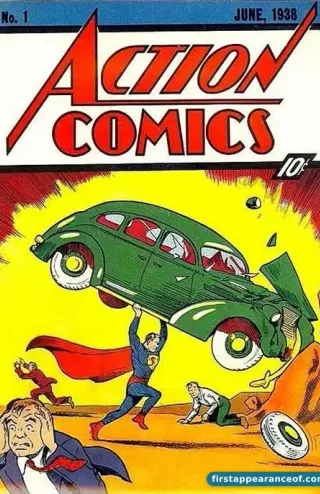
Action Comics #1 (1938) — First Appearance, First Cover, First Origin
Action Comics #1 is a 64-page anthology with seven features. The Superman story is the lead, 13 pages, drawn by Shuster and written by Siegel. The story opens with a one-page origin: the doomed planet Krypton, the rocket to Earth, the orphaned infant found by “a passing motorist” (the Kents are unnamed in this earliest telling), the child’s discovery of his powers as he grew up, his decision to devote his strength to helping mankind.
The remaining twelve pages are a sequence of Superman-in-action scenes: stopping a lynching, saving a wife from an abusive husband, confronting a corrupt senator, and intervening in a South American war. The tone is explicitly reformist. Superman is not a crime-fighter in the later sense; he is a champion for the weak against social injustice. He does not yet fly (he leaps), does not yet have heat vision or most of his later powers, and is not yet limited by Kryptonite (which is invented in 1949). The character the issue introduces is recognizable but still in its initial form.
The cover, Shuster’s image of Superman holding a green car over his head with criminals fleeing in terror, is one of the most-reproduced images in American pop culture. It establishes the visual vocabulary of the genre: the costumed figure in an action pose, the hero at the center of the composition, the immediate visual proof of superhuman capability. Every superhero cover published since operates within the template Shuster set on Action Comics #1.
Collector significance. Action Comics #1 is the single most valuable comic book in existence. A CGC 8.5 copy sold at Heritage Auctions in April 2024 for $6.0 million, the highest public sale of any comic book. Approximately 100 unrestored copies are estimated to survive worldwide. CGC 6.0 and above populations are in the single digits. The book’s status as the foundational document of the superhero genre, combined with its extreme scarcity in high grade, makes it the defining key of the hobby.
Superman #1 (1939) — First Solo Title
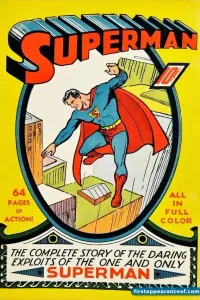
Summer 1939. One year after Action Comics #1, DC launched the first comic named after a single superhero: Superman #1. The issue reprints the Action Comics #1 origin story and adds new Superman material. Siegel wrote, Shuster drew. The cover features Superman leaping toward the reader with the city skyline behind him.
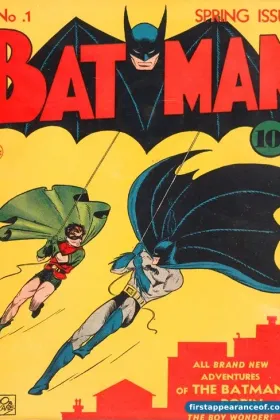
Superman #1 matters as a first for two reasons. It is the character’s first dedicated solo title, establishing the commercial pattern for every superhero to follow: headline appearance in an anthology, then spin off into a solo book. And it is the first superhero-named solo comic ever published, a template that Batman #1 (Spring 1940) followed nine months later, and every major superhero since has adopted.
The issue is a significant Golden Age key in its own right. Print runs were higher than Action Comics #1 (estimated several hundred thousand copies), so it is less scarce in low grades, but high-grade copies remain expensive. CGC 9.0 and above copies have traded in the high six figures.
Legacy
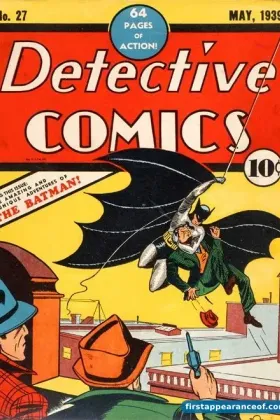
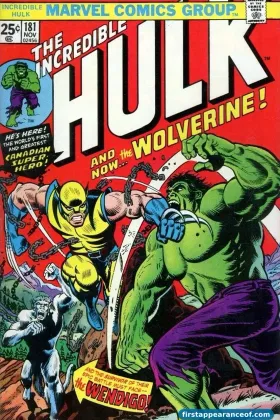
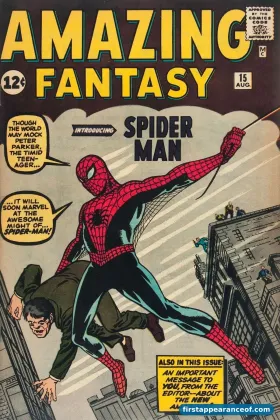
Superman is the longest-running superhero in publication history, continuously in print from 1938 forward. He is the template every subsequent superhero character is either modeled on or deliberately contrasted with. Batman is Superman’s opposite (human, nocturnal, fear-based); the Hulk is a Superman who cannot control his power; Spider-Man is a Superman who struggles with responsibility; the Incredible family members of the Fantastic Four each hold one Superman-adjacent power.
Outside the comics, Superman is one of the most-adapted fictional characters in American media. Christopher Reeve (1978-1987), Tom Welling (Smallville, 2001-2011), and Henry Cavill (2013-2017) each played the character for a full generation. David Corenswet takes over for James Gunn’s DC Studios reboot in 2025. The character’s essential appeal, a strong being choosing to use strength to protect the weak, has not meaningfully changed in the 87 years since Siegel and Shuster sold Action Comics #1 for $130.
For collectors, Superman is the entry point to Golden Age collecting. Action Comics #1 is the Holy Grail; Superman #1 is the accessible key; the 1940s run of Action Comics and Superman titles is a lifelong collecting project. The character’s primacy in the hobby mirrors his primacy in the genre.