Creation Story
Batman is the product of two men whose credits did not match their contributions for 76 years. Bob Kane was a 22-year-old Bronx cartoonist who had been freelancing for DC on minor features. Vin Sullivan, DC’s editor in charge of Detective Comics, asked Kane in early 1939 to create a new costumed hero in the wake of Superman’s commercial success in Action Comics #1 (June 1938). Kane worked up an initial concept over a weekend: a character called “Bird-Man” or “Bat-Man” wearing a red leotard with a black domino mask, stiff bat-wings attached to the arms, and no cape or cowl. The design was garish and generic, closer to a Golden Age strongman than a pulp avenger.
Kane brought the concept to Bill Finger, a ghostwriter he was collaborating with informally. Finger proposed structural changes that transformed the character: replace the red suit with grey and black for a night-operating silhouette, swap the bat-wings for a flowing cape, replace the domino mask with a full cowl to hide Bruce Wayne’s identity (and to move the character’s silhouette further from Superman), darken the tone from strongman-hero to pulp-detective. Finger wrote the script for the first Batman story and adapted plot beats from Walter B. Gibson’s Shadow pulp novel “Partners of Peril” (1936), which Kane and Finger both read. Finger also named the character Bruce Wayne, selecting Robert the Bruce and Mad Anthony Wayne as the historical reference points.
The resulting character appeared in Detective Comics #27 (May 1939) with a single creator credit: Bob Kane. Kane had signed a contract with DC that named him sole creator, with perpetual credit on every subsequent Batman publication. Finger received page rates as a ghostwriter but no creator credit, no royalties, and no public association with the character for the rest of his life. Finger died in 1974. Kane died in 1998. In 2015, after a long-running industry and family effort led by Finger’s granddaughter Athena Finger, DC formally added Bill Finger’s name as Batman’s co-creator. The credit now appears on every Batman comic published after 2015 and on every Batman film released after 2016, including Batman v Superman and all subsequent Warner Bros. productions. Historians and the broader comics industry treat Finger as the primary creative force behind the character, with Kane’s contribution bounded to the initial sketch-level concept.
The design specifics that Finger fixed have remained consistent for over 85 years. The grey-and-black night-operating silhouette, the cape, the full cowl with pointed ears, the utility belt, the absence of a gun in standard continuity, and the detective framing are all Finger innovations. Kane’s original red-and-yellow bat-winged flier survives only as a historical curiosity referenced occasionally in flashbacks and Elseworlds stories.
First Appearance and First Cover: Detective Comics #27
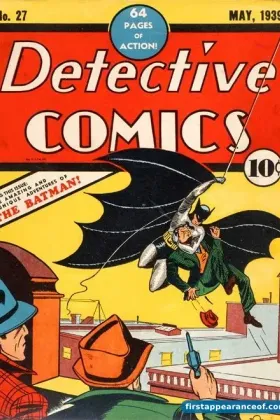
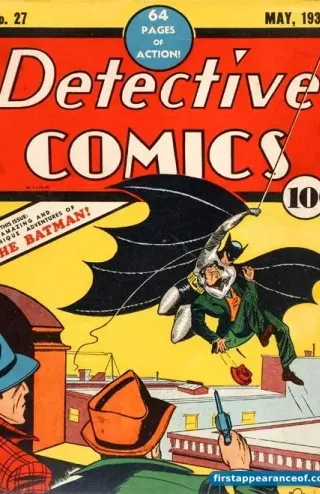
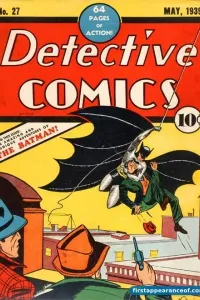
Detective Comics #27 is cover-dated May 1939 and was on newsstands in March. The book was 64 pages at 10 cents, typical for the anthology format DC published in that era. Detective Comics had been running since 1937 as a crime-and-mystery anthology with multiple features per issue, none of which had broken out commercially. Issue #27 was given the Batman debut as a six-page feature, unassuming by placement and page count but positioned as the cover story.
The cover is by Bob Kane. Batman is in mid-swing with a rope, carrying an unconscious criminal by the shirt collar, against a purple-and-orange rooftop skyline. It is one of the most-reproduced covers in comic-book history and the single image most associated with the character’s Golden Age incarnation. The composition was Kane’s, the color palette decisions were editorial, and the cover is typically inked by Kane himself (the cover inker credit is sometimes contested by historians).
The story, “The Case of the Chemical Syndicate,” opens with Commissioner Gordon, the newly-introduced police commissioner of an unnamed city (Gotham is not named until later), hosting his friend Bruce Wayne as a phone call reports a murder. Bruce makes an excuse and slips away. Batman appears at the crime scene. Over six pages, Batman solves the case, reveals the villain Alfred Stryker as the industrialist behind a chemical-syndicate conspiracy, and delivers Stryker’s accidental death when Stryker falls into a vat of acid during the climax. The death is presented matter-of-factly, which is notable because later Batman continuity establishes Batman’s no-killing code, a rule that does not exist in the 1939 debut story.
Three characters debut in the issue: Batman, Bruce Wayne, and Commissioner James Gordon. None are in the cover image by name, although Batman is the central figure. The final panel shows Bruce Wayne back in his study, revealing to the reader that Batman and Bruce Wayne are the same person. This identity reveal is structurally the issue’s climactic beat, not the villain takedown.
Collector significance is at the highest tier of American comic-book collecting. Detective Comics #27 is commonly cited alongside Action Comics #1 (Superman), Marvel Comics #1, and Amazing Fantasy #15 as one of the four most important superhero first-appearance issues in existence. Surviving high-grade copies are extremely rare because Detective Comics was a newsstand-distributed pulp magazine handled roughly by readers and destroyed in wartime paper drives. CGC currently recognizes fewer than 20 copies in grades of 8.0 or above across all census records. A CGC 7.0 copy sold at Heritage Auctions in 2021 for $1.74 million. A CGC 9.0 copy has never been confirmed at public auction; prices for such a book are extrapolated and estimated at well over $3 million.
First Solo Title: Batman #1
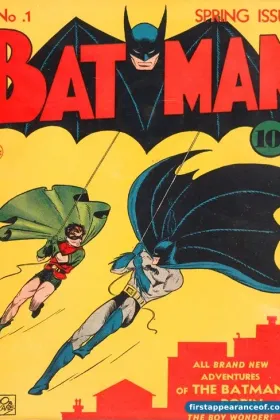
Batman #1 is cover-dated Spring 1940 (the industry convention for the period used seasonal rather than monthly cover dates on some titles) and was on newsstands April 1940. The book is 64 pages at 10 cents. Unlike Detective Comics, which was an anthology with multiple features, Batman #1 is dedicated entirely to Batman. The issue contains four Batman stories: a two-page origin recap titled “The Legend of the Batman, Who He Is and How He Came to Be,” followed by “The Joker,” then “The Cat,” then “The Joker Returns.”
The issue contains three landmark first appearances. The origin recap is the first expanded retelling of the Bruce Wayne backstory. The original Detective Comics #27 did not explain why Bruce Wayne had become Batman; the two-page recap in Batman #1 is the first version of the now-canonical origin where Bruce’s parents are murdered by a mugger outside a theatre and young Bruce swears to avenge them by fighting crime. “The Joker” is the first appearance of the Joker, the character who has since become the most adapted supervillain in any medium. “The Cat” is the first appearance of Selina Kyle, introduced as a jewel thief and not yet named Catwoman (the name arrives a few issues later). Her debut in Batman #1 is unmasked and without the cat-themed costume, which would evolve over the next several appearances.
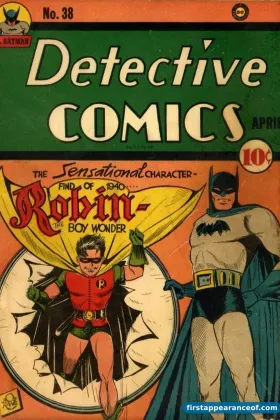
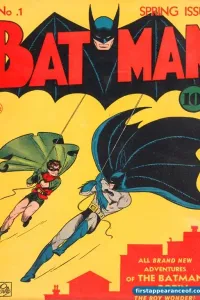
The cover is by Bob Kane and Jerry Robinson. Batman and Robin, the Boy Wonder, are shown swinging through Gotham on a rope, grinning at the reader. Robin is on the cover of Batman #1 because Batman #1 shipped after Detective Comics #38 (April 1940), Robin’s actual first-appearance issue. Both books carry April 1940 cover dates, but Detective Comics #38 hit newsstands first. This is why Robin is on the Batman #1 cover without Batman #1 being a first-appearance issue for Robin.
Collector significance is second only to Detective Comics #27 among Batman keys. Batman #1 is the first dedicated Batman book, which is structurally different from a first-feature-in-anthology debut, and it contains two of the three most famous Batman villains of all time. A CGC 9.2 copy sold at Heritage Auctions in 2021 for $2.22 million. Surviving copies in grades of 9.0 and above are in the single digits. The book’s rarity is driven by the same factors as Detective Comics #27 (pulp handling, wartime paper drives) plus its appeal to Joker collectors, Catwoman collectors, and origin-story completists, each of whom treats the issue as a key in their own collection frame.
Two of the household names that arrive later have their own contested debuts: Batgirl in Detective Comics #359 (1967), and the Red Hood, the second Robin who came back wearing the Joker’s old alias, in Batman #635 (2005).