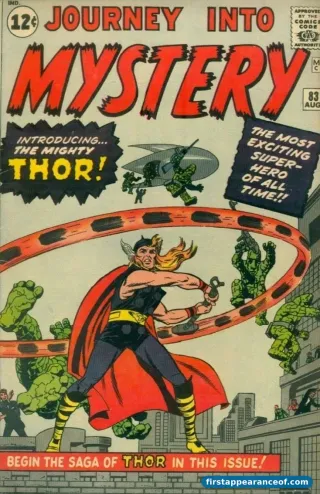
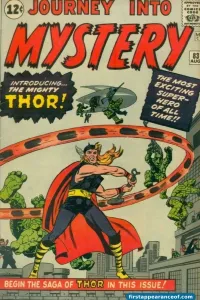
Thor on the cover of Journey into Mystery #83 (1962), hammering down against the Stone Men from Saturn.

1st Appearance and 1st Cover

First Appearance of Thor

Journey into Mystery #83

August 1962 · Marvel · Silver Age

The Norse god Marvel hired when every other pantheon was taken, and the character whose book Jack Kirby used to invent modern cosmic comics.

Key Issue

Created by Stan Lee · Larry Lieber · Jack Kirby

By Atomm Updated

The first appearance (1st app) of Thor is Journey into Mystery #83 (August 1962), created by Stan Lee and Larry Lieber with art by Jack Kirby. The thirteen-page origin establishes the Donald Blake alter ego: a disabled American doctor vacationing in Norway who finds a walking stick in a cave, strikes it against a rock, and transforms into the Asgardian god of thunder. Marvel renamed the book The Mighty Thor with issue #126 in March 1966. Thor was one of the founding members of the Avengers in The Avengers #1 (September 1963).

Quick Facts

Debut
Journey into Mystery #83 (August 1962)
Real name
Thor Odinson. Alter ego Donald Blake (Lee-era), later retconned as a persona Odin constructed for him.
Creators
Stan Lee (plot), Larry Lieber (script), Jack Kirby (art). Based loosely on Norse mythology.
Publisher
Marvel Comics
First enemy
The Stone Men from Saturn, the aliens Thor fights in his debut
First ally
Jane Foster, his nurse in the Donald Blake identity, who becomes the recurring love interest of the early run
Team affiliations
Avengers, Warriors Three, Asgardian royal court

Firsts Timeline

  1. Journey into Mystery #83 cover
    First Appearance First Cover August 1962

    Journey into Mystery #83

    By Stan Lee, Larry Lieber, Jack Kirby

    Thirteen-page origin. Stan Lee plot, Larry Lieber script, Jack Kirby interior and cover. Introduces Donald Blake, the crippled American doctor who finds Mjolnir in a Norwegian cave and transforms into the Asgardian god.

    Read the full breakdown
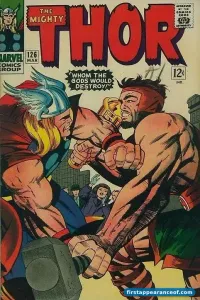
  2. First Self-Titled Series March 1966

    The Mighty Thor #126

    By Stan Lee, Jack Kirby

    Journey into Mystery was officially renamed The Mighty Thor with issue #126 (the prior issues had carried the Thor masthead for years, but #126 is the first with only his name on the cover). The Lee and Kirby run on Mighty Thor through the late 1960s is considered among the most ambitious superhero storytelling of the Silver Age.

    Read the full breakdown

Creation Story

Thor was a test of whether superhero readers would accept a god. In 1962 Marvel was two books into a relaunch (Fantastic Four #1 in November 1961, Amazing Fantasy #15 in August 1962) and Stan Lee was looking for concepts that differentiated Marvel from DC. DC’s Superman and Wonder Woman borrowed mythology loosely. Lee and Jack Kirby decided to go the other direction: take an actual historical pantheon, in this case the Norse gods, and build a superhero around the most visually distinctive one. Thor. A god with a hammer.

The execution was a three-way split similar to Iron Man’s. Lee plotted Journey into Mystery #83, his brother Larry Lieber scripted it, and Kirby drew the interiors and cover. The origin structure hit the formula Lee was perfecting in 1962: the hero is a wounded civilian (Donald Blake, a disabled American doctor vacationing in Norway), he stumbles into an extraordinary transformation (finding Mjolnir disguised as a walking stick in a cave), and he uses his new powers to fight an immediate threat (the Stone Men from Saturn, alien invaders landing nearby). Thirteen pages. Complete origin. Villain dealt with. Secret identity established.

What made Thor different from the other 1962 debuts was the scope Kirby drew into the background. The Donald Blake material is filler. Kirby visibly lights up on the Asgard panels: the armor design, the rainbow bridge, the architectural language of the Nine Realms, the visual grammar of gods interacting with gods. Kirby spent the next eight years expanding this side of the book into the most ambitious cosmic superhero comic of the 1960s, culminating in the Thor stories that later informed his Fourth World work at DC in the 1970s.

For collectors, Journey into Mystery #83 is a Silver Age key that sits comfortably below Amazing Fantasy #15 and Fantastic Four #1 but above most other non-Spider-Man 1960s Marvel debuts. High-grade copies crossed $100,000 at auction after Chris Hemsworth’s 2011 debut as the character and have held value through four solo films and numerous Avengers appearances.

The Simonson pivot

Every Thor story after 1983 operates in the shadow of Walter Simonson’s run (Thor #337 to #382, November 1983 through August 1985 as writer-artist, continuing as writer through #382). Simonson took over the book with one editorial mandate from Marvel: do something interesting. He did. First issue introduces Beta Ray Bill, an alien who lifts Mjolnir and is deemed worthy, destabilizing the entire premise of the character’s lore. Subsequent issues destroy Asgard, kill Odin multiple times, turn Thor into a frog for five issues, and reshape the book’s visual and narrative grammar with lettering, page-layout, and dialogue-rhythm experiments.

The run is the reference point for every major Thor moment since. Taika Waititi’s Thor: Ragnarok (2017) is structurally Simonson-influenced. Jason Aaron’s 2012 to 2019 Thor run referenced Simonson page layouts openly. The Walt Simonson Thor Omnibus is the single volume most serious readers are pointed toward first.

Collector context

Journey into Mystery #83 is a required Silver Age key for any Marvel collector building the full 1962 lineup. Its per-grade pricing sits in the tier below Amazing Fantasy #15, Fantastic Four #1, and Hulk #1, and above Tales of Suspense #39 (Iron Man’s first) and Strange Tales #110 (Doctor Strange’s first). The 1966 renaming to The Mighty Thor at issue #126 creates a secondary collector target for the solo-title-first crowd; #126 is easier to find in high grade than #83 and often functions as a more affordable entry point to the character’s collector corner.

Bronze Age keys worth knowing: Thor #337 (first Beta Ray Bill) is the most-traded Simonson-era book and a modern-grade collector target. Thor #165 (1969, first full appearance of Him/Warlock) is adjacent-cosmic Marvel and trades on Adam Warlock’s collector weight. Both are entry-level relative to the Silver Age #83.
Key subsequent appearances

After the debut, these are the issues collectors and historians reach for next.

  1. 1963

    The Avengers #1

    Founding Avenger. Thor is part of the original Lee and Kirby five-member lineup alongside Iron Man, Ant-Man, Wasp, and Hulk.

  2. 1965

    Journey into Mystery #112

    Thor versus Hulk. The Lee and Kirby issue that codified the 'who is stronger' comparison Marvel would re-run for the next fifty years.

  3. 1983

    Thor #337

    Simonson Era

    Walter Simonson's first issue as writer-artist. Introduces Beta Ray Bill, reshapes the book's tone, and launches a run considered among the greatest in Marvel's publishing history.

    Walter Simonson took over Thor with issue #337 and wrote and drew the book for four years. The run reinvented what a Thor story could be: Simonson leaned into Norse myth rather than away from it, introduced Beta Ray Bill (an alien who is deemed worthy to lift Mjolnir), destroyed Asgard and rebuilt it, killed Odin multiple times, and ended with Thor transformed into a frog. The run is the reference point every subsequent Thor writer works against. It is also the primary visual and tonal influence on Taika Waititi's Thor: Ragnarok (2017).

  4. 2007

    Thor #1 (2007)

    J. Michael Straczynski and Olivier Coipel's relaunch. Thor returns after the 2004 to 2007 Disassembled and Civil War arcs and is reintroduced as a new-era character for the MCU-launch period.

  5. 2012

    Thor: God of Thunder #1

    Jason Aaron begins his seven-year Thor run. Introduces Gorr the God-Butcher. Anchors the modern comics Thor in parallel with the MCU adaptation.

  6. 2014

    Thor #1 (2014)

    Jane Foster Thor

    Jane Foster becomes Thor. Aaron's decision to hand the name and the hammer to a female character produced one of the best-selling Marvel relaunches of the 2010s and directly informs the Thor: Love and Thunder (2022) film.

In adaptations

Film, TV, animation, and game appearances.

  1. 1966

    The Marvel Super Heroes

    Animated

    Grantray-Lawrence Animation syndicated series. Thor was one of five rotating heroes. First screen appearance.

  2. 2011

    Thor

    Film

    Starring:Chris Hemsworth

    Kenneth Branagh directs. Introduces Hemsworth as Thor and Tom Hiddleston as Loki. Grossed $449M worldwide.

  3. 2013

    Thor: The Dark World

    Film

    Starring:Chris Hemsworth

    Alan Taylor directs. Weakest of the four Thor films critically but kept Hemsworth and Hiddleston in the MCU rotation.

  4. 2017

    Thor: Ragnarok

    Film

    Starring:Chris Hemsworth

    Taika Waititi directs. The Simonson-influenced tonal reinvention that recast Thor as comedic lead. Grossed $855M worldwide and reset audience expectations of the character.

  5. 2022

    Thor: Love and Thunder

    Film

    Starring:Chris Hemsworth

    Waititi returns. Natalie Portman's Jane Foster picks up the hammer per the 2014 comics arc. Mixed reception but completed the Hemsworth quadrilogy.

Frequently asked questions

The questions readers and collectors ask most.

What is Thor's first appearance?

Thor's first appearance is Journey into Mystery #83 (August 1962), a thirteen-page origin story. Stan Lee plotted, his brother Larry Lieber scripted, and Jack Kirby drew the interiors and cover. The book was an anthology title for its first eight decades of Thor stories before Marvel renamed it The Mighty Thor with issue #126 in 1966.

Who is Donald Blake?

Donald Blake is Thor's original alter ego in the 1962 continuity: a disabled American doctor who finds Mjolnir in a Norwegian cave and transforms into Thor by striking the walking stick against a rock. Later retcons (particularly Walter Simonson's run in the 1980s) re-framed Donald Blake as a persona Odin constructed to humble Thor. In modern continuity, Blake is not a separate person but a temporary mortal identity Thor uses sparingly.

Is Thor a valuable collectible?

Journey into Mystery #83 is a meaningful Silver Age key. High-grade copies (CGC 9.0 and above) have crossed $100,000 at auction after the 2011 film and Hemsworth's continued MCU presence. Low-grade copies are accessible in the $2,000 to $5,000 range. It sits below Amazing Fantasy #15 and Fantastic Four #1 in the Silver Age hierarchy but is a required book for a complete Marvel Silver Age collection.

Why did Jack Kirby draw Thor?

Kirby was Marvel's primary visual architect through the 1960s and his interest in mythology was unique among the Bullpen artists. Kirby had already drawn mythology-adjacent stories for DC in the 1950s (Sandman, Boy Commandos) and he arrived at Thor with a full mental library of Norse visual iconography. The character was developed specifically to take advantage of Kirby's strengths. Kirby's run on Thor from 1962 through 1970 is considered his most ambitious Marvel work after Fantastic Four.

Why did Jane Foster become Thor?

Writer Jason Aaron made Jane Foster the new Thor in his 2014 relaunch as a deliberate editorial reset. In the story, Thor Odinson becomes unworthy of Mjolnir and Jane Foster, dying of cancer, picks up the hammer instead and transforms into the Goddess of Thunder. The run was one of Marvel's best-selling relaunches of the 2010s and the film Thor: Love and Thunder (2022) adapted the arc with Natalie Portman.

Is Walter Simonson's run on Thor good?

Walter Simonson's four-year run as writer and artist on Thor starting with issue #337 (November 1983) is widely considered one of the greatest superhero runs in Marvel's publishing history. It introduced Beta Ray Bill, leaned into Norse mythology rather than away from it, and experimented with format, lettering, and visual style in ways that still look daring. It is the primary reference for Taika Waititi's Thor: Ragnarok and the closest thing the character has to a definitive comics expression.