Creation Story
Spawn is the product of a single creator making a single bet that American comic publishing would let artists keep what they built. Todd McFarlane had been one of Marvel’s highest-profile artists in the late 1980s and early 1990s. His run as penciller on The Amazing Spider-Man (1988 through 1990) and his launch of the 1990 Spider-Man title (commonly called “McFarlane Spider-Man” and the issue #1 of which sold over 2.5 million copies) made him one of the most commercially valuable people at Marvel. He received work-for-hire page rates and no ownership stake in any character he worked on.
By 1991, the creator-rights debates that had been simmering in American comics for a decade had accelerated. Jim Shooter’s 1980s Marvel had refined work-for-hire into a legal default. Creator-rights advocates including Marv Wolfman, Chris Claremont, and (from the writing side) Alan Moore had been publicly critical of Marvel’s and DC’s treatment of creators’ characters. McFarlane, along with six other top-tier Marvel artists (Jim Lee, Rob Liefeld, Marc Silvestri, Erik Larsen, Jim Valentino, and Whilce Portacio), decided to leave Marvel and co-found a new publisher that would give creators full ownership of their work.
Image Comics was founded in February 1992. The seven founders each had their own imprint within Image: McFarlane’s was Todd McFarlane Productions. The deal was structured so that Image would provide infrastructure (printing, distribution, legal, accounting) while each creator retained full ownership and creative control of their own characters. Image’s first published title was Rob Liefeld’s Youngblood #1 in April 1992. Spawn #1 was the second, published in May 1992.
McFarlane wrote, pencilled, inked, lettered, and published Spawn #1 himself. This is unusual. No major superhero character since at least the 1940s had debuted with a single-creator credit for every production role. Spawn was McFarlane’s statement that creator-owned meant exactly what it said: he owned the character, he made the character, and he would bear full commercial and creative responsibility for the outcome.
The bet paid off. Spawn #1 sold 1.7 million copies. Spawn #5 (three months later) sold over 1.8 million. By the end of 1992, Spawn was outselling every Marvel and DC title at the newsstand level. The book’s commercial trajectory validated the Image thesis: creators could own their characters, publish through a cooperative, and reach a scale previously assumed to require corporate backing.
The character of Spawn is the commercial vehicle for the creator-rights thesis, but also its own thing. Al Simmons, the protagonist, is a Black former government assassin killed by his own handler. Malebolgia, a Hell-lord, offers Simmons a bargain: return to Earth in exchange for leading Hell’s army in the coming apocalypse. Simmons accepts, not realizing the return is on Malebolgia’s terms. He wakes up disfigured, wearing a sentient symbiotic cape that functions as a suit of living armor, in an alley in New York five years after his death. Most of Spawn’s early run is Simmons rediscovering his life (a wife who has remarried his best friend; a world that has moved on) and refusing to serve the bargain he struck.
The aesthetic is McFarlane’s. The cape is absurdly long. The chains are impractical and permanent. The visuals lean gothic, urban, and exaggerated. The tone is heavy, and the book does not soften its violence for mainstream superhero audiences. All of this was commercially validated by the Image launch’s success. McFarlane’s 1992 decision to keep Spawn wholly his, scripted and drawn solo, turned out to be one of the most lucrative single creator decisions in American comic publishing history.
First Appearance, First Cover, and First Solo Title: Spawn #1
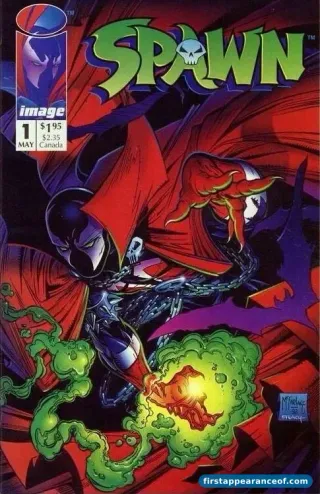
Spawn #1 is cover-dated May 1992 and was on newsstands in May. The book is 36 pages at $1.95 direct-market and $2.25 newsstand. Cover, interior pencils, interior inks, script, and plot are all credited to Todd McFarlane. The lettering is by Tom Orzechowski. Colors are by Steve Oliff and Reuben Rude of Olyoptics. No other creative credits appear on the issue. The book was published by Image Comics under the Todd McFarlane Productions imprint.
The cover is an iconic McFarlane composition: Spawn centered, full figure, cape flaring upward into a curling upper-left swoop, chains snaking outward in multiple directions, background reduced to an abstract cold gradient. The cover price is prominently displayed in the upper-left corner. The Image Comics logo, then new, appears in the upper-right. This is Spawn’s first cover and one of the most-imitated 1990s superhero cover compositions.
The story opens with Al Simmons’s return from Hell, disoriented and amnesiac, crawling out of an alley in New York City. Over 22 pages of story, Simmons gradually reconstructs his identity: he recognizes his own face in a newspaper photograph from five years earlier, identifying him as a deceased CIA operative. He reaches out to his wife Wanda, finds she has remarried his best friend Terry Fitzgerald, and begins to process that the deal he struck with Malebolgia for his return cost him more than his life. The issue introduces the Hellspawn’s symbiotic cape and armor as a sentient entity bonded to Simmons. It introduces the Violator (as a clown, though not yet named) in a brief appearance. It establishes the urban-gothic New York setting that became Spawn’s visual signature. The ending is unresolved: Simmons has returned, has learned the broad shape of his new existence, and has not yet chosen what to do about it.
Collector significance is tied to three factors. First, Spawn #1 is one of the foundational issues of the Image Comics creator-owned imprint, which makes it a key for any collector building an Image-launch run. Second, it is a character first appearance in the classical sense, with the character visually and narratively complete in his debut issue. Third, the print-run figures tell the scarcity story clearly. Approximately 1.7 million copies of Spawn #1 were printed. An estimated 98 to 99 percent of that run was distributed through the direct market (comic shops). Only around 34,000 copies, about 2 percent of the total print run, went to newsstand distribution. The newsstand edition is identical to the direct edition on paper, price, and cover art; the only distinguishing feature is the UPC barcode format on the cover. That 2 percent scarcity is why the newsstand variant trades at roughly 2.5 to 3 times the direct-market equivalent at matched CGC grade, despite functionally being the same book.
Pre-release Spawn marketing ran across several other 1992 comics before the book itself shipped. In April 1992, black-and-white sketch advertisements for Spawn #1 appeared in Rust #1, Rocket Ranger #3, and Torg #3. These ads showed an early SPAWN logo design distinct from the logo that ended up on the published book. Rust #1 itself had two printings (a standard direct run of approximately 20,000 copies and a scarcer bronze-foil variant of approximately 11,000 copies), which has made the Rust #1 bronze-foil an obscure but tracked collectible in Spawn-completionist circles specifically for carrying the pre-release Spawn ad.
Malibu Sun #13 (May 1992) ran a preview feature on Spawn #1 two weeks before the book’s official release. The preview includes what is effectively a prototype Spawn #1 cover, again with the earlier SPAWN logo. Malibu Sun #13 is sometimes discussed as a “pre-first appearance” collectible, though CGC and CBCS do not recognize it as a true first appearance, and the prevailing collector consensus is that Spawn #1 remains the canonical first. Malibu Sun #13 trades at a modest premium over standard 1992 fanzines for its cover-preview content but is not treated as a key in the grading-service sense.
The Spawn #1 black-and-white variant is a later-printed incentive promotion, not an original-release variant. In 1997, Image and Todd McFarlane Productions offered retailers one copy of a black-and-white reprinted Spawn #1 for every 50 copies of Spawn #65 ordered. Estimates put the total number of black-and-white variants shipped at around 3,100 copies. The book is a reprint, not a first appearance, and so is not recognized as a collectible key in the grading sense, though its scarcity (roughly 0.2 percent of the original Spawn #1 print run) gives it specific collector appeal. As of 2024, with Spawn in issue #350+ and counting, the character’s brand has held for 32 years, which makes Spawn #1 a historically durable collectible at every grade tier.