First Appearance

First Appearance of Joker

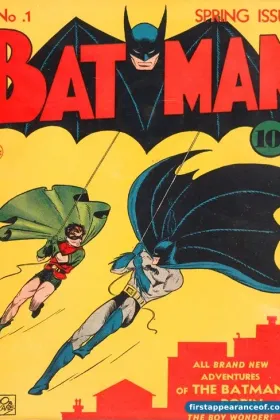
Batman #1 (1940). The one villain who has outlasted every Batman interpretation by refusing to hold still.

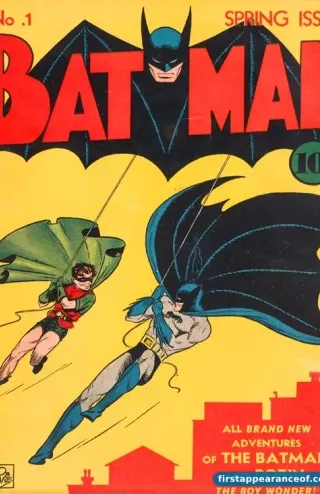
Batman #1 cover (1940). The Joker debuts inside this issue, though the cover features Batman and Robin.

Firsts Timeline

  1. Batman #1 cover (1940). The Joker debuts inside this issue.
    First Appearance April 1940

    Batman #1

    By Bill Finger, Bob Kane, Jerry Robinson

    Batman #1 is Batman's first solo title. The Joker debuts inside in the lead story 'The Joker.' Catwoman also debuts in this issue as The Cat.

    Read the full breakdown
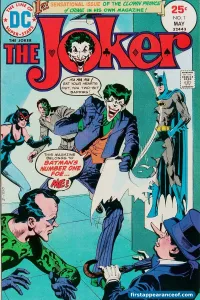
  2. Joker #1 cover
    First Solo Title May 1975

    Joker #1

    By Dennis O'Neil, Irv Novick

    The first time a supervillain headlined their own solo title in mainstream comics. Nine-issue DC series by Dennis O'Neil and Irv Novick. Predates the collector-era speculation market that would later turn villain solo titles into a recurring format.

    Read the full breakdown

Quick Facts

Debut
Batman #1 (April 1940)
Real name
Unknown. Alan Moore's The Killing Joke (1988) proposed an origin that later writers have alternately canonized and retconned.
Creators
Bill Finger (writer). Bob Kane (pencils). Jerry Robinson (character design credit, contested).
Publisher
DC Comics (originally Detective Comics, Inc.)
First villain
Batman, in every meaningful sense. The character exists as Batman's primary antagonist from the debut forward.
Team affiliations
Injustice Gang, Injustice League, Secret Society of Super Villains, the Legion of Doom.

The first appearance (1st app) of the Joker is Batman #1 (April 1940), in the lead story titled simply "The Joker," created by writer Bill Finger, penciller Bob Kane, and character designer Jerry Robinson. The same issue contains the first appearance of Catwoman (introduced as The Cat) and is Batman's first solo title. The Joker's creator-credit attribution is contested to this day: Robinson claimed he originated the playing-card-joker visual concept, while Kane claimed the character was his idea based on Conrad Veidt's performance in the 1928 film The Man Who Laughs. DC's current credit lists all three.

Creation Story

The Joker’s creator credit is the longest-running dispute in superhero comics. Three people claim some version of origin for the character, and DC today lists all three on every Joker publication: writer Bill Finger, penciller Bob Kane, and character designer Jerry Robinson. The attribution dispute was active from 1940 through the 1990s and remained unresolved at every participant’s death.

Jerry Robinson’s version: he was an art-school student working as Kane’s studio assistant when Kane and Finger were developing Batman #1. Robinson proposed a villain based on a playing-card joker, sketched a clown-faced character with green hair and a red smile, and showed the sketch to Finger. Finger wrote the debut story using Robinson’s visual.

Bob Kane’s version: Kane said he conceived the Joker independently, based on actor Conrad Veidt’s performance in the 1928 film The Man Who Laughs, in which Veidt plays a carnival performer whose face has been surgically carved into a permanent grin. Kane said Robinson’s contribution was limited to the joker-card visual framing.

Bill Finger’s version: Finger said the character was a collaborative creation, that Robinson brought the joker-card concept, that Kane produced the Conrad Veidt reference image, and that he (Finger) wrote the story. Finger received no co-creator credit on the Joker for his lifetime, just as he received none for Batman. In 2015 DC added Finger’s name to the Batman credit; the Joker credit remains formally split between Finger, Kane, and Robinson.

What the historical record supports: Robinson’s joker-card sketch from early 1940 exists and predates Batman #1’s publication. The Conrad Veidt / The Man Who Laughs reference also exists and was in the pop-culture atmosphere of 1940. Finger wrote the story. All three contributions are real. The dispute is about which was the primary creative decision, and the answer depends on whether you define “primary” as the visual concept (Robinson), the tonal template (Kane via Veidt), or the character’s behavioral framework as the reader encounters it (Finger).

The character himself has survived this unresolved origin question for 85 years. Every Joker reinterpretation (Romero camp, Nicholson theatre, Hamill animation voice, Ledger anarchist, Phoenix character study, Leto DCEU, Keoghan cameo) is a different answer to the same question the creators never resolved: what exactly is the Joker? That the character has no canonical origin, no canonical real name, and no canonical creator credit is not a bug in the property. It is the defining feature.

First Appearance: Batman #1

Batman #1 is cover-dated Spring 1940 (April 1940) and was on newsstands in April. The book is 64 pages at 10 cents. It is a Batman-dedicated title, the first of its kind, and the successor property to Detective Comics where Batman had debuted 11 months earlier. Of the four Batman stories in the issue, the lead is titled simply “The Joker.” It is the Joker’s first appearance.

“The Joker” runs 12 pages. It opens with a radio broadcast announcing that Henry Claridge, a wealthy Gotham industrialist, has received a death threat: the Joker will kill him at the stroke of midnight and steal the Claridge diamond. Police surround Claridge. At the stroke of midnight, Claridge drops dead, a chemical toxin in his bloodstream leaving his face locked in a rictus grin. The Joker has killed him with a timed poison administered hours earlier. The diamond is gone.

The story continues through a second Joker murder, a radio broadcast in which the Joker taunts Gotham’s police, and a third confrontation where Batman finally corners the Joker on a rooftop. The Joker falls (off-panel, ambiguously), and the issue treats him as dead. This was intended as a one-off. Editorial recognized the character’s breakout potential before Batman #1 went to press, and the decision was made to bring the Joker back in Batman #1’s second story, titled “The Joker Returns,” where he escapes custody and resumes his crime spree.

The visual design in “The Joker” is Robinson’s: chalk-white skin, green hair, red lips stretched into a permanent smile, purple suit with tails. The design has remained effectively unchanged for 85 years. Every live-action Joker film builds from this baseline. Every animated adaptation does. The costume has not meaningfully been redesigned. It is one of comics’ most-preserved visual identities.

Collector significance runs on three vectors. Batman #1 is one of the three most valuable Golden Age comics in existence (alongside Action Comics #1 and Detective Comics #27). It is the first Joker. It is the first Catwoman (The Cat). A CGC 9.2 copy sold at Heritage Auctions in 2021 for $2.22 million. Copies in grades of 8.0 and above are in the low single digits; the total census of surviving copies in any collectible grade is estimated at fewer than 100 worldwide.

The story’s most-reproduced image is the final panel of the first Joker murder, where Henry Claridge is slumped in his chair with the rictus grin and an insurance-company title card reads “The Joker has killed again.” That panel has been referenced, parodied, homaged, and adapted for 85 years.

Key subsequent appearances

After the debut, these are the issues collectors and historians reach for next.

  1. 1941

    Batman #5

    Third Joker appearance. The character is already the book's recurring antagonist by issue #5.

  2. 1951

    Detective Comics #168

    First appearance of The Red Hood. This is retroactively canonized as the Joker's pre-Joker identity in Alan Moore's The Killing Joke.

  3. 1973

    Batman #251

    Laughing Fish Era

    Dennis O'Neil and Neal Adams's 'The Joker's Five-Way Revenge.' Returns the Joker to his murderous Golden Age roots after a decade of camp-era softening.

    Batman #251 is the issue that reset the Joker for the Bronze Age and every era since. The character had been played for camp through the 1960s Batman TV series and the corresponding soft 1960s DC comics treatment. O'Neil and Adams restored the Joker as a lethal serial murderer whose crimes are comedic only to himself. The 'Joker fish' arc that followed (including Detective #475-476's 'The Laughing Fish') established the now-canonical Joker: a killer who structures his murders as punchlines. Every subsequent writer, from Miller to Moore to Morrison to Snyder, works from the O'Neil/Adams template set in Batman #251.

  4. 1988

    Batman: The Killing Joke

    One-shot by Alan Moore and Brian Bolland. Proposes a specific origin (failed comedian, bad day, chemical accident) that has been alternately canonized and retconned since.

  5. 1988

    Batman: A Death in the Family

    Batman #426-429. The Joker kills Jason Todd, the second Robin. DC ran a 1-900 phone vote letting readers decide whether Jason lived or died; he died.

  6. 1986

    Batman: The Dark Knight Returns #3

    Frank Miller's Joker finale. Future-Batman confrontation and the Joker's suicide framing.

  7. 1989

    Arkham Asylum: A Serious House on Serious Earth

    Grant Morrison and Dave McKean one-shot. Reframes the Joker as 'super-sane,' a character whose identity is reconstructed daily.

  8. 2005

    Batman: The Man Who Laughs

    Ed Brubaker and Doug Mahnke retell Batman #1's Joker debut through a modern lens. Treated as the canonical Year One / Year Two-era Joker introduction in current continuity.

  9. 2020

    Batman: Three Jokers

    Geoff Johns and Jason Fabok three-issue limited series. Canonizes the concept that there have been three distinct Jokers across DC continuity.

In adaptations

Film, TV, animation, and game appearances.

  1. 1966

    Batman (TV series)

    TV

    Starring:Cesar Romero

    Camp-era Joker. Romero refused to shave his moustache, which is visible under the makeup in every episode.

  2. 1989

    Batman

    Film

    Starring:Jack Nicholson

    Tim Burton's film. Established the Joker as A-list movie villain material.

  3. 1992

    Batman: The Animated Series

    Animated

    Starring:Mark Hamill

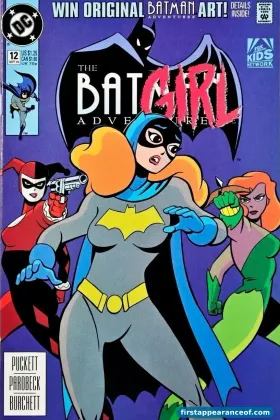
    Hamill's voice performance is the reference for every animated or game Joker that followed. Introduced Harley Quinn in Batman Adventures #12.

  4. 2008

    The Dark Knight

    Film

    Starring:Heath Ledger

    Christopher Nolan's film. Ledger's performance won a posthumous Academy Award.

  5. 2016

    Suicide Squad

    Film

    Starring:Jared Leto

    DCEU entry. Divisive reception.

  6. 2019

    Joker

    Film

    Starring:Joaquin Phoenix

    Todd Phillips's standalone character study. Phoenix won the Academy Award for Best Actor. Grossed over $1 billion worldwide.

  7. 2022

    The Batman

    Film

    Starring:Barry Keoghan

    Matt Reeves's film. Joker appears briefly at the end, setting up the Reeves sequel.

  8. 2024

    Joker: Folie à Deux

    Film

    Starring:Joaquin Phoenix

    Musical sequel to the 2019 film. Lady Gaga co-stars as Harley Quinn.

Frequently asked questions

The questions readers and collectors ask most.

Who created the Joker?

The Joker was created by writer Bill Finger, penciller Bob Kane, and character designer Jerry Robinson. DC's current credits list all three. The attribution is contested: Robinson said he originated the playing-card-joker visual concept. Kane said the character was his idea based on Conrad Veidt's performance in the 1928 film The Man Who Laughs. Finger wrote the debut story. Historians generally treat Robinson as the primary visual creator and Finger as the writing creator.

What is the Joker's first appearance?

The Joker's first appearance is Batman #1 (April 1940), in a 12-page story titled simply 'The Joker.' Written by Bill Finger, pencilled by Bob Kane. The same issue contains Catwoman's first appearance and is Batman's first solo title.

What is the Joker's real name?

The Joker does not have a canonical real name. Alan Moore's The Killing Joke (1988) proposed a specific origin (a failed stand-up comedian who falls into a vat of chemicals after a bad day), which later writers have alternately canonized and retconned. Geoff Johns's Three Jokers (2020) proposed three distinct Jokers across DC continuity. The character's namelessness is a deliberate editorial choice maintained since 1940: the Joker is the one major villain whose real-name mystery is part of the brand.

Is Batman #1 the first appearance of Catwoman too?

Yes. Batman #1 contains three landmark first appearances: the Joker (in the lead story), Catwoman (introduced as The Cat in a separate story later in the issue), and the first expanded retelling of Batman's origin. This makes Batman #1 one of the most valuable Golden Age comics in existence. A CGC 9.2 copy sold at Heritage Auctions in 2021 for $2.22 million.

Who is the definitive Joker actor?

There isn't one. The character's durability comes from resisting definitive interpretation. Jack Nicholson (1989) established the A-list film Joker. Mark Hamill (1992 onward) is the reference voice Joker. Heath Ledger (2008) won an Academy Award for a chaos-agent version. Joaquin Phoenix (2019, 2024) won one for a character-study version. The Joker is specifically a role where the best-known performances don't reduce to a single portrayal.

Related characters