Creation Story
Harley has four distinct firsts (animated debut, first comics appearance, origin one-shot, first in main DC continuity), and the distinction between them is the entire reason the True First Appearance guide exists.
Harley Quinn is the most successful character in modern comics history to have been created for animation first and comics second. Her origin story is not about a new writer pitching a new villain. It is about a voice actor, a one-episode gag, and two creators who realized halfway through production that the henchperson they had written for a single scene was the best thing in the script.
Paul Dini was writing a Batman: The Animated Series episode called “Joker’s Favor” in early 1992. The Joker needed a henchperson to follow him into a scene. Bruce Timm, the show’s co-creator and designer, was sketching the episode. Dini had recently seen an old Arleen Sorkin dream-sequence clip from Days of Our Lives in which Sorkin wore a harlequin jester costume. The image stuck. Dini and Timm wrote the henchperson as a jester-costumed sidekick, called her Harley Quinn as a bilingual pun on “harlequin,” and asked Sorkin to voice her.
Sorkin’s Brooklyn-inflected delivery, physical-comedy rhythm, and manic affection for the Joker were improvised into the booth and then written back into subsequent scripts. Within a handful of episodes, Harley had graduated from one-off bit to recurring character, then to fan favorite, then to the single most-requested animated character DC had produced since the original Super Friends era.
The episode “Joker’s Favor” aired on Fox Kids on September 11, 1992. That broadcast is, by any reasonable standard, Harley Quinn’s first appearance.
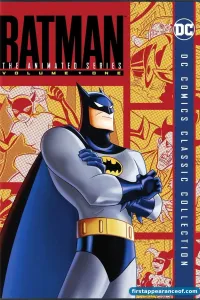
Batman: The Animated Series, "Joker's Favor" (1992) — Animated Debut
The episode is not a Harley showcase. She appears in a single scene as the Joker’s henchperson, delivering setup dialogue and reacting to the Joker’s punchlines. But the performance established every key beat that carried into three decades of subsequent work: the voice, the costume, the physical comedy, the pathology of devotion to the Joker, and the clear sense that this character was funnier and stranger than the role the script had given her.
For collectors, the episode exists as animation production material — original cels, production art, storyboards, and archival releases on home video. Physical memorabilia from this first appearance is rare, valuable, and handled through animation-specific auction houses rather than comics grading services. The episode is the foundation of every other Harley first.
The Batman Adventures #12 (1993) — First Comics Appearance and First Cover
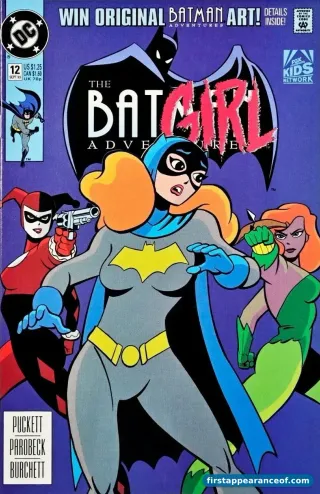
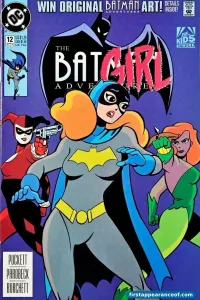
A year after the BTAS debut, DC launched The Batman Adventures, an all-ages title set in the animated continuity. Kelley Puckett wrote, Mike Parobeck and Rick Burchett drew, and the book functioned as a written extension of the TV show. Harley’s popularity on the cartoon justified promoting her to the comics line, and The Batman Adventures #12 put her on the cover beside the Joker in a story titled “The Last Laugh?”.
This is Harley’s first appearance on a printed page and her first cover. It is also her first paper collectible and, by far, the most valuable Harley book on the secondary market. The issue was printed in direct-market and newsstand editions and the newsstand variant is meaningfully scarcer. CGC 9.8 populations for both variants are modest, and the newsstand is tiered higher.
An important caveat: The Batman Adventures is not considered DC Universe main continuity. The line is an all-ages tie-in to the animated series, set in the DC Animated Universe (sometimes called the Timmverse or DCAU). For 1st-app collectors, this is the first comics appearance and the first cover; it is not the first in main DC continuity. That distinction matters, and it is why Harley has four firsts on this page rather than two.
The Batman Adventures: Mad Love (1994) — Origin
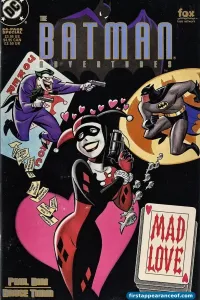
Paul Dini and Bruce Timm wrote and drew a prestige-format one-shot titled The Batman Adventures: Mad Love in 1994. The book is the single most important Harley Quinn story ever published. It tells her complete origin: Dr. Harleen Quinzel, newly minted psychiatrist, takes an internship at Arkham Asylum, is assigned to the Joker, and gradually falls into obsessive devotion. The transformation from Quinzel to Harley Quinn happens inside this book, with the psychological pathology rendered by Dini’s script and the character work carried by Timm’s art.
Mad Love won the Eisner Award for Best Single Issue in 1994 and has been reprinted in every major Harley collection since. It is set in the DCAU, not in main DC continuity — which is why Harley gets a separate continuity first entry. The Mad Love origin is nevertheless the canonical origin template that every subsequent adaptation (Suicide Squad 2016, Birds of Prey 2020, the animated series) has used as its foundation.
Batman: Harley Quinn (1999) — First Appearance in Main DC Continuity
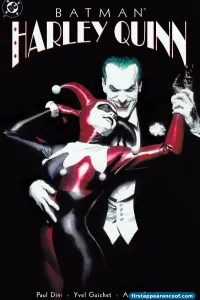
Harley spent seven years as an animation-continuity character before DC formally introduced her into the main DC Universe. That arrival is the Batman: Harley Quinn prestige one-shot, published October 1999, written by Paul Dini with art by Yvel Guichet. The book is set during the No Man’s Land event and folds Harleen Quinzel into DCU continuity with a new origin that parallels but does not duplicate Mad Love. From this point forward, Harley is a DCU character in good standing.
Why this is a distinct first: DC’s internal continuity structure treats the Animated Universe as a separate imprint. Characters who originated there and were later imported into the DCU have a continuity first that is structurally identical to what Marvel does with MAX or Ultimate characters who cross into 616 continuity. Harley’s first DCU appearance is a separate key from her first comics appearance. Both issues are real firsts, both are valuable, and both mark different moments in the character’s evolution.
For serious collectors, the complete Harley Quinn first-appearance set is:
- BTAS “Joker’s Favor” (Sept 1992) — animated debut, the true origin.
- Batman Adventures #12 (Sept 1993) — first comics appearance, first cover, top printed key.
- Batman Adventures: Mad Love (1994) — origin story, Eisner-winning one-shot.
- Batman: Harley Quinn (Oct 1999) — first in main DCU continuity.
Owning all four is the complete first-appearance run.
Legacy
Harley Quinn is the rare character who graduated from supporting animation role to genuine franchise lead. She has headlined multiple ongoing comic series, two live-action films, a long-running HBO Max adult animated series, video games, merchandise lines, and cultural references that extend well outside comics fandom. She is routinely cited among the few characters created since 1980 who have achieved the same cultural footprint as Golden and Silver Age originals.
Margot Robbie’s live-action performance across Suicide Squad (2016), Birds of Prey (2020), and The Suicide Squad (2021) cemented the modern Harley aesthetic in mass culture. Kaley Cuoco’s HBO Max series has given her an irreverent adult-animation home for the character’s voice through four seasons. And Arleen Sorkin, who passed away in 2023, remains the performance foundation that all subsequent interpretations circle back to.