Who are the Brotherhood of Mutants
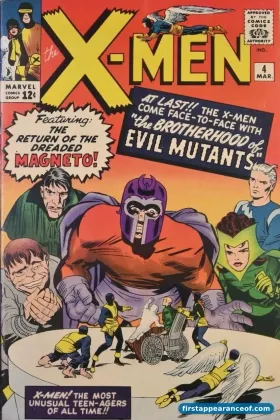
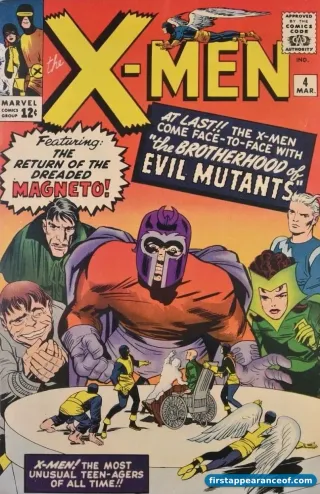
The Brotherhood of Mutants is the X-Men’s dark mirror: a mutant team that takes the same persecution the X-Men face and draws the opposite conclusion. Where Xavier preaches coexistence, the Brotherhood answers with mutant supremacy. It debuted, as the Brotherhood of Evil Mutants, in X-Men #4, cover-dated March 1964, by Stan Lee and Jack Kirby.
It has never been one fixed group. The name is an argument, and different leaders have picked it up to make that argument their way, so the eras below track the roster.
Magneto’s Brotherhood (1964)
Roster: Magneto, Mastermind, the Toad, Quicksilver, and the Scarlet Witch.
The original lineup arrived in X-Men #4, the X-Men’s first recurring antagonists. The issue carries real collector weight beyond the team itself, because Quicksilver and the Scarlet Witch debut here, the twins who would soon reform, join the Avengers, and become two of Marvel’s most-used characters.
Mystique’s Brotherhood (1981)
Roster: Mystique, Destiny, Avalanche, Pyro, and the Blob.
The most famous later version is Mystique’s, introduced in the run-up to Days of Future Past. This Brotherhood tried to assassinate a US senator, the act that sets the dystopian future in motion, and it was later coerced into government service as Freedom Force.
Later incarnations
Roster: varies, from Toad’s team to Exodus’s Acolyte-adjacent groups.
The Brotherhood has reformed repeatedly under whoever wants to carry the supremacist banner, which keeps the team current as the X-line’s political climate shifts. The constant is the role, not the membership.
Notable issues
- X-Men #4 (1964): first appearance of the Brotherhood; first Quicksilver and Scarlet Witch.
- X-Men #141 (1981): Mystique’s Brotherhood and the opening of Days of Future Past.
For collectors
X-Men #4 (1964) is the key, and it is valuable for two reasons at once: the first Brotherhood and the first appearances of Quicksilver and the Scarlet Witch. It is one of the stronger Silver Age X-Men back issues outside Giant-Size X-Men #1 and the original X-Men #1.