Creation Story
The Hulk was Stan Lee’s try at adapting classic horror-film archetypes for the superhero readership. Boris Karloff’s Frankenstein’s Monster and Robert Louis Stevenson’s Dr. Jekyll and Mr. Hyde are the two sources Lee cited most often. The pitch was to take Jekyll and Hyde’s loss-of-control transformation and fuse it with Frankenstein’s sympathetic-monster framing, then run that combination through the Cold War nuclear-age anxiety that superhero books were leaning into in 1962. Atomic-age science gives Bruce Banner the trigger; the psychology of repression gives him the transformation cycle.
Jack Kirby drew the debut issue and designed the original gray look. Kirby’s Hulk in 1962 is visibly a Frankenstein’s Monster reference: flat-topped hair, heavy brow, deliberate ungainliness. The green color, which became the character’s permanent identity, arrived in issue #2 as a production workaround. Marvel’s ink supplier was not producing consistent gray reproduction on newsprint stock; panels varied from near-black to nearly-white within a single issue. Lee and Kirby switched to green, which reproduced cleanly, and the color stuck.
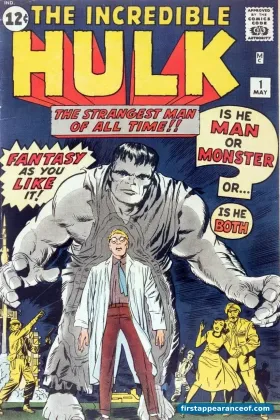
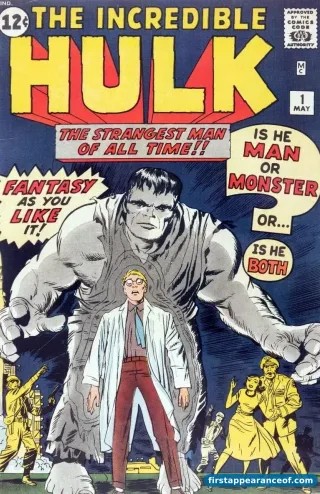
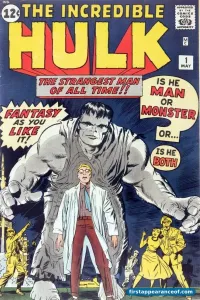
First Appearance, First Cover, First Solo Title: The Incredible Hulk #1
The Incredible Hulk #1, cover-dated May 1962, does three jobs at once: first appearance, first cover, and first issue of the character's own series. That is unusual. Most [Silver Age](/eras/silver-age/) Marvel heroes debuted inside an anthology before earning a title; the Hulk launched straight into one.The story opens at a New Mexico test site. Banner has built a gamma bomb for the military, working under General Thaddeus “Thunderbolt” Ross, whose daughter Betty is there too. A teenager named Rick Jones drives onto the range on a dare. Banner runs out to push him into a protective trench and takes the gamma blast himself. That night he transforms for the first time. The debut also introduces the Soviet spy Igor and the issue’s antagonist, the Gargoyle, Yuri Topolov, a Soviet scientist deformed by his own radiation work, which makes him a deliberate mirror of Banner.
The single most-asked question about this book is the color. The Hulk is gray on the cover and throughout the interior, and he is gray for one issue only.
Gray to green
Lee picked gray on purpose. He didn’t want the Hulk’s skin to imply any particular ethnicity, and gray read as neutral and monstrous at once. The problem was production. Gray printed terribly on 1962 newsprint, coming out in different shades from page to page within the same copy. Rather than fight the presses, the team switched to green starting with issue #2, and green reproduced cleanly.
So the defining visual of one of the most recognizable characters in comics is, at root, a printer’s workaround. The afterlife of that accident is the best part: in 1988, Peter David brought the gray Hulk back as a separate personality, the Las Vegas enforcer Joe Fixit, which retroactively turned a 1962 ink problem into canon. The mistake became lore.
Cancelled, then saved
The original series was a flop. It ran six issues and was cancelled in 1963. The first year couldn’t decide what the book was: the Hulk was gray, then green, changed at night, then by emotion, was piloted by Rick Jones, was a monster, then an antihero. The inconsistency showed in the sales.
What saved him was exposure elsewhere. Lee and Kirby made the Hulk a founding member of the Avengers in 1963, even though he quit the team almost immediately. The character then landed a feature in the anthology Tales to Astonish in 1964, sharing the book with Giant-Man. Four years of steady stories there rebuilt him, and in 1968 Tales to Astonish was renamed The Incredible Hulk with issue #102, keeping the old numbering. The cancelled monster had his own title again, and this time it lasted.
The Peter David decade
The writer who shaped the modern Hulk wasn’t Lee. Peter David took over in the late 1980s and stayed for roughly a decade, ending with issue #467 in 1998, one of the longest single-writer runs on any Marvel title. David is responsible for most of the texture readers now take for granted: Joe Fixit, the multiple-personality framework, and Professor Hulk, the 1991 fusion of Banner’s mind with the Hulk’s body. When a modern Hulk story leans on the idea that Banner and the Hulk are several people sharing one body, it is building on David.
The character kept generating landmark runs after him. Greg Pak’s Planet Hulk (2006) exiled him to a gladiator world; Al Ewing and Joe Bennett’s Immortal Hulk (2018) rebuilt him as outright horror across fifty issues, the most acclaimed take in years.
On screen
The Hulk became famous on television before the comic ever broke through. The CBS live-action series, starting in 1977 with Bill Bixby as Banner and bodybuilder Lou Ferrigno as the Hulk, ran five seasons and reached an audience the book never touched. It made its own changes, renaming Banner “David,” painting Ferrigno green, and ending episodes on Banner walking a lonely highway, but it fixed the character in the public mind.
Film took longer. Ang Lee’s Hulk (2003) with Eric Bana was an ambitious, divisive misfire that got no sequel. The 2008 reboot, The Incredible Hulk, gave the role to Edward Norton for a single film. It stuck with Mark Ruffalo, who debuted in The Avengers (2012) and has played Banner across the MCU since, including the Planet Hulk-flavored Thor: Ragnarok (2017). Ruffalo’s version finally made the Hulk work on screen the way he works on the page: best in an ensemble, a problem the other heroes have to manage.
Why the Hulk’s continuity is confusing
No major Marvel character has a messier paper trail, and most of the confusion comes from the publishing history rather than the stories. The original Incredible Hulk ran six issues and was cancelled in 1963. The character then spent four years as a back-up feature in the anthology Tales to Astonish, from issue #59 in 1964 through #101. In 1968 that anthology was simply renamed: Tales to Astonish #101 was followed by The Incredible Hulk #102, with the numbering carried straight over. So the Hulk’s “second” first issue is #102, and there is no Incredible Hulk #7 through #101 at all. That single renumbering trips up almost everyone.
The in-story continuity is just as layered, because the Hulk has been several different characters under one name. He has changed colors (gray, then green), changed triggers (nightfall, then emotion), and changed minds. Peter David’s Professor Hulk arc (The Incredible Hulk #377, 1991) merged Banner’s intellect with the Hulk’s body into a single integrated personality, and the multiple-personality framework David built — Banner, the savage green Hulk, the cunning gray Joe Fixit, and Professor Hulk as the synthesis — is still the model the comics use. Most modern readers meet the character through Ruffalo’s MCU version, which borrows Professor Hulk for its personality and Greg Pak’s Planet Hulk for the Sakaar half of Thor: Ragnarok, so even the screen Hulk is a composite of separate comics eras.
For collectors
The Incredible Hulk #1 is a top-tier Silver Age key, in the conversation with Fantastic Four #1 and Amazing Fantasy #15. High grades are genuinely scarce, a direct result of that six-issue cancellation and poor sell-through, and prices climbed sharply through the Ruffalo era; clean copies are six and seven figures. A specific collector’s warning applies here: the cover’s large gray field hides color touch-ups well, so restoration is common, and any high-grade copy is worth buying graded.
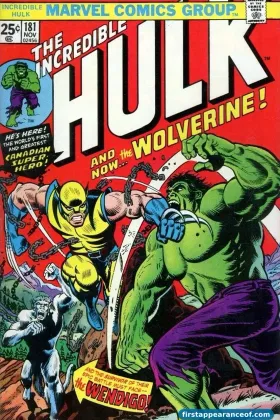
The other Hulk-shelf keys are mostly other characters’ debuts wearing a Hulk logo. The Incredible Hulk #181 (1974) is Wolverine’s first full appearance, the most valuable book with “Hulk” on the cover, and not a Hulk key at all. Among genuinely Hulk-driven issues, #347 (first Joe Fixit) and #377 (first Professor Hulk) are the Copper Age targets, and Immortal Hulk #1 (2018) is the modern one.