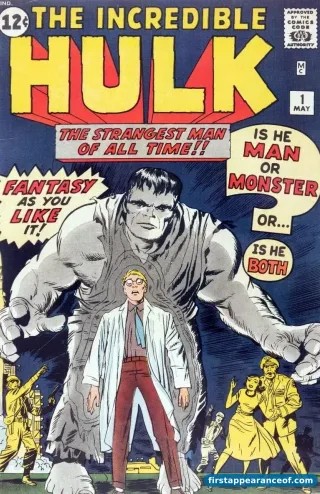
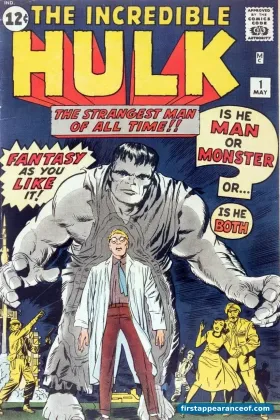
The Incredible Hulk #1 (1962). Rick Jones is the small figure looking up at the Hulk on the cover. His debut and the Hulk's are the same book.

1st Appearance and 1st Cover

First Appearance of Rick Jones

The Incredible Hulk #1

May 1962 · Marvel · Silver Age

The kid who caused the Hulk by accident and never stopped trying to make it right. The most-used civilian in the Marvel Universe.

Key Issue

Created by Stan Lee · Jack Kirby

By Atomm Updated

The first appearance (1st app) of Rick Jones is The Incredible Hulk #1 (May 1962), created by Stan Lee and Jack Kirby. Rick is the teenager whose stunt drive onto a New Mexico gamma-bomb test site triggers the Hulk's origin. Banner pushes him to safety and takes the blast himself. Rick spends the next six decades attached to the Hulk as the closest thing the character has to a permanent friend, and he keeps appearing across other corners of the Marvel Universe at moments that matter: he triggers the formation of the Avengers in Avengers #1, replaces Bucky as Captain America's wartime-style sidekick during the Silver Age, and becomes the host for the Nega-Bands during the Mar-Vell era of Captain Marvel. He has died and come back at least three times.

Quick Facts

Debut
The Incredible Hulk #1 (May 1962)
Real name
Richard Milhouse Jones
Creators
Stan Lee (writer, co-creator), Jack Kirby (artist, co-creator)
Publisher
Marvel Comics
First enemy
The Gargoyle (alongside Banner, in the same issue)
First ally
Bruce Banner / The Hulk
Team affiliations
Avengers (helped form the team in Avengers #1, served as Bucky-replacement to Captain America), Hulkbusters, briefly Captain Marvel via the Nega-Bands

First Appearance

  1. The Incredible Hulk #1 cover
    First Appearance First Cover May 1962

    The Incredible Hulk #1

    By Stan Lee, Jack Kirby

    Lee writes; Kirby pencils. Rick is the teenage civilian whose stunt drive onto the gamma-bomb test site triggers the entire Hulk premise. Banner saves him; the gamma blast hits Banner; Rick spends the next 60 years feeling responsible for it. He is the longest-running supporting character in the Marvel Universe attached to a single hero.

    Read the full breakdown

Creation Story

Stan Lee needed someone for the Hulk to talk to. Bruce Banner alone is a scientist with a problem. The Hulk alone is a monster. The interesting story sits in between, and the structure for that kind of story usually involves a third party: someone who knows both, who travels with both, who is small enough to be in danger and cheap enough (in story terms) to die later if the writer needs the stakes. Rick Jones was that third party. Lee wrote him as a teenage drifter, no parents around, a CB radio in his pocket and a habit of putting himself in places he should not be. Jack Kirby drew him as physically small, almost cartoonish next to Banner and the Hulk, which kept the size relationships legible in the panels.

The choice that mattered most about Rick was that he was not a sidekick in the Bucky tradition. He did not put on a costume in Hulk #1. He did not get powers. He stayed civilian, and that civilian-ness was a tool. When Lee needed the Hulk to be sympathetic, Rick was there to register the sympathy. When the next writer needed the Avengers to form, Rick had a CB radio. When Roy Thomas needed Mar-Vell to have a human anchor, Rick was the only Marvel character with the right shape: civilian, mobile, narratively expendable but emotionally familiar.

Rick has been the connective tissue between Marvel franchises in a way that no costumed character is allowed to be. He did Hulk, Avengers, Captain America, Captain Marvel. He has died at least three times. He has been brought back at least three times. The longevity is not because Rick is a strong character; it is because the Marvel writer’s room keeps needing the type, and Rick already is the type. Removing him would mean inventing a replacement, which is harder than just finding a way to bring him back.

The character has aged in awkward ways. The teenage civilian who happens to be at every superhero scene reads less natural in the 21st century, where the universe is bigger and the supporting cast is more specialized. Rick spent most of the 2000s and 2010s as a character writers used and put back in the box. The Peter David Hulk: The End one-shot from 2002 is the strongest treatment of the character in the modern era because it lets Rick age with Banner. He is still alive at the end of the world, still carrying the same guilt he had on page one of Hulk #1, only now there is no one left to share it with.

He has not appeared on screen in a meaningful way. He shows up briefly in some Hulk-adjacent media. The MCU has not used him because the role he plays is partly absorbed by Bruce Banner himself in the Ruffalo framing (the self-reflective Banner who has a relationship with his own monstrous half does not need a Rick), and partly absorbed by other supporting roles like Betty Ross or Tony Stark. Rick is a character whose value is more visible to long-time comics readers than to anyone watching the films.

First Appearance and First Cover: The Incredible Hulk #1

Rick is on the cover of Hulk #1. He is the small figure on the right, looking up at the Hulk, scared. The composition does the work the writing has to do: the Hulk is enormous; Rick is the human reader-stand-in inside the panel. Without Rick on the cover, the Hulk image is just a monster shot. With Rick there, you have a story.

Inside the book, Rick is a teenager from nowhere in particular. Lee never specified the parents-or-no-parents detail in the first issue, but the way Rick behaves (driving onto a military test site for a stunt, being available to follow Banner around afterward) makes the no-supervision read implicit. Banner pushes him into a trench. The gamma bomb goes off. Rick is fine. Banner is not. Rick spends the rest of the issue and most of the next year following Banner around, trying to help, mostly failing.

For collectors, Rick’s first appearance is the same as the Hulk’s, so the price is the Hulk’s price. There is no sub-market for a Rick Jones key. This matters because Rick is one of the most-referenced supporting characters in Marvel history, and yet his debut commands no incremental premium beyond what a Hulk first commands. If you own Hulk #1, you own Rick’s first too. There is no second issue or first cover or first solo to chase, because Rick has never headlined a series in his own name (the Captain Marvel run is structurally a Mar-Vell book, even when Rick is on the cover).
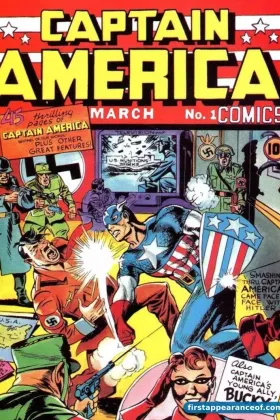
Key subsequent appearances

After the debut, these are the issues collectors and historians reach for next.

  1. 1963

    The Avengers #1

    Rick's CB radio summons Thor, Iron Man, Hulk, and the rest. He is the reason the Avengers exist as a team. Lee writes; Kirby pencils.

  2. 1964

    The Avengers #4

    Rick is in the issue when the Avengers thaw out Captain America. He becomes Cap's adoptive Bucky-replacement for the next several issues, which is one of the more poignant subplots Lee ever wrote.

  3. 1969

    Captain Marvel #17

    Rick becomes the human host who shares space-time with Mar-Vell through the Nega-Bands. The 'switch places between Earth and the Negative Zone' framing was Roy Thomas's idea. The Nega-Band bond is the longest non-Hulk relationship Rick has.

  4. 2002

    Hulk: The End

    Peter David and Dale Keown's elegiac one-shot. Rick is the last human alive in the post-apocalyptic future. Hulk and Rick's relationship is the spine of the issue.

Frequently asked questions

The questions readers and collectors ask most.

What is Rick Jones's first appearance?

The Incredible Hulk #1 (May 1962), Lee and Kirby. Rick debuts in the same issue and same scene that introduces Bruce Banner and the Hulk. He is the civilian Banner saves at the bomb test, which means his first appearance and the Hulk's are inseparable. There is no precursor issue, no cameo. The character was built into the premise from page one.

Why is Rick Jones in so many Marvel comics?

Stan Lee used him as a flexible utility character through most of the 1960s. Rick was the kid with no powers who could plausibly be present at any superhero scene. He calls in the Avengers in Avengers #1. He replaces Bucky in Captain America's life. He gets bonded to Mar-Vell as Captain Marvel's human partner. None of those moves were planned in 1962; they emerged as Lee and the post-Lee writers reached for a connective character. Rick is the load-bearing supporting character of the early Marvel Universe.

Did Rick Jones ever become a hero himself?

Sort of, repeatedly. He carried the Nega-Bands as Mar-Vell's partner from Captain Marvel #17 onward. He briefly became A-Bomb (a blue Hulk-style transformation) during Jeph Loeb's Hulk run in 2008. He has worn the Bucky costume more than once as Cap's partner. He has died and returned. None of these have stuck as the primary framing for the character because the actual job he does, structurally, is being the civilian friend who lives at the edge of the Hulk's life.

Is Hulk #1 a Rick Jones key?

Yes, technically. Hulk #1 is the first appearance of Rick Jones, Bruce Banner, the Hulk, Betty Ross, and General Thaddeus Ross. Most collectors do not value it as a Rick Jones key because Rick's collector premium is folded entirely into the Hulk premium. There is no separate market for a Rick Jones first appearance. The book is valued on the Hulk debut alone, which is fine, but it does mean Rick is one of the more historically significant Silver Age characters whose name does not show up in price-guide listings.