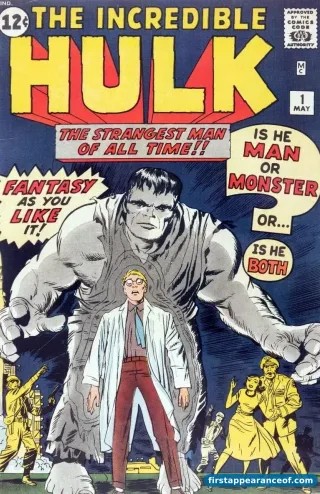
The Incredible Hulk #1 (1962). Betty Ross does not appear on the cover; her debut is in the interior pages alongside her father General Ross and Bruce Banner.

1st Appearance

First Appearance of Betty Ross

The Incredible Hulk #1

May 1962 · Marvel · Silver Age

The civilian load-bearing point of the Hulk's emotional life. Daughter of his hunter, wife of his quieter self.

Key Issue

Created by Stan Lee · Jack Kirby

By Atomm Updated

The first appearance (1st app) of Betty Ross is The Incredible Hulk #1 (May 1962), created by Stan Lee and Jack Kirby. Betty is the daughter of General Thunderbolt Ross, the military commander overseeing the gamma bomb test that creates the Hulk. She becomes Bruce Banner's primary love interest in the series and eventually his wife. Liv Tyler played her in The Incredible Hulk (2008). Jennifer Connelly played her in the 2003 Ang Lee version. In the comics she briefly carried a transformation of her own as Red She-Hulk during Jeph Loeb's 2008-onward Hulk run, which ran for about three years before Marvel quietly walked it back.

Quick Facts

Debut
The Incredible Hulk #1 (May 1962)
Real name
Elizabeth Ross (Banner)
Creators
Stan Lee (writer, co-creator), Jack Kirby (artist, co-creator)
Publisher
Marvel Comics
First enemy
The Gargoyle (in the same issue)
First ally
Bruce Banner (her future husband)
Team affiliations
Hulk supporting cast (decades-long); briefly Red She-Hulk during Jeph Loeb's late-2000s Hulk run

First Appearance

  1. The Incredible Hulk #1 cover
    First Appearance May 1962

    The Incredible Hulk #1

    By Stan Lee, Jack Kirby

    Lee writes; Kirby pencils. Betty debuts in the same issue as the Hulk and her father, General Thaddeus 'Thunderbolt' Ross. Daughter of Banner's military overseer, eventual love interest and wife. The Banner-Ross-Banner triangle (scientist, daughter, soldier-father) is the load-bearing structure of the Hulk's supporting cast for the next 60 years.

    Read the full breakdown

Creation Story

Stan Lee built the Hulk’s emotional life around a civilian woman whose father was the man trying to kill the monster her boyfriend turned into. That triangle is the entire premise. Without it the Hulk is a chase scene; with it, you have a story you can run for sixty years. Lee figured this out on the first issue and the structure has not changed.

Betty in 1962 is a Lee love-interest in the standard Marvel mode. Demure, loyal, mostly there to be in danger when the writer needs Bruce Banner to have something to lose. Kirby’s design is plain by intention. She was not meant to be a visual statement. The visual statement was the Hulk. Betty was the steady eye in the room, the one whose face you watched to see how scared you should be.

She has aged better than most Silver Age love interests, not because she has been written more progressively (she has not, mostly) but because the role she occupies is structurally important enough that successive writers have had to reckon with her. Roger Stern, Bill Mantlo, John Byrne, Peter David, Jeph Loeb: every long-form Hulk writer has had a Betty take. Peter David’s was the most influential. David positioned Betty as the slow gamma-poisoning subplot during his eleven-year run, which ended with her death in #466. The death stuck for a few years and reframed the Banner-Hulk dynamic in ways that still echo.

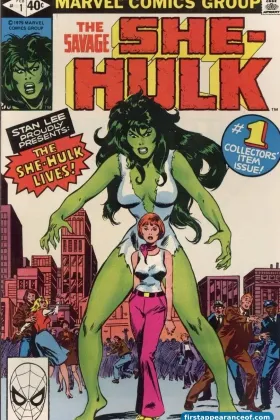
The Red She-Hulk arc under Jeph Loeb in 2009 is the only sustained attempt to give Betty her own power identity. It ran about three years and Marvel walked it back. The reasons it did not stick are the same reasons most Betty-as-hero attempts do not stick: her structural job is being the civilian, and powers undo the structural job. Removing her civilian-ness removes the emotional pivot the Hulk franchise has depended on since 1962.

Liv Tyler played her in 2008 and Jennifer Connelly played her in 2003. Connelly’s performance is the better one and it sits in a film most people do not rewatch. Tyler’s is the more visible. Neither has been brought back. The MCU has effectively retired the character as a live-action presence, which has not stopped Marvel Studios from referencing the Banner-Ross relationship indirectly in later films through other family members (General Ross is now William Hurt’s Thunderbolt Ross and now Harrison Ford’s Red Hulk, but Betty as a person is gone).

First Appearance: The Incredible Hulk #1

Betty’s debut is on the interior pages of Hulk #1. She is at the New Mexico bomb test site as part of her father’s command staff. She meets Banner before the bomb goes off. Lee’s dialogue is light: a brief flirtation, an acknowledgment that they have known each other through the project, the establishing shot that Betty respects Banner’s mind. After the gamma blast, when Banner returns to base looking shaken but not yet visibly transformed, Betty is the one who registers that something is wrong with him before anyone else does.

The first cover does not show her. The composition (Hulk looming, Rick Jones small) does not have room for the supporting cast. Betty’s debut is therefore an interior-page first appearance, which is the standard mode for love interests in Silver Age books and is part of why her market premium is hidden inside the Hulk premium. There is no Betty-specific cover image to compete with.

For collectors, the Betty Ross first appearance is identical to the Hulk first appearance. Hulk #1 is the book. There is no second-tier Betty key worth chasing. Her later milestones (the marriage in #319, the death in #466, the Red She-Hulk turn in Hulk #15 Vol. 2) are all priced relative to the surrounding Hulk story rather than as Betty-specific keys. This makes Betty one of the more historically important Silver Age supporting characters with no dedicated collector market of her own.
Key subsequent appearances

After the debut, these are the issues collectors and historians reach for next.

  1. 1976

    The Incredible Hulk Annual #5

    Roger Stern story. Betty's first significant Bronze-Age spotlight outside the standard romantic-subplot framing.

  2. 1986

    The Incredible Hulk #319

    John Byrne run. Betty and Bruce Banner finally get married. Byrne's short Hulk run is uneven but this issue lands.

  3. 1998

    The Incredible Hulk #466

    Peter David's exit issue. Betty dies of gamma exposure she has been absorbing throughout David's run. The death sticks for a few years and is the emotional climax of David's eleven-year arc.

  4. 2009

    Hulk #15 (Vol. 2)

    Jeph Loeb and Ed McGuinness. Betty returns as Red She-Hulk. The transformation is a Loeb invention; reception was mixed and the framing was rolled back over the next few years.

In adaptations

Film, TV, animation, and game appearances.

  1. 2003

    Hulk

    Film

    Starring:Jennifer Connelly

    Ang Lee directs. Connelly plays Betty as the central emotional voice of the film. The performance is well-regarded even by people who do not like the film.

  2. 2008

    The Incredible Hulk

    Film

    Starring:Liv Tyler

    Tyler plays Betty in the second MCU film. Has not been brought back as the character in subsequent MCU appearances; the role was effectively retired.

Frequently asked questions

The questions readers and collectors ask most.

What is Betty Ross's first appearance?

The Incredible Hulk #1 (May 1962), Lee and Kirby. Same issue as the Hulk, Bruce Banner, and General Ross. Betty is on interior pages, not the cover. There is no precursor or cameo issue. The character was built into the original Hulk premise as the love-interest leg of the love-triangle structure that has run through the title for six decades.

Did Betty become a hero?

Briefly, as Red She-Hulk, starting in Hulk #15 (Vol. 2) in 2009 under Jeph Loeb. The transformation was a Loeb invention and ran for about three years before Marvel walked it back to standard-Betty framing. She has not been a regular hero since. The character's primary value to the Hulk franchise is structural (the civilian voice in the room) rather than as a power-set holder, which is why every attempt to give her her own powered identity has been short-lived.

Is The Incredible Hulk #1 a Betty Ross key?

Yes, technically. Three significant Marvel debuts share the issue (Hulk, Rick Jones, Betty Ross, plus General Ross). Collectors do not pay an incremental premium for the Betty Ross debut. Her market value is folded entirely into the Hulk premium. The book is valued on the Hulk first; Betty rides for free.

Who created Betty Ross?

Stan Lee and Jack Kirby co-created Betty in Hulk #1. Lee wrote the love-interest framing; Kirby designed the visual. The Ross family (Betty plus her father General Thaddeus Ross) was conceived as a single supporting-cast unit and has stayed that way; you rarely see one without the other showing up nearby.