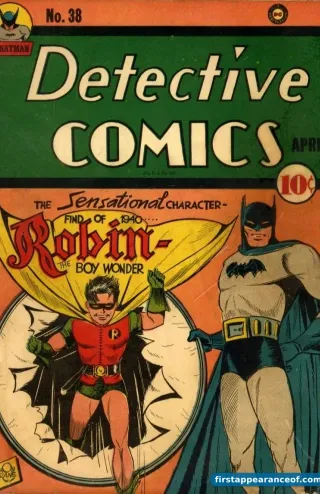
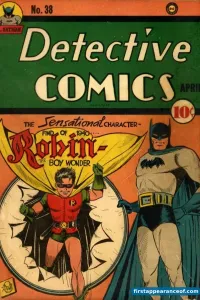
Robin on the cover of Detective Comics #38 (1940), his first appearance.

1st Appearance and 1st Cover

First Appearance of Robin

Detective Comics #38

April 1940 · DC · Golden Age

The first superhero sidekick. Batman's ward, Nightwing's origin, and the character every Teen Titans book has been written around since 1964.

Key Issue

Created by Bob Kane · Bill Finger · Jerry Robinson

By Atomm Updated

The first appearance (1st app) of Robin is Detective Comics #38 (April 1940), created by Bill Finger, Bob Kane, and Jerry Robinson. Dick Grayson debuts as The Boy Wonder, Batman's ward and crimefighting partner, the first kid sidekick in superhero comics and the template every subsequent sidekick follows. Dick retires the Robin name in Tales of the Teen Titans #44 (July 1984) and becomes Nightwing. Jason Todd, Tim Drake, Stephanie Brown, and Damian Wayne have since held the Robin mantle.

Quick Facts

Debut
Detective Comics #38 (April 1940)
Real name
Richard John Grayson
Creators
Bill Finger (script and concept), Bob Kane (byline), Jerry Robinson (art and costume design)
Publisher
DC Comics
First enemy
Tony Zucco, the mobster who killed Dick's parents in the debut issue
First ally
Batman (his mentor and adoptive father)
Team affiliations
Batman Family, Teen Titans (founding member), Justice League

Firsts Timeline

  1. Detective Comics #38 cover
    First Appearance First Cover April 1940

    Detective Comics #38

    By Bob Kane, Bill Finger, Jerry Robinson

    Dick Grayson debuts as Robin, The Boy Wonder. Bill Finger writes; Bob Kane and Jerry Robinson on art (credited to Kane under his contract). The first superhero sidekick. The template every subsequent kid-sidekick in comics builds on.

    Read the full breakdown
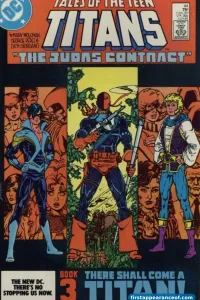
  2. Tales of the Teen Titans #44 cover
    First Appearance as Nightwing July 1984

    Tales of the Teen Titans #44

    By Marv Wolfman, George Perez

    Dick Grayson retires the Robin identity and takes the Nightwing name. Wolfman and Perez's long New Teen Titans run produces the character-defining transition. Jason Todd takes over as Robin shortly after.

    Read the full breakdown

Creation Story

Robin was Bill Finger’s editorial solution to a storytelling problem: Batman, two years into his run, had no one to talk to. Detective Comics’s 1939 Batman was a brooding loner who operated in silence; Finger needed a character Batman could explain his plans to so that readers could follow along. The Robin concept was a young orphan Batman adopts as a ward, trained in the same skills, costumed in contrast to Batman’s dark palette.

Detective Comics #38 (April 1940) introduces Dick Grayson as the youngest son of the Flying Graysons, a circus trapeze act. Mobster Tony Zucco sabotages the trapeze rigging and kills Dick’s parents during a performance. Bruce Wayne, in the audience, adopts Dick as his ward and eventually reveals his Batman identity. Dick trains and becomes Robin, The Boy Wonder. The issue is structurally a complete origin story in twelve pages.

Jerry Robinson designed the costume and the physical character. The red-and-yellow color scheme, the green cape, the domino mask: all Robinson. Bob Kane received the byline per his DC contract but Finger’s writing and Robinson’s art are the actual creative work. Modern DC crediting recognizes all three as co-creators. The Robin visual identity has been essentially unchanged for eighty-five years.

The character worked. Detective Comics #38 sold well, and within a year every major superhero publisher had introduced a kid sidekick in response: Bucky for Captain America (March 1941), Toro for the Human Torch (October 1940), Speedy for Green Arrow (More Fun Comics #73, 1941). Robin is the template.

The Nightwing pivot

Tales of the Teen Titans #44 (July 1984) by Marv Wolfman and George Perez transitioned Dick Grayson from Robin to Nightwing. The story was built into the New Teen Titans run (which had been running since 1980) and treats the transition as a character-driven coming-of-age arc. Dick has grown out of the Robin role, and the Nightwing identity is his first as an adult hero operating independently of Batman.

The pivot made room for Jason Todd (first appeared Batman #357, March 1983) to take over the Robin mantle. Jason’s death in Batman: A Death in the Family (Batman #428, 1988), voted on by readers via a 900-number phone poll, is the single most consequential Robin-related editorial decision in DC’s publishing history.

Collector context

Detective Comics #38 is a foundational Golden Age DC key. High-grade CGC 9.0+ copies have crossed $300,000 at auction. Low-grade reader copies in the mid-five-figure range. The book’s value has held across decades.

Secondary keys: The Brave and the Bold #54 (1964, first Teen Titans prototype). The New Teen Titans #1 (1980, Wolfman-Perez launch). Tales of the Teen Titans #44 (1984, first Nightwing). Batman #357 (1983, first Jason Todd). Batman #428 (1988, Jason Todd’s death).
Key subsequent appearances

After the debut, these are the issues collectors and historians reach for next.

  1. 1940

    Detective Comics #38

    First appearance.

  2. 1947

    Star Spangled Comics #65

    First Solo Feature

    Robin gets his own solo feature in Star Spangled Comics. Runs through the late 1940s.

  3. 1964

    The Brave and the Bold #54

    First Teen Titans

    Robin teams with Aqualad and Kid Flash. Prototype for the Teen Titans formalized the following year.

  4. 1980

    The New Teen Titans #1

    Wolfman-Perez Era

    Marv Wolfman and George Perez launch the defining Teen Titans run. Dick Grayson as team leader.

  5. 1984

    Tales of the Teen Titans #44

    Dick becomes Nightwing. Jason Todd takes Robin mantle.

  6. 1983

    Batman #357

    First Jason Todd

    First appearance of Jason Todd, the second Robin.

  7. 1988

    Batman: A Death in the Family (Batman #428)

    Jason Todd's Death

    Jim Starlin and Jim Aparo. Readers vote by phone to kill Jason Todd. The Joker murders the second Robin.

In adaptations

Film, TV, animation, and game appearances.

  1. 1943

    Batman (serial)

    TV

    Starring:Douglas Croft

    Columbia Pictures fifteen-part serial. First live-action Robin.

  2. 1966

    Batman

    TV

    Starring:Burt Ward

    ABC live-action series. Ward's Robin and the 'Holy ___!' verbal tic defined popular perception for two decades.

  3. 1995

    Batman Forever

    Film

    Starring:Chris O'Donnell

    Joel Schumacher directs. O'Donnell plays Robin across two films.

  4. 2018

    Titans

    TV

    Starring:Brenton Thwaites

    DC Universe / HBO Max series. Thwaites plays Dick Grayson as both Robin and Nightwing.

Frequently asked questions

The questions readers and collectors ask most.

What is Robin's first appearance?

Robin's first appearance is Detective Comics #38 (April 1940), created by Bill Finger, Bob Kane, and Jerry Robinson. Dick Grayson debuts as Batman's ward and sidekick. The character was designed to make Batman more accessible to young readers and to give the hero someone to explain his plans to; the template worked and spawned decades of sidekicks across both DC and Marvel.

Is Detective Comics #38 valuable?

Yes. Detective Comics #38 is a Golden Age DC key and a foundational superhero-comics book. High-grade copies (CGC 9.0 and above) have crossed $300,000 at auction. Low-grade reader copies trade in the low five figures. The book's value has held across decades because Robin is one of the most recognized superhero-sidekick characters in media.

Who created Robin?

Bill Finger wrote the Detective Comics #38 script and provided the character concept. Jerry Robinson designed the costume (red, yellow, and green based on Robin Hood aesthetics) and the physical character. Bob Kane received the byline per his DC contract. Modern DC credits Finger, Kane, and Robinson as co-creators, with Finger and Robinson recognized as the primary creative forces.

How many people have been Robin?

Five in main continuity: Dick Grayson (1940, original), Jason Todd (1983), Tim Drake (1989), Stephanie Brown (2004, briefly), and Damian Wayne (2006). Carrie Kelley was Robin in Frank Miller's The Dark Knight Returns (1986), an alternate-future story that remains influential but is not main continuity. Each Robin has a distinct personality and eventual trajectory: Dick became Nightwing, Jason was killed and returned as Red Hood, Tim eventually operates as Red Robin, Stephanie briefly used the Batgirl name, and Damian is Bruce Wayne's biological son.

When does Dick Grayson become Nightwing?

Tales of the Teen Titans #44 (July 1984), written by Marv Wolfman with art by George Perez. Dick retires the Robin identity during the Wolfman-Perez Teen Titans run and takes the Nightwing name from a Kryptonian story Superman had told him. The transition is the defining Dick Grayson character moment and set up Jason Todd's introduction as the second Robin.