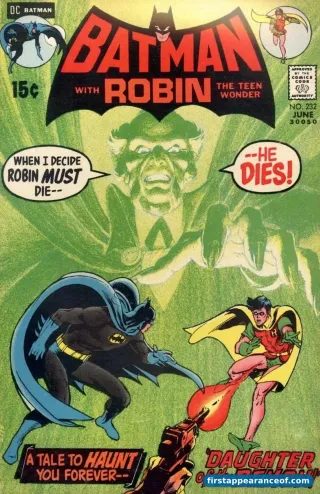
Batman #232 (1971). Ra's al Ghul debuts. Neal Adams cover. The 'Daughter of the Demon' arc.

1st Appearance and 1st Cover

First Appearance of Ra's al Ghul

Batman #232

June 1971 · DC · Bronze Age

Dennis O'Neil and Neal Adams's eco-terrorist immortal. The Bat-villain whose League of Assassins, Lazarus Pits, and intellectual-equal-to-Batman framework reset what Bat-rogues could be in 1971.

Key Issue

Created by Dennis O'Neil · Neal Adams

By Atomm Updated

The first appearance (1st app) of Ra's al Ghul is Batman #232 (June 1971), created by Dennis O'Neil (writer) and Neal Adams (artist). The issue is both his first appearance and first cover. Ra's debuts as a centuries-old immortal eco-terrorist whose League of Assassins operates as a global threat. The O'Neil-Adams Bronze Age Batman run is widely regarded as the foundational modern Batman creative era; Ra's is its most consequential character creation. Liam Neeson played Ra's in Christopher Nolan's Batman Begins (2005) as one of the franchise's most-cited screen Bat-villains.

Quick Facts

Debut
Batman #232 (June 1971)
Real name
Ra's al Ghul (Arabic: 'Head of the Demon')
Creators
Dennis O'Neil (writer, co-creator), Neal Adams (artist, co-creator)
Publisher
DC Comics
First enemy
Antagonist himself.
First ally
Talia al Ghul (his daughter), the League of Assassins
Team affiliations
League of Assassins (founder, leader), occasionally Society of Super-Villains

First Appearance

  1. Batman #232 cover
    First Appearance First Cover June 1971

    Batman #232

    By Dennis O'Neil, Neal Adams

    Dennis O'Neil writes; Neal Adams pencils and provides cover art. Ra's al Ghul debuts as a centuries-old immortal eco-terrorist whose League of Assassins operates as a global threat. The issue is both his first appearance and first cover. The O'Neil-Adams Bronze Age Batman run is widely regarded as the foundational modern Batman creative era; Ra's is its most consequential character creation.

    Read the full breakdown

Creation Story

Ra’s al Ghul is Dennis O’Neil and Neal Adams’s Bronze Age Batman addition and one of the most consequential character creations in DC history. Batman #232 (June 1971) introduces him in a story titled “Daughter of the Demon”: Talia al Ghul (introduced one issue earlier in Detective Comics #411, May 1971) is kidnapped, and Bruce Wayne is recruited by her father Ra’s to help recover her. The framework that defines Ra’s across the next fifty-plus years is essentially complete in the debut.

O’Neil writes; Adams pencils and provides cover art. The Adams visual interpretation (sharp-featured, robed, intellectually formidable) became the canonical Ra’s design that virtually every subsequent comics, animation, and live-action portrayal has preserved.

The character’s structural role is unprecedented for the Batman rogues gallery at the time. Pre-1971 Bat-villains were Gotham-scale antagonists: Joker, Penguin, Riddler, Two-Face all operated within Gotham as criminals or terrorists with finite ambitions. Ra’s al Ghul is global in scope, ideologically motivated (he believes humanity must be culled to preserve the planet), centuries-old, and intellectually positioned as Batman’s equal. The framework reset what a Bat-villain could be and influenced subsequent character creation across DC and Marvel.

The Lazarus Pits

Batman #235 (September 1971) introduced the Lazarus Pit, the chemical-mystical resurrection pool that explains Ra’s al Ghul’s centuries-long lifespan. The Pit framework gave the character a reusable in-fiction mechanic: Ra’s can be killed but always returns; the cost is temporary madness post-resurrection that constrains the character’s tactical capability for a window after each Pit use.

The Lazarus Pit framework expanded over subsequent decades. Talia, Damian Wayne, Jason Todd, and various other DC characters have been resurrected through Pits. The Pit is one of the most-borrowed plot devices in the broader DC catalogue.

The Damian Wayne lineage

Batman: Son of the Demon (October 1987) by Mike W. Barr and Jerry Bingham was a prestige one-shot in which Bruce Wayne and Talia al Ghul’s relationship produced a son. The arc was originally non-canonical; for nearly two decades the Damian Wayne character existed only in the Son of the Demon framework.

Grant Morrison’s Batman & Son arc (Batman #655 to #658, September to December 2006) integrated Damian Wayne into mainstream DC continuity as Bruce and Talia’s son. Morrison’s framework made Ra’s al Ghul Batman’s father-in-law (informally) and Bruce Wayne’s son’s grandfather. The three-generation family framework gave Ra’s al Ghul his most extensive modern character work.

The screen tradition

David Warner’s Ra’s al Ghul in Batman: The Animated Series (1992 to 1995) is widely regarded as the definitive animated portrayal. Liam Neeson’s Ra’s in Batman Begins (2005, Christopher Nolan) is the canonical screen Ra’s; Neeson’s performance is one of the most-cited screen Bat-villain interpretations. Matt Nable’s Ra’s in Arrow (The CW, season three) and Alexander Siddig’s Ra’s in Gotham (Fox, seasons three and four) provide alternate-register modern portrayals.

Collector context

Batman #232 is the Ra’s al Ghul Bronze Age first-appearance key. High-grade CGC 9.6+ copies have crossed $1,500 at auction. Neal Adams’s cover is one of the strongest Bronze Age Batman covers and contributes meaningfully to the book’s collector demand.

Secondary keys: Detective Comics #411 (May 1971, first Talia al Ghul, technically predates Ra’s by one month). Batman #235 (September 1971, first Lazarus Pit). Batman: Son of the Demon (1987, original Damian Wayne conception). Batman #655 (September 2006, Damian Wayne canonical introduction).
Key subsequent appearances

After the debut, these are the issues collectors and historians reach for next.

  1. 1971

    Batman #232

    First appearance and first cover.

  2. 1971

    Batman #235

    First Lazarus Pit

    Dennis O'Neil and Neal Adams. First appearance of the Lazarus Pit, the chemical-mystical resurrection device that explains Ra's al Ghul's centuries-long lifespan.

  3. 1987

    Batman: Son of the Demon

    Damian Wayne Conception

    Mike W. Barr writes; Jerry Bingham pencils. Bruce Wayne and Talia al Ghul's relationship produces Damian Wayne in this prestige one-shot. The arc was originally non-canonical; subsequent continuity (post-2006 Grant Morrison run) integrated Damian as canonical.

  4. 2006

    Batman & Son #1 (Batman #655)

    Damian Wayne Mainstream

    Grant Morrison and Andy Kubert. Damian Wayne integrated into mainstream DC continuity as Bruce and Talia's son. Establishes the Ra's-Bruce-Damian three-generation family framework.

In adaptations

Film, TV, animation, and game appearances.

  1. 1992

    Batman: The Animated Series

    Animated

    Starring:David Warner

    Fox Kids series. Warner voices Ra's al Ghul across multiple appearances. Widely regarded as the definitive animated portrayal.

  2. 2005

    Batman Begins

    Film

    Starring:Liam Neeson

    Christopher Nolan directs. Neeson's Ra's is one of the most-cited screen Bat-villains. The character also appears in The Dark Knight Rises (2012) in flashback. Ken Watanabe plays an alternate-Ra's decoy figure earlier in the same film.

  3. 2014

    Arrow

    TV

    Starring:Matt Nable

    The CW series. Nable plays Ra's across season three as Oliver Queen's primary antagonist. The Arrowverse adaptation substantially expanded the character's screen presence.

  4. 2014

    Gotham

    TV

    Starring:Alexander Siddig

    Fox series. Siddig plays Ra's in seasons three and four.

Frequently asked questions

The questions readers and collectors ask most.

What is Ra's al Ghul's first appearance?

Ra's al Ghul's first appearance is Batman #232 (June 1971), created by Dennis O'Neil (writer) and Neal Adams (artist). The issue is both his first appearance and first cover. Ra's debuts as a centuries-old immortal eco-terrorist whose League of Assassins operates as a global threat.

Is Batman #232 valuable?

Yes. Batman #232 is a Bronze Age DC key with substantial collector demand. High-grade copies (CGC 9.6 and above) have crossed $1,500 at auction. The book's value tracks with Ra's al Ghul's adaptation visibility, particularly Liam Neeson's portrayal in Batman Begins (2005) and the Arrow CW series. The first cover by Neal Adams is widely cited as one of the strongest Bronze Age Batman covers.

How is Ra's al Ghul pronounced?

The most common pronunciation is 'Raysh al Ghoul' (rhymes with 'fresh'), which Christopher Nolan's Batman Begins canonized for mainstream audiences. The Arabic-correct pronunciation would be closer to 'Raas al Ghool,' but the comics and Batman: The Animated Series both used 'Raysh' which has become the dominant accepted pronunciation in English-language Batman discussions.

What is a Lazarus Pit?

A chemical-mystical resurrection pool that grants its user extended life and resurrection from death, at the cost of temporary madness. The Lazarus Pit framework (introduced in Batman #235, September 1971) is the in-fiction explanation for Ra's al Ghul's centuries-long lifespan. Ra's has used the Pits hundreds of times across his life. Modern continuity has expanded the Pit framework: Talia al Ghul, Damian Wayne, Jason Todd, and various other characters have been resurrected through them.

Who is Talia al Ghul?

Ra's al Ghul's daughter and Bruce Wayne's recurring romantic partner across decades of Bat-stories. Talia first appeared in Detective Comics #411 (May 1971), one month before her father's debut. The Bruce-Talia relationship has produced Damian Wayne (initially in the non-canonical Batman: Son of the Demon, 1987; integrated into mainstream continuity through Grant Morrison's Batman run starting in Batman #655, 2006). Damian Wayne's existence makes Ra's al Ghul Batman's father-in-law (informally) and Bruce Wayne's son's grandfather.