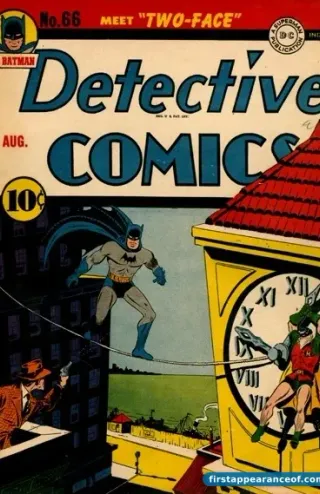
Two-Face on the cover of Detective Comics #66 (1942).

1st Appearance and 1st Cover

First Appearance of Two-Face

Detective Comics #66

August 1942 · DC · Golden Age

The Gotham district attorney who trusted his coin more than his conscience after the acid hit.

Key Issue

Created by Bob Kane · Bill Finger

By Atomm Updated

The first appearance (1st app) of Two-Face is Detective Comics #66 (August 1942), created by Bill Finger and Bob Kane with uncredited contribution from Jerry Robinson. Harvey Dent (originally spelled Harvey Kent and changed to avoid confusion with Clark Kent) is Gotham City's district attorney, disfigured by acid during a trial and subsequently split into a dual-personality criminal who makes decisions by flipping a scarred coin. The character is Batman's most psychologically significant rogue after the Joker and is a required read for any Batman Golden Age collection.

Quick Facts

Debut
Detective Comics #66 (August 1942)
Real name
Harvey Dent
Creators
Bill Finger (script), Bob Kane (pencils), Jerry Robinson (uncredited contribution)
Publisher
DC Comics
First enemy
Batman (as Two-Face's immediate opposition in the debut)
First ally
None initially. Gilda Dent is his wife in later continuity.
Team affiliations
None long-term. Occasional Gotham villain team-ups.

First Appearance

  1. Detective Comics #66 cover
    First Appearance First Cover August 1942

    Detective Comics #66

    By Bob Kane, Bill Finger

    Bill Finger writes; Bob Kane pencils (with Jerry Robinson contributing). Debut issue is also Two-Face's first cover. Originally named Harvey Kent; later renamed Harvey Dent to avoid confusion with Clark Kent.

    Read the full breakdown

Creation Story

Two-Face is Bill Finger’s character. Finger, writing under a contract that gave sole public credit to Bob Kane, built the Harvey Dent concept around the Jekyll-and-Hyde duality that he had been interested in developing as a Batman antagonist for some time. Finger had written the Joker’s first appearance (Batman #1, 1940) and had established the Batman rogues-gallery structure over the preceding two years; Two-Face was his next major contribution.

Detective Comics #66 (August 1942) introduces Harvey Kent (later renamed Harvey Dent to avoid confusion with Clark Kent) as Gotham’s district attorney. Mobster Boss Moroni throws acid in his face during a trial. The disfigurement splits Harvey’s psyche into two opposing personalities, one law-abiding and one criminal, and the coin-flip becomes his decision-making mechanism. Kane’s pencils, with uncredited contribution from Jerry Robinson, established the half-and-half facial design that has persisted essentially unchanged for eighty years.

The character’s essential elements were all in place from the debut: the coin, the dual costume (half-suit, half-ragged-clothing), the scarred side of the face, the district-attorney backstory, the Gotham-specific tragic-hero framing. Finger’s writing positioned Two-Face as the most sympathetic of Batman’s major rogues; unlike the Joker, Harvey Dent was a good man destroyed by circumstance, and Batman’s recurring interaction with the character is tragic rather than adversarial.

The Long Halloween era

The modern Two-Face is defined by Jeph Loeb and Tim Sale’s Batman: The Long Halloween (1996 to 1997). The 13-issue limited series tracks Harvey Dent as Gotham’s district attorney across a year of serial killings, his collaboration with Batman and James Gordon on the investigation, and the acid attack that transforms him into Two-Face. The arc concludes with Harvey committing murder in cold blood, completing his fall.

Long Halloween is the single most-referenced modern Batman story in film adaptations. Christopher Nolan’s The Dark Knight (2008) adapts its structure and character arcs directly; Aaron Eckhart’s Harvey Dent performance draws explicitly from the Loeb and Sale version. Jeph Loeb returned to Two-Face with the sequel Batman: Dark Victory (1999) and the one-shot Batman: When in Rome (2005), completing a trilogy.

Collector context

Detective Comics #66 is the primary Two-Face key and one of the most important Golden Age Batman books after Batman #1 and Detective Comics #27. High-grade copies have crossed $250,000 at auction. The book’s collector weight increased meaningfully with the 2008 film and has held through the DC animated properties and modern Batman book events.

Secondary keys: Batman: The Long Halloween #1 (1996) is the modern Two-Face key and the most-recommended starting point for new readers. Available in multiple collected editions.
Key subsequent appearances

After the debut, these are the issues collectors and historians reach for next.

  1. 1942

    Detective Comics #66

    First appearance and first cover.

  2. 1996

    Batman: The Long Halloween #1

    Loeb Era

    Jeph Loeb and Tim Sale 13-issue limited series. Builds the modern Harvey Dent origin. Primary source for Christopher Nolan's The Dark Knight (2008).

  3. 1999

    Batman: Dark Victory #1

    Loeb and Sale sequel to Long Halloween. Continues the Harvey Dent arc.

In adaptations

Film, TV, animation, and game appearances.

  1. 1989

    Batman (1989)

    Film

    Starring:Billy Dee Williams

    Williams plays Harvey Dent in Tim Burton's film, pre-acid. The sequel that would have featured his transformation into Two-Face never happened under Williams.

  2. 1992

    Batman: The Animated Series

    Animated

    Starring:Richard Moll

    Two-episode origin arc. Moll's performance defined the animated Two-Face for the Warner Bros. animated canon.

  3. 1995

    Batman Forever

    Film

    Starring:Tommy Lee Jones

    Joel Schumacher directs. Jones's Two-Face is deliberately campy and widely panned. Replaced Williams despite the earlier casting promise.

  4. 2008

    The Dark Knight

    Film

    Starring:Aaron Eckhart

    Christopher Nolan directs. Eckhart's Harvey Dent / Two-Face arc is the central tragedy of the film and draws heavily from The Long Halloween.

Frequently asked questions

The questions readers and collectors ask most.

What is Two-Face's first appearance?

Two-Face's first appearance is Detective Comics #66 (August 1942). Bill Finger wrote, Bob Kane pencilled, and Jerry Robinson contributed uncredited. The issue is both Two-Face's first appearance and first cover. Harvey Dent was originally named Harvey Kent and renamed to avoid confusion with Clark Kent.

Is Detective Comics #66 valuable?

Yes. Detective Comics #66 is a Golden Age Batman key. High-grade copies (CGC 9.0 and above) have crossed $250,000 at auction. Low-grade copies trade in the five-figure range. The book's value moved significantly after Aaron Eckhart's performance in The Dark Knight (2008) renewed the character's cultural weight.

Who actually created Two-Face?

Bill Finger is widely regarded as the primary creative force. Finger wrote the script for Detective Comics #66 and built Harvey Dent's backstory around the dual-personality Jekyll-and-Hyde framework Finger had been interested in for years. Bob Kane received credit per his contract with DC. Jerry Robinson contributed artistic work uncredited. Modern scholarship credits Finger as the principal creator. DC has publicly acknowledged Finger's creative contribution since 2015.

How does The Long Halloween relate to Two-Face?

Jeph Loeb and Tim Sale's Batman: The Long Halloween (1996 to 1997) is the definitive modern Harvey Dent origin. The 13-issue limited series tracks Harvey's pre-Two-Face life as Gotham's district attorney, his collaboration with Batman and James Gordon, and the acid attack that transforms him. Christopher Nolan's The Dark Knight (2008) adapts the arc's core character beats for Aaron Eckhart's film performance.