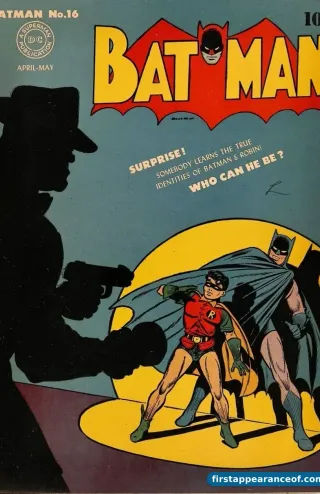
Batman #16 (1943). DC Comics. Alfred debuts as the Wayne family butler in a back-up feature.

1st Appearance (as Alfred Beagle)

First Appearance of Alfred Pennyworth

Batman #16

April 1943 · DC · Golden Age

The Wayne family butler. Eight decades of unwavering moral counsel, the Bat-family's emotional center, and the rare supporting character whose visual redesign came directly from a film adaptation.

Key Issue

Created by Bob Kane · Don Cameron · Jerry Robinson

By Atomm Updated

The first appearance (1st app) of Alfred Pennyworth is Batman #16 (April 1943), where he debuts as 'Alfred Beagle,' an overweight aspiring detective who arrives at Wayne Manor. Don Cameron writes; Bob Kane and Jerry Robinson handle the art. The character was redesigned to the slim, mustachioed, formal-butler interpretation in Detective Comics #83 (January 1944), influenced by William Austin's portrayal in the 1943 Columbia Pictures Batman serial. The visual update became canonical and the surname was eventually changed from Beagle to Pennyworth in subsequent stories.

Quick Facts

Debut
Batman #16 (April 1943)
Real name
Alfred Thaddeus Crane Pennyworth
Creators
Don Cameron (writer), Bob Kane and Jerry Robinson (artists)
Publisher
DC Comics
First enemy
None — Alfred is not an antagonist character.
First ally
Bruce Wayne / Batman, Dick Grayson / Robin (his charges and emotional family)
Team affiliations
Batman Family

Firsts Timeline

  1. Batman #16 cover
    First Appearance (as Alfred Beagle) April 1943

    Batman #16

    By Bob Kane, Don Cameron, Jerry Robinson

    Don Cameron writes; Bob Kane and Jerry Robinson handle the art. Alfred debuts as 'Alfred Beagle,' an overweight aspiring detective who arrives at Wayne Manor and gradually integrates into the household. The original visual interpretation was substantially different from the modern slim-and-dignified Alfred; the redesign came in 1944.

    Read the full breakdown
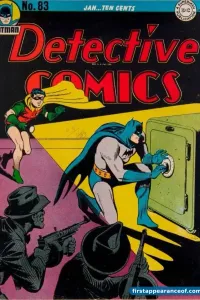
  2. Detective Comics #83 cover
    Modern Visual Redesign January 1944

    Detective Comics #83

    By Don Cameron, Bob Kane

    Don Cameron and Bob Kane redesigned Alfred to match the slim, mustachioed, formal-butler interpretation that William Austin had played in the 1943 Columbia Pictures Batman serial. The visual update became canonical. The 'Alfred Beagle' surname was eventually changed to 'Pennyworth' in subsequent stories.

    Read the full breakdown

Creation Story

Alfred Pennyworth is Don Cameron, Bob Kane, and Jerry Robinson’s Wayne Manor butler. Batman #16 (April 1943) introduces him as Alfred Beagle, an overweight aspiring detective who arrives at Wayne Manor seeking employment. The original visual interpretation is substantially different from the modern Alfred: heavy-set, comedically clumsy, framed as a gentle ongoing inconvenience to Bruce Wayne and Dick Grayson.

The redesign came quickly and externally. The 1943 Columbia Pictures Batman serial cast William Austin as Alfred: slim, mustachioed, formal in the dignified-British-butler tradition. The serial was popular, and the comics’ visual interpretation followed the film. Detective Comics #83 (January 1944) by Don Cameron and Bob Kane implemented the change in canon: Alfred returns from a vacation transformed into the slim-butler form readers now recognize. The “Alfred Beagle” surname was retained for several years before being changed to “Alfred Pennyworth” in subsequent stories.

The visual-redesign-from-an-adaptation framework is unusual in comics history. Most adaptation-driven character changes flow the other direction (the comics introduce a character; the film/TV adaptation interprets them). Alfred’s visual identity was determined by the film’s casting and imported back into the source.

Eight decades of moral counsel

Alfred has remained a continuous Batman supporting character for over eighty years. His structural role has stabilized into the framework most readers know: the Wayne family butler, Bruce Wayne’s paternal figure after the deaths of Thomas and Martha Wayne, the Bat-family’s emotional center, and the moral counsel Bruce Wayne reliably ignores at his own cost.

The character’s first canonical death came in Detective Comics #328 (June 1964) by Bill Finger and Sheldon Moldoff. The death held for several years of publishing time before being reversed via the Outsider arc. Tom King and Mikel Janin’s Batman #77 (June 2019) killed Alfred in modern continuity. The 2019 death has held through subsequent Bat-family runs.

Grant Morrison’s Batman run (2008 to 2013) gave Alfred his most extensive modern characterization, particularly through Batman #682 (November 2008, with Lee Garbett) and the Batman R.I.P. fallout arcs. Morrison developed Alfred’s full backstory: former British intelligence operative, retired stage actor, lifelong Wayne family servant.

The screen tradition

Alfred has appeared in nearly every Batman screen adaptation. Alan Napier (1966 to 1968 ABC television series) is the foundational live-action portrayal. Michael Caine (Christopher Nolan’s Dark Knight trilogy, 2005 to 2012) is widely regarded as the definitive screen Alfred. Jeremy Irons (Batman v Superman, 2016 onwards) reframed the character as a more action-capable operative. Sean Pertwee (Gotham, 2014 to 2019) played Alfred as a former British military operative. Jack Bannon (Pennyworth, 2019 to 2022) starred in a young-Alfred 1960s London prequel series.

Collector context

Batman #16 is the Alfred Pennyworth Golden Age first-appearance key. High-grade CGC 6.0+ copies have crossed $20,000 at auction. Golden Age Batman keys are extraordinarily scarce in high grade; the book is more frequently encountered in mid-grade form.

Secondary keys: Detective Comics #83 (1944, visual redesign). Detective Comics #328 (1964, first death). Batman #77 (2019, modern death).
Key subsequent appearances

After the debut, these are the issues collectors and historians reach for next.

  1. 1943

    Batman #16

    First appearance as Alfred Beagle.

  2. 1944

    Detective Comics #83

    Visual redesign to canonical slim-butler form.

  3. 1964

    Detective Comics #328

    Death (Reversed)

    Bill Finger and Sheldon Moldoff. Alfred's first canonical death. The death held for several years of publishing time before being reversed via the Outsider arc.

  4. 2008

    Batman #682

    Modern Reframing

    Grant Morrison and Lee Garbett. Batman R.I.P. fallout. Alfred's full backstory and Bruce-Wayne-paternal-figure framework canonized in Morrison's Batman run.

In adaptations

Film, TV, animation, and game appearances.

  1. 1966

    Batman

    TV

    Starring:Alan Napier

    ABC television series. Napier's Alfred is the foundational live-action portrayal. Three seasons.

  2. 2005

    Batman Begins

    Film

    Starring:Michael Caine

    Christopher Nolan directs. Caine reprises across The Dark Knight (2008) and The Dark Knight Rises (2012). Widely regarded as the definitive screen Alfred.

  3. 2014

    Gotham

    TV

    Starring:Sean Pertwee

    Fox series. Pertwee's Alfred is reframed as a former British military operative with a distinct working-class register. Five seasons.

  4. 2019

    Pennyworth

    TV

    Starring:Jack Bannon

    Epix / HBO Max series. Bannon plays a young Alfred in a 1960s London prequel framework. Three seasons through 2022.

Frequently asked questions

The questions readers and collectors ask most.

What is Alfred Pennyworth's first appearance?

Alfred Pennyworth's first appearance is Batman #16 (April 1943), where he debuts as 'Alfred Beagle,' an overweight aspiring detective who arrives at Wayne Manor. Don Cameron writes; Bob Kane and Jerry Robinson handle the art. The character was redesigned to the slim, mustachioed, formal-butler interpretation in Detective Comics #83 (January 1944).

Why was Alfred originally fat?

The original Alfred Beagle was conceived as a comedic-supporting character: a clumsy, overweight aspiring detective whose presence at Wayne Manor was framed as a gentle ongoing inconvenience. The 1943 Columbia Pictures Batman serial cast William Austin (a slim, mustachioed actor) as Alfred, and the comics' visual redesign followed the film's interpretation. Detective Comics #83 (January 1944) implemented the change. The 'Beagle' surname was retained for several years before being changed to 'Pennyworth.'

Is Batman #16 valuable?

Yes. Batman #16 is a Golden Age key with substantial first-appearance weight. High-grade copies (CGC 6.0 and above) have crossed $20,000 at auction. The book carries first-Alfred weight and is part of the early-1940s Batman Golden Age collector framework.

Has Alfred ever died?

Multiple times across various continuities. Detective Comics #328 (June 1964) was Alfred's first canonical death; the death held for several years before being reversed. Batman #77 (June 2019) by Tom King and Mikel Janin killed Alfred in modern continuity, with the death holding through subsequent Bat-family runs. The character has also died in various alternate-continuity stories (Injustice, the DCeased line, others).

Who is the definitive screen Alfred?

Most discussions point to Michael Caine in Christopher Nolan's Dark Knight trilogy (2005 to 2012). Caine's Alfred combines the dignified-butler tradition with substantial emotional weight as Bruce Wayne's paternal figure. Alan Napier's 1966 television Alfred is the foundational live-action portrayal but reads as period-comedic to modern audiences. Jeremy Irons (Batman v Superman, 2016) and Sean Pertwee (Gotham, 2014 to 2019) provide alternate-register portrayals.