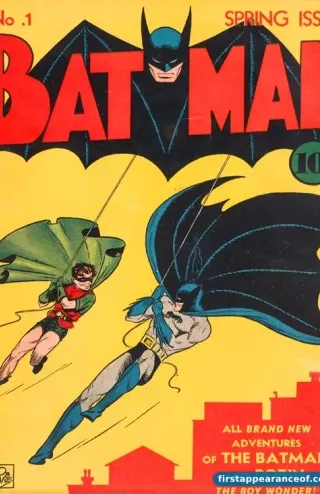
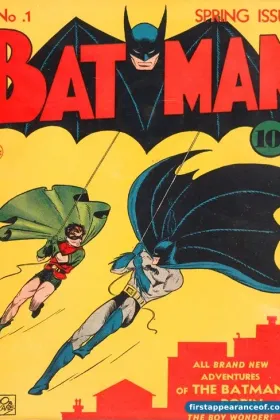
Batman #1 (1940). Batman and Robin on the cover; the Cat (future Catwoman) debuts inside alongside the Joker.

1st Appearance (as The Cat)

First Appearance of Catwoman

Batman #1

April 1940 · DC · Golden Age

Batman's oldest recurring rogue and his most complicated romantic partner. The Cat who became Catwoman, Selina Kyle, and the through-line across eighty-five years of Gotham stories.

Key Issue

Created by Bob Kane · Bill Finger

By Atomm Updated

The first appearance (1st app) of Catwoman is Batman #1 (April 1940), created by Bill Finger and Bob Kane. Selina Kyle debuts as 'The Cat' and is named Catwoman for the first time in Batman #2 (June 1940). Batman #1 is a dual first-appearance book: Catwoman and the Joker both debut in this issue, making it one of the most consequential Golden Age books ever published. Her first self-titled series is the Catwoman limited series #1 (February 1989).

Quick Facts

Debut
Batman #1 (April 1940)
Real name
Selina Kyle
Creators
Bill Finger (script), Bob Kane (byline per his DC contract)
Publisher
DC Comics
First enemy
Batman (her debut antagonist, though their romantic entanglement starts in subsequent issues)
First ally
None initially. Poison Ivy and Harley Quinn as the Gotham City Sirens in modern era.
Team affiliations
Gotham City Sirens, Batman Family (modern era), Birds of Prey (occasional)

Firsts Timeline

  1. Batman #1 cover
    First Appearance (as The Cat) April 1940

    Batman #1

    By Bob Kane, Bill Finger

    Selina Kyle debuts in Batman #1 as 'The Cat,' the alias she uses before adopting the Catwoman identity. Bill Finger writes; Bob Kane credited on art per his contract. Same issue: first appearance of the Joker. Two foundational Batman rogues in a single book.

    Read the full breakdown
  2. First Appearance as Catwoman June 1940

    Batman #2

    By Bob Kane, Bill Finger

    Selina's second appearance and the first time she is called Catwoman (or The Cat Woman in the early framing). The Catwoman identity becomes permanent.

    Read the full breakdown
  3. First Self-Titled Series February 1989

    Catwoman #1 (limited series)

    By Mindy Newell, J.J. Birch

    First Catwoman self-titled limited series, four issues. Mindy Newell writes; J.J. Birch pencils. The character had been a Batman-book supporting figure for forty-nine years before earning a dedicated title.

    Read the full breakdown

Creation Story

Catwoman is one of the most consequential Golden Age supporting characters in DC’s publishing history. Batman #1 (April 1940) introduced her alongside the Joker, making the issue one of the most important dual-first-appearance books in comics. Bill Finger wrote the debut script; Bob Kane received the byline per his DC contract. Finger’s Catwoman (originally “The Cat”) was a cat burglar whose framing deliberately mixed antagonism with a specifically romantic tension: Batman catches her, she escapes, and there is an explicit mutual attraction that Finger wrote as a complication rather than a resolution.

Batman #2 (June 1940) named her Catwoman for the first time (or “The Cat Woman” in the earliest framing), and the identity became permanent. Selina Kyle, her civilian name, was established in later Golden Age stories. The character has run continuously since 1940 with various interpretive shifts but no extended absence from DC’s publishing lineup.

The Miller era

Frank Miller and David Mazzucchelli’s Batman: Year One (Batman #404 to #407, 1987) is the most consequential modern Catwoman reframing. Miller positioned Selina Kyle as an East End sex worker whose survival skills propel her into cat-burglar work. The framing is grittier and more socially-grounded than any prior Catwoman portrayal. Miller’s Year One Catwoman informs virtually every subsequent film, television, and comics version.

Michelle Pfeiffer’s Catwoman in Tim Burton’s Batman Returns (1992) is a fundamentally different reinvention: a psychologically shattered office worker brought back to life as an avatar of vengeance. Pfeiffer’s performance is widely regarded as the best film Catwoman, though the Burton framing is tonally distinct from the Miller-era comics.

The Brubaker era

Ed Brubaker and Darwyn Cooke’s Catwoman #1 (2002) launched one of the strongest Catwoman runs in the character’s publishing history. Brubaker wrote Selina as a full protagonist rather than as a Batman-adjacent supporting character, with Cooke’s animated-inspired visual style giving the book a distinct identity. The run built out Selina’s East End Gotham operational base and her supporting cast (Holly Robinson, Slam Bradley) substantially.

Matt Reeves’s The Batman (2022) with Zoe Kravitz draws directly from the Brubaker-Cooke framing.

The Bat-wedding

Tom King’s Batman run (2016 to 2019) built toward a Bruce-Selina wedding across three years of issues, culminating in Batman #50 (July 2018). Selina calls off the wedding at the last moment, arguing that Bruce’s heroism depends on his grief and that marriage would weaken Batman. The anticlimactic framing was controversial at the time; it remains canonical in current DC continuity.

Collector context

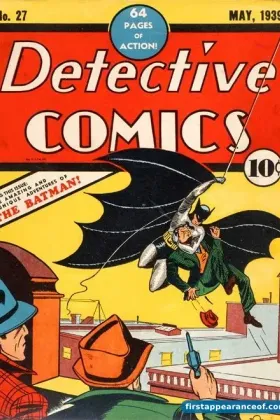
Batman #1 is one of the most valuable Golden Age DC books. High-grade CGC 9.0+ copies have crossed $2 million at auction. The book’s value is driven by compounded first-appearance weight: Catwoman, the Joker, and Batman’s first solo title all in one issue. It sits alongside Action Comics #1 and Detective Comics #27 at the top tier of Golden Age collector demand.

Secondary keys: Batman #2 (first named Catwoman). Batman #62 (1950, first origin). Batman: Year One issues (1987). Catwoman #1 (1993, first ongoing). Catwoman #1 (2002, Brubaker-Cooke relaunch).
Key subsequent appearances

After the debut, these are the issues collectors and historians reach for next.

  1. 1940

    Batman #1

    First appearance (as The Cat). Also first Joker.

  2. 1940

    Batman #2

    First appearance under the Catwoman name.

  3. 1950

    Batman #62

    First Origin

    Catwoman's first canonical backstory. Bill Finger and Bob Kane.

  4. 1987

    Batman: Year One (Batman #404-407)

    Miller Era

    Frank Miller and David Mazzucchelli's Batman: Year One arc modernizes Catwoman as an East End sex worker. The Miller framing informs every subsequent Catwoman portrayal.

  5. 1993

    Catwoman #1 (1993)

    First Ongoing

    First Catwoman ongoing series. Chuck Dixon writes; Jim Balent pencils. Ran 94 issues through 2001.

    Newsstand variant
  6. 2002

    Catwoman #1 (2002)

    Brubaker Era

    Ed Brubaker and Darwyn Cooke relaunch. Widely regarded as one of the strongest Catwoman runs in the character's history.

In adaptations

Film, TV, animation, and game appearances.

  1. 1966

    Batman

    TV

    Starring:Julie Newmar, Eartha Kitt, Lee Meriwether

    ABC live-action series. Three different actresses across the series run. Newmar's performance is the most iconic television Catwoman.

  2. 1992

    Batman Returns

    Film

    Starring:Michelle Pfeiffer

    Tim Burton directs. Pfeiffer's Selina Kyle is a fundamentally reinvented character. Widely regarded as the best film Catwoman.

  3. 2004

    Catwoman

    Film

    Starring:Halle Berry

    Pitof directs. Standalone film unrelated to Batman or Selina Kyle continuity. Critical and commercial failure.

  4. 2012

    The Dark Knight Rises

    Film

    Starring:Anne Hathaway

    Christopher Nolan directs. Hathaway's Selina Kyle in the Nolan trilogy finale.

  5. 2022

    The Batman

    Film

    Starring:Zoe Kravitz

    Matt Reeves directs. Kravitz's Selina Kyle pulls from the Brubaker-Cooke era framing.

Frequently asked questions

The questions readers and collectors ask most.

What is Catwoman's first appearance?

Catwoman's first appearance is Batman #1 (April 1940), created by Bill Finger and Bob Kane. She debuts as 'The Cat' and is first called Catwoman in Batman #2 (June 1940). Batman #1 is a dual first-appearance book: Catwoman and the Joker both debut in this issue.

Is Batman #1 valuable?

Yes, extraordinarily. Batman #1 is one of the most valuable Golden Age DC books. High-grade copies (CGC 9.0 and above) have crossed $2 million at auction. The book's value is driven by the compounded first-appearance weight: Catwoman, the Joker, and the first Batman solo title all in one issue. It is one of the three highest-demand Golden Age DC books along with Action Comics #1 and Detective Comics #27.

Who created Catwoman?

Bill Finger wrote the Batman #1 script and is credited as the primary creative force. Bob Kane received the byline per his DC contract. Modern DC crediting recognizes Finger as the primary creator. The visual character (cat-themed costume, physical athleticism, morally ambiguous framing) was developed across the first several Batman appearances and has evolved substantially across decades.

Is Catwoman a hero or a villain?

Both, across her publishing history. Golden Age Catwoman was a pure antagonist. Silver Age Catwoman alternated between antagonism and romantic interest. The Frank Miller-era Catwoman is a morally ambiguous street-level operator. Modern Catwoman is frequently an anti-hero, part of the Batman Family and Gotham City Sirens, and an ongoing romantic partner to Bruce Wayne. Her alignment depends entirely on which era and which writer you're reading.

Did Catwoman and Batman really almost get married?

Yes. Tom King's Batman run (2016 to 2019) built toward a Bruce-Selina wedding across three years of issues, culminating in Batman #50 (July 2018). Selina calls off the wedding at the last moment. The arc was controversial for its anticlimactic framing but remains canonical in current DC continuity.