Creation Story
Stan Lee built Sue Storm in 1961 as the engagement leg of the Fantastic Four’s family premise. Reed has a fiancée; she has a younger brother; the four-person team includes them both. The structural choice was correct and has held for sixty years. The naming choice (Invisible Girl) was a Lee Silver-Age default that aged badly inside a character who was, on the page, a fully grown adult woman who got married in the third FF Annual.
Sue’s power set in the first issue is invisibility only. Lee and Kirby added force-field projection in FF #22 (1964), which is when the character starts to look like the modern Sue. The reasoning, per Lee, was that the team needed a visible offensive power on the woman in the group; Sue had been positioned as the support member through twenty issues and the editorial calculus was that another twenty issues with the same framing was not going to hold. The force fields gave Sue a way to attack and defend. They also made her the most flexible member of the team in power-set terms, which most writers since Byrne have recognized.
The decade-plus John Byrne run from 1981 to 1986 is the most influential extended Sue Storm portrait outside the Lee-Kirby originals. Byrne wrote her with authority. The issue numbering is FF #232 through #295, and she is on most of those covers as a co-equal lead. Byrne also did the rename in FF #284, which was contemporaneous with the character’s force-field upgrades that gave her star-killing offensive options. The character has continued to grow since Byrne, but the modern Sue is mostly a Byrne portrait with later writers fine-tuning.
She has had four live-action actors: Jessica Alba in 2005 and 2007, Kate Mara in 2015, and Vanessa Kirby in 2025. Alba’s casting was controversial and her two films are remembered as the late stage of the Fox-era Marvel pre-MCU films that did not work. Mara’s casting was one of the few elements of Trank’s Fant4stic that critics did not single out, which says less about Mara than about the rest of the film. Kirby in 2025 is the first MCU Sue and the first attempt to write the character with the Byrne-era authority intact.
Lee’s framing in the original Silver Age books reads paternalistic now and registered as romantic at the time. Read FF #1 with modern eyes and Sue is the secretary of the team, taking notes and worrying about Reed. Read it with 1961 eyes and Sue is the team’s only woman who got herself shot into space on an unauthorized rocket flight, which is its own kind of agency. The way the character has aged is mostly a story about Marvel’s writers room slowly taking the part of her that was always there and giving it more room.
First Appearance and First Cover: Fantastic Four #1
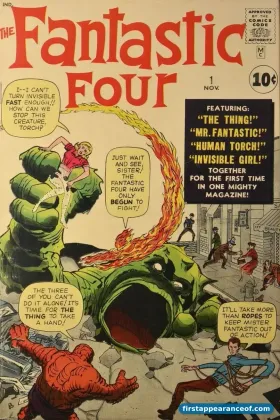
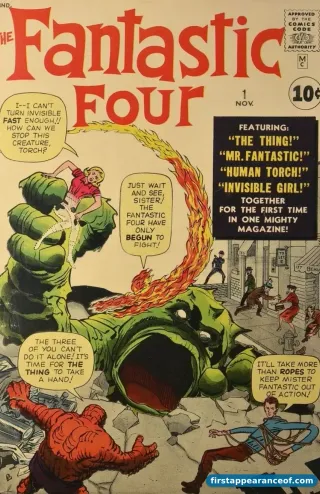
Sue is on the cover of FF #1, not invisible, just standing with the rest of the team. The cover is a fight composition: Mole Man’s monster, the FF in scrambling poses, Reed stretching, Ben rocky, Johnny on fire. Sue is the figure on the left, hand raised. Kirby’s design choice was to keep her visible on the cover so readers could identify the team. Putting an invisible character on the team’s debut cover would have undercut the recognition value, which is correct.
The story inside has Sue as the engaged-to-Reed civilian who decides to take the rocket flight with the rest of them. She is in the standard 1961 Lee-female register: voice-of-reason in the love-interest mode, less specific than the men around her in dialogue terms. The cosmic-ray transformation gives her invisibility. The first issue does not yet have the force fields; those are five months and twenty-one issues away. Sue’s role in the first issue is mostly to react to the men and to discover she can vanish.
The cover identifies her as “The Invisible Girl” in the team-name banner across the top of the cover. The text is in Kirby’s standard sans-serif logo font and is the canonical first instance of the character’s name in the Marvel Universe. The rename to Invisible Woman in 1985 means that for collectors of the Silver Age, Sue’s first appearance is forever tied to the older name, which has its own historical weight.
For pricing, FF #1 is FF #1. The Sue Storm debut sits inside the team debut, which is a top-three Silver Age key. There is no Sue-specific market premium; the sub-keys to chase are FF #22 (force fields) and FF Annual #3 (the wedding). The 1985 rename in FF #284 is a recognized milestone but not a high-value key on its own; it is a Bronze-Age book in modern reader-grade circulation that trades for double-digits in CGC 9.8.