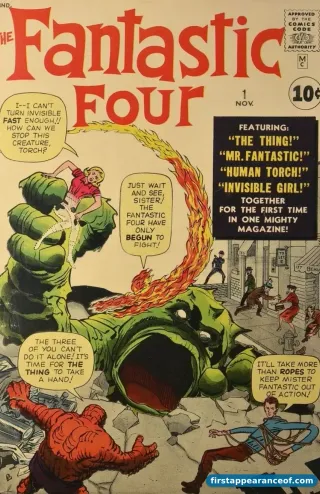
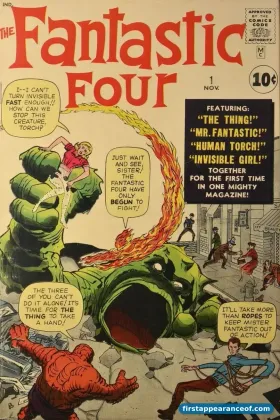
Fantastic Four #1 (1961). Reed Richards as Mr. Fantastic stretches across the cover alongside the Thing, Invisible Girl, and the Human Torch fighting the Mole Man's monster.

1st Appearance and 1st Cover

First Appearance of Mr. Fantastic

Fantastic Four #1

November 1961 · Marvel · Silver Age

Stan Lee and Jack Kirby's smartest man in the Marvel Universe, except when the story needs Bruce Banner to be smarter, which is most stories. The leader who keeps making the wrong call about his own family.

Key Issue

Created by Stan Lee · Jack Kirby

By Atomm Updated

The first appearance (1st app) of Mr. Fantastic is Fantastic Four #1 (November 1961), created by Stan Lee and Jack Kirby. Reed Richards is the scientist who pilots the unauthorized space flight that gives the four characters their powers. He is the team's leader and Marvel's chief scientist for the next sixty years. The issue is the most valuable Silver Age comic by market measure, with high-grade copies trading in the seven figures. Ioan Gruffudd played Reed in the 2005 and 2007 films. John Krasinski played him briefly in Doctor Strange in the Multiverse of Madness (2022). Pedro Pascal plays him in The Fantastic Four: First Steps (2025).

Quick Facts

Debut
Fantastic Four #1 (November 1961)
Real name
Reed Richards
Creators
Stan Lee (writer, co-creator), Jack Kirby (artist, co-creator)
Publisher
Marvel Comics
First enemy
The Mole Man
First ally
Sue Storm, Johnny Storm, Ben Grimm (his FF teammates and family)
Team affiliations
Fantastic Four (founder), Illuminati, Future Foundation, Avengers (occasional)

First Appearance

  1. Fantastic Four #1 cover
    First Appearance First Cover November 1961

    Fantastic Four #1

    By Stan Lee, Jack Kirby

    Lee writes; Kirby pencils. The book that started the Marvel Age. Reed, Sue, Johnny, and Ben take an unauthorized space flight, get hit with cosmic rays on the way through the Van Allen belts, return to Earth changed. Reed is the team's leader and the Marvel Universe's de facto chief scientist for the next sixty years. The issue also debuts the Fantastic Four as a team, Sue Storm, Johnny Storm (Human Torch), the Thing, and the Mole Man.

    Read the full breakdown

Creation Story

Stan Lee tells the story of Fantastic Four #1’s creation as a Goodman-handed-down assignment: Marvel publisher Martin Goodman heard that DC’s Justice League was selling and asked Lee to do a team book. Lee drafted with Kirby, who was already working at Marvel doing monster comics. Reed Richards was the leader-figure of the team. Lee’s framing was a Mr.-Spock type of brain who would steer the rest of the cast. Kirby’s framing was an FDR-grade public-intellectual figure who happened to be young. The two framings combined into the Reed Richards we know: the smartest man in the room who is also the worst at reading the rooms he is in.

The character has aged unevenly. The Lee-Kirby original is a Cold War scientist-hero archetype, confident and responsible. By the late 1970s, under Roy Thomas and others, Reed is more of a paternal authority figure, occasionally annoying. John Byrne’s six-year run from 1981 to 1986 is the modern definitive Reed Richards: Byrne played him as compassionate, occasionally arrogant, mostly competent, and willing to be wrong on screen. That portrayal has been the template for the character ever since.

The Civil War turn under Mark Millar in 2006 is the most argued-about Reed Richards arc of the 21st century. Reed sided with the pro-registration position, which the Marvel reader audience found out of character. Millar’s defense was that Reed’s character has always been a planner who believes problems have engineered solutions; the registration act was an engineered solution; therefore Reed would back it. The defense convinces some readers and not others. The choice has remained in continuity. Subsequent writers have tried to soften it without erasing it.

Reed is the load-bearing scientist of the Marvel Universe in the same way Bruce Banner is the load-bearing physicist. There is overlap between them and there has always been narrative awareness of the overlap. Lee usually placed Reed as the smartest man in the Marvel Universe; later writers (especially during Peter David’s Hulk run, and later Jonathan Hickman’s books) elevated Banner to peer status or above. The way the Marvel Universe handles this contradiction is to give Reed authority over engineering and applied science and Banner authority over gamma-physics and theoretical work. Most writers respect the carve-up. Some do not.

He has had four screen actors: Ioan Gruffudd in the Tim Story films, Miles Teller in Josh Trank’s Fant4stic, John Krasinski in a brief Multiverse of Madness cameo, and Pedro Pascal in the 2025 MCU First Steps reboot. The 2005 and 2025 versions are the only ones that meaningfully tried to capture the character. The 2015 version is structurally an example of how badly the FF translates when the studio does not understand the family-unit premise. Trank’s film is dark and serious; the Lee-Kirby FF is family and warmth; the gap is the entire problem.

First Appearance and First Cover: Fantastic Four #1

The book hit stands in August 1961 with a November 1961 cover date. 24 pages of story plus filler. Cover price was 10 cents. The cover is Jack Kirby. Reed is on the cover doing what Reed does: stretching to reach the Mole Man’s monster while the rest of the team scrambles. The composition centers the team rather than any one member, which is correct for the premise; you cannot launch a team book on a single-figure cover.

Print run was probably under 250K based on Marvel’s circulation data from that period, which is low for a Silver Age launch. Survival in high grade is rare. CGC 9.0 and above is approximately 100 census copies. CGC 9.6 and above is single digits. The book was a slow-burn key for collectors through the 1970s and 1980s; it became a top-three Silver Age key in the 2000s as the modern superhero film market started to drive prices on the foundational Marvel debuts.

The story opens with Reed firing a flare gun over Manhattan to summon his three teammates. The flashback inside the issue tells how they got here: Reed had built a rocket designed to take advantage of cosmic rays for interplanetary travel. The military pulled funding. Reed, his fiancée Sue Storm, Sue’s brother Johnny, and Reed’s college roommate Ben Grimm took the rocket up anyway. Cosmic rays got through the inadequate shielding. They came back changed. Reed stretches; Sue turns invisible; Johnny ignites; Ben turns into a rock-skinned monster. The four take superhero names within the same issue and adopt the FF identity, which is unprecedented for 1961. Most Silver Age teams formed across multiple issues; this one is a one-shot from civilian to costumed in 24 pages.

For Reed specifically, the issue establishes the leadership pattern that will define him for sixty years: he is the one who knows what is happening, he is the one who chooses the team name, he is the one who directs the response to the Mole Man’s first attack. The dynamic with Ben (Reed feels guilty about Ben’s transformation; Ben blames Reed for it) starts on page one and never resolves, even in the eras when Reed has cured Ben temporarily. The dynamic with Sue (engaged at start of issue, married within a few years of publication) is the only Marvel-Universe marriage that has survived continuously without retcon since the Silver Age.
Key subsequent appearances

After the debut, these are the issues collectors and historians reach for next.

  1. 1962

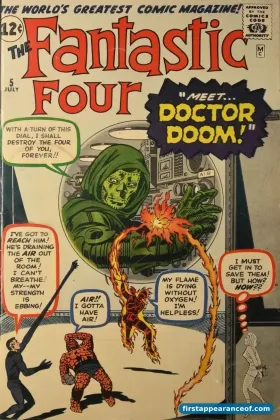
    Fantastic Four #5

    First appearance of Doctor Doom. Reed's rival from college and the most consequential antagonist of his career.

  2. 1966

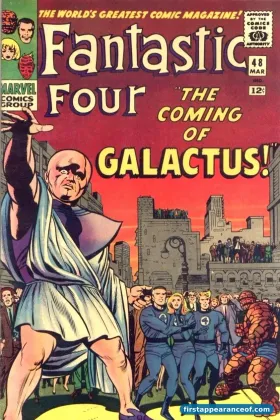
    Fantastic Four #48

    Galactus Trilogy begins. Silver Surfer debuts. Reed's encounter with Galactus is the turning point that establishes him as the Marvel Universe's diplomat-of-last-resort.

  3. 1982

    Fantastic Four #245

    John Byrne run. Reed builds the device that ages Galactus's herald Tyros. Byrne's six-year FF run from #232 to #295 is the strongest extended Reed Richards portrait outside the Lee-Kirby originals.

  4. 2006

    Civil War #1

    Reed sides with the registration act. Mark Millar and Steve McNiely. The decision damages Reed's relationship with Sue and the rest of the FF and is the most controversial extended Reed-Richards arc in modern Marvel.

  5. 2011

    Fantastic Four #587

    Death of the Human Torch. Jonathan Hickman writes. Reed's grief is the issue's centerpiece. The death is reversed within a year.

In adaptations

Film, TV, animation, and game appearances.

  1. 2005

    Fantastic Four

    Film

    Starring:Ioan Gruffudd

    Tim Story directs. Two-film run with the same cast. Critically panned but commercially successful enough for a sequel; not enough for a third.

  2. 2015

    Fant4stic

    Film

    Starring:Miles Teller

    Josh Trank. Fox-era reboot. Notorious failure. The film is an example of how badly the FF translates when the studio does not understand the family-unit premise.

  3. 2025

    The Fantastic Four: First Steps

    Film

    Starring:Pedro Pascal

    Marvel Studios. The first MCU FF film. Pascal as Reed, set in a retro-1960s alternate reality.

Frequently asked questions

The questions readers and collectors ask most.

What is Mr. Fantastic's first appearance?

Fantastic Four #1 (November 1961), Lee and Kirby. Same issue debuts the entire FF team, the Mole Man, and the Marvel Age framing. Reed is on the cover with the rest of the team. There is no precursor; the character was built whole-cloth for this debut.

Why is Reed Richards on Civil War's pro-registration side?

Mark Millar's framing in Civil War #1 (2006) puts Reed with the surveillance-state position because Reed's character has always been built around the assumption that systems should be controllable. Reed believes problems have engineered solutions. The registration act is presented to him as an engineered solution. The choice damages his marriage and his standing inside the FF, and it has remained one of the most argued-about extended decisions in modern Marvel. Subsequent writers have tried to walk back, complicate, or recontextualize the choice. None of them have removed it.

Is Fantastic Four #1 valuable?

Yes, top-tier. CGC 9.0 copies trade in the seven figures. Mid-grade (CGC 4.0 to 6.0) starts in the high five figures. The book is structurally the start of the Marvel Age, which is the franchise that drives most modern superhero media. Hulk #1 and Amazing Fantasy #15 are the only Silver Age keys in the same value range. There is no cheap entry. Restoration is common at every grade and warrants verification before buying.

Who created Mr. Fantastic?

Stan Lee and Jack Kirby co-created Reed Richards in Fantastic Four #1. Lee provided the premise (a four-person space-flight team, a leader who is a scientist) and the dialogue. Kirby designed the visual: the receding hairline, the jawline, the prematurely greying temples that signal age and authority within the team. Reed's quiet-academic posture is Kirby's; Reed's scolding-husband cadence in early issues is Lee's.