Creation Story
Juggernaut is one of the X-Men’s oldest villains and one of their most personal. Stan Lee and Jack Kirby introduced him in 1965, near the end of the team’s first two years, and built him as the thing Professor X could not simply outthink: an unstoppable mass of muscle with a grudge that predates the team entirely.
The grudge is family. Cain Marko is Charles Xavier’s stepbrother, and the two grew up hating each other. Tying the new villain directly to the team’s leader made Juggernaut more than a monster of the week; he is a piece of Xavier’s past that keeps coming back. His power is not mutation, the X-Men’s whole subject, but magic: the Crimson Gem of Cyttorak, found in a hidden temple during the Korean War, which turns Marko into a human juggernaut who cannot be stopped once he is moving.
First Appearance: X-Men #12
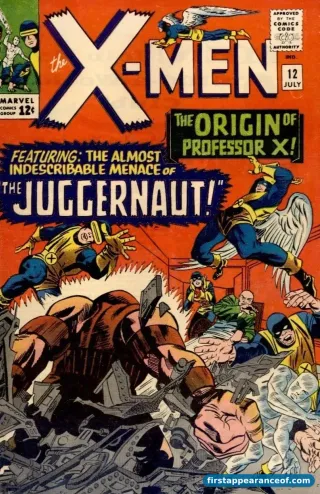
X-Men #12, cover-dated July 1965, is the first appearance of the Juggernaut and the issue collectors chase, and he is barely in it. The book spends most of its pages on Professor X's origin, told in flashback, while an unseen figure batters through the mansion's defenses one barrier at a time. Juggernaut is not actually shown until the final pages, which makes the debut a cameo built for suspense: the whole issue is the X-Men bracing for an arrival.That structure is exactly why X-Men #12 is the key. It is the debut of a major, long-running villain in a Lee and Kirby Silver Age issue, from a period when the X-Men title sold poorly and printed modestly. High-grade copies are scarce, and it ranks among the Silver Age X-Men keys readers track in a first-appearance database.
X-Men #12 vs X-Men #13
Both issues matter, for different reasons.
| X-Men #12 | X-Men #13 | |
|---|---|---|
| Published | July 1965 | September 1965 |
| Appearance | Cameo, glimpsed on the final pages | First full appearance, fights the X-Men across the issue |
| Collector significance | The debut and the defining key | The first full appearance; more common |
If the question is which book is the first Juggernaut, the answer is X-Men #12. If the question is which book the Juggernaut is actually in, the answer is X-Men #13. Collectors prize #12; readers meet the character in #13.
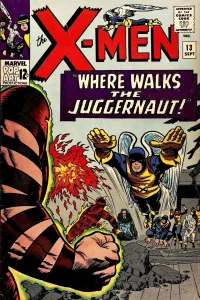
First Full Appearance: X-Men #13
X-Men #13, cover-dated September 1965, pays off the previous issue's build. The Juggernaut breaks through, and the X-Men learn what Professor X already knew: this is Cain Marko, his stepbrother, and stopping him is less a fight than a problem of physics. The issue fills in the history behind the threat, the resentment between the stepbrothers and the Korean War temple where Marko found the Crimson Gem, that turned a violent man into an unstoppable one.It also sets the template the character has run on since. Juggernaut works best as a force the heroes cannot beat head-on and have to outthink or redirect, and X-Men #13 is where that idea first plays out at length.
For collectors
X-Men #12 is the key, not X-Men #13, and the gap between them is the whole story. The debut is a last-page cameo in a poorly-selling Silver Age title with a modest print run, the exact combination that keeps high-grade copies scarce; clean examples trade in the four figures and climb whenever Juggernaut turns up on screen. X-Men #13, the first full appearance, is the more common and more affordable book.
The other Juggernaut issues worth knowing are story keys, not scarcity plays. Uncanny X-Men #322 names Onslaught for the first time, and Uncanny X-Men #410 turns the unstoppable villain into an X-Man. Both matter to the character; neither commands the price of the 1965 debut.