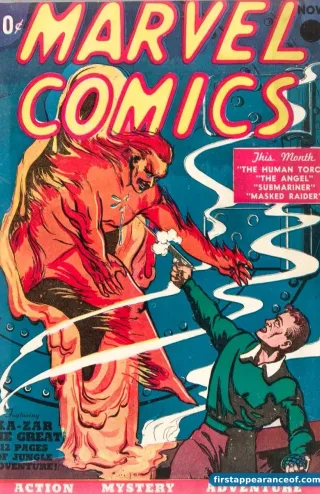
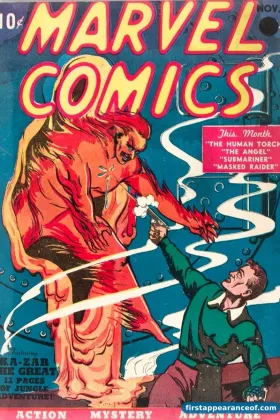
Marvel Comics #1 (1939). Sub-Mariner does not appear on the cover; the cover is the Human Torch. Namor's debut is in the interior pages.

1st Appearance

First Appearance of Sub-Mariner

Marvel Comics #1

October 1939 · Marvel · Golden Age

Bill Everett's 1939 antihero. The Atlantean prince who hated the surface world long before Marvel had a publishing model for that kind of character.

Key Issue

Created by Bill Everett

By Atomm Updated

The first appearance (1st app) of the Sub-Mariner is Marvel Comics #1 (October 1939), created by Bill Everett. Namor is the half-Atlantean, half-human prince who debuts the same month as the Human Torch (also in Marvel Comics #1). The character is one of the three foundational Timely Comics heroes alongside the Human Torch and Captain America. Namor is also Marvel's first antihero; he debuts as an antagonist of surface-world humanity who later becomes ally and hero. The unpublished Motion Picture Funnies Weekly #1 (April 1939) is sometimes cited as the technical first appearance. Tenoch Huerta plays Namor in Black Panther: Wakanda Forever (2022), which is the character's first major live-action appearance.

Quick Facts

Debut
Marvel Comics #1 (October 1939)
Real name
Namor McKenzie
Creators
Bill Everett (writer, artist, sole creator)
Publisher
Timely Comics (later Marvel)
First enemy
Surface-world humans (broadly; no single Golden Age villain in the debut)
First ally
(Solo at debut; later allied with the Invaders, the Defenders, the Atlanteans)
Team affiliations
Invaders (WWII era), All-Winners Squad, Defenders (founder, with Hulk and Doctor Strange), Illuminati

Firsts Timeline

  1. Marvel Comics #1 cover
    First Appearance October 1939

    Marvel Comics #1

    By Bill Everett

    Bill Everett writes, pencils, and inks. Namor is the half-Atlantean, half-human prince who debuts the same month as the Human Torch (also in Marvel Comics #1). Namor predates the Human Torch by a few months in original creation; Everett had drawn the Sub-Mariner story for an unpublished Funnies Inc. promotional comic earlier in 1939, but the canonical first published appearance is Marvel Comics #1. Some collectors still cite the unpublished Motion Picture Funnies Weekly #1 (April 1939, an in-house promo distributed in limited quantities) as the technical first; the public-on-newsstands first is Marvel Comics #1.

    Read the full breakdown
  2. First Newsstand Public Appearance (alternate) April 1939

    Motion Picture Funnies Weekly #1

    By Bill Everett

    An unpublished promotional comic distributed in extremely limited quantities (estimated 8 copies known in any condition). The Sub-Mariner story was reused in Marvel Comics #1 with minor revisions. Most collectors recognize Marvel Comics #1 as the canonical first appearance; specialists treat MPFW #1 as the technical first publication. The market reflects this: MPFW #1 trades at unique-collectible prices when it appears, but Marvel Comics #1 is what mainstream collectors chase.

Creation Story

Bill Everett was nineteen years old when he created the Sub-Mariner for Funnies Inc., the studio that produced content for Timely Comics’ launch. Everett’s pitch was a half-Atlantean prince whose mother was an Atlantean royal and whose father was a surface-world sea captain. Namor’s anger at humanity for damaging his kingdom was the engine of the original stories. Most 1939 superhero comics were Superman variations: a hero with powers who fought criminals. Everett’s Sub-Mariner was an antagonist with powers who fought human civilization. The framing was unusual for the time and remained unusual through the Golden Age.

The unpublished Motion Picture Funnies Weekly #1 (April 1939) is the first publication of a Sub-Mariner story. It was a promotional comic distributed in tiny quantities; estimates put surviving copies at around eight. The Namor story in MPFW #1 was reused in Marvel Comics #1 (October 1939) with minor revisions. Mainstream collector framing puts Marvel Comics #1 as the canonical first appearance because it is the first newsstand-distributed Sub-Mariner story; specialists who track ultra-rare Golden Age books recognize MPFW #1 as the technical first publication. Both claims have weight. The market generally settles the question by treating Marvel Comics #1 as the first appearance for collector purposes and MPFW #1 as a separate ultra-rare adjacent collectible.

Everett’s career-long association with the character is unusual in comics. Most Golden Age creators left the work and were replaced by other artists; Everett kept coming back to Sub-Mariner. He wrote and drew the character intermittently from 1939 through 1973, including the Silver Age revival run and the Tales to Astonish co-feature. Everett died in 1973 with Sub-Mariner work still in his portfolio. The character’s visual identity is entirely his.

Stan Lee revived Sub-Mariner in Fantastic Four #4 (May 1962) as the first Timely character to return to publication in the Marvel Age. Lee and Kirby found Namor as an amnesiac in the Bowery; Johnny Storm restored his memory. The 1962 revival reframed Namor as both a Marvel Universe antagonist and a connecting bridge between the Golden Age Timely line and the Silver Age Marvel line. The character has been a permanent fixture of Marvel continuity ever since.

Tenoch Huerta’s MCU performance in Black Panther: Wakanda Forever (2022) is the first major live-action Sub-Mariner. Ryan Coogler’s adaptation rewrote the character’s cultural origin to a Mesoamerican setting (the Talokanil people), which gave the film a different cultural anchor than the comic-book Atlantis. The performance was widely praised; the character’s MCU future was set up but has not yet had a follow-up. The original Atlantean version remains the canonical comic-book character.

First Appearance: Marvel Comics #1

Sub-Mariner does not appear on the cover of Marvel Comics #1. The cover is the Human Torch (Frank R. Paul illustration of the Torch escaping from a glass cylinder). Namor’s debut is on interior pages, in a 12-page story by Bill Everett that introduces the character, his Atlantean heritage, his half-human father, his quest to investigate damage to his undersea homeland.

Everett’s interior art is rougher and more cartoony than Paul’s cover, which is consistent with the 1939 distinction between magazine illustration and comic-book art. Namor in the early panels has a long jaw, pointed ears, and the canonical green swim trunks. The wing-shaped ankle ornaments are present from the first appearance. Everett’s draftsmanship is loose by 1960s standards; by 1939 standards, he is one of the more accomplished comic-book artists working.

The story has Namor encountering surface-world divers, attacking them, then surfacing in New York to investigate further damage to Atlantis. The action sequences run through the issue and continue in subsequent Marvel Mystery Comics issues. Everett wrote Namor as morally complex from page one; the character’s anger is rationalized within the story (the surface humans are causing harm to his people) which gives him a sympathetic frame even when he is attacking civilians.

For pricing, Marvel Comics #1 is one of the highest-value Golden Age books in the market. CGC 9.0 and above is seven figures. Mid-grade copies are six figures. Restoration is common and warrants verification at every level. The book sits in the same value tier as Action Comics #1 and Detective Comics #27 because it is foundational to a major superhero publishing line.
Key subsequent appearances

After the debut, these are the issues collectors and historians reach for next.

  1. 1940

    Marvel Mystery Comics #8

    First on-page meeting between Sub-Mariner and the Human Torch. The fight runs across this issue and continues in MMC #9. The crossover is one of the first inter-title superhero battles in publishing history.

  2. 1941

    Sub-Mariner Comics #1

    First solo title for Namor. The book ran through 1949 with Bill Everett returning intermittently to the character.

  3. 1962

    Fantastic Four #4

    Stan Lee and Jack Kirby revive Namor for the Marvel Age. The Sub-Mariner is found amnesiac in a Bowery flophouse and restored to memory by Johnny Storm. The 1962 revival is the bridge between Golden Age Timely and Silver Age Marvel; Namor is the first Timely character Lee and Kirby brought back.

  4. 1965

    Tales to Astonish #70

    Sub-Mariner's solo Silver Age feature begins as a co-feature in Tales to Astonish (alongside the Hulk, who took over the title from Giant-Man). The feature ran through TtA #101, then continued as Sub-Mariner Comics #1 (1968).

  5. 1968

    Sub-Mariner #1 (1968)

    First issue of Namor's Silver Age solo title. John Buscema pencils. Marie Severin and others contribute. The 1968 series ran through #72 (1974).

In adaptations

Film, TV, animation, and game appearances.

  1. 2022

    Black Panther: Wakanda Forever

    Film

    Starring:Tenoch Huerta

    Ryan Coogler directs. Huerta plays Namor as the leader of the Talokanil people, a Mesoamerican variant on the comic-book Atlantean origin. The MCU rewrote the character's heritage to allow for a different visual and cultural anchor than the comic-book Atlantis. The performance was widely praised.

Frequently asked questions

The questions readers and collectors ask most.

What is the Sub-Mariner's first appearance?

Marvel Comics #1 (October 1939), Bill Everett. Same issue as the Human Torch's debut. There is a technical first-appearance debate involving Motion Picture Funnies Weekly #1 (April 1939), an unpublished promotional comic with an estimated 8 surviving copies; the Namor story in MPFW #1 was reused in Marvel Comics #1 with minor revisions. Mainstream collector framing puts Marvel Comics #1 as the canonical first; specialists who track ultra-rare Golden Age comics recognize MPFW #1 as the technical first publication. Both have valid claims.

Why did the Sub-Mariner attack the surface world?

Bill Everett wrote Namor in 1939 as an antihero who blamed the human world for damage to his Atlantean kingdom (oil drilling, surface pollution, and undersea exploration are all threats to Atlantis in the original stories). The character is one of the first sympathetic antagonists in superhero comics; Everett wrote him as morally complex from the debut. This places Namor structurally before the standard Marvel-Age 'flawed hero' archetype that Lee and Kirby developed in the 1960s. Namor was a Marvel-style antihero twenty years before Marvel had a publishing model for it.

Is Marvel Comics #1 valuable?

Yes, top-tier Golden Age. CGC 9.0 and above is genuinely rare and trades in the seven figures. Mid-grade copies (CGC 4.0 to 6.0) are six-figure books. Restoration is common at every grade. Marvel Comics #1 is foundational to Marvel's existence as a publisher and is one of the highest-value Golden Age comics in the market alongside Action Comics #1 and Detective Comics #27.

Who created the Sub-Mariner?

Bill Everett created Namor solo. Everett was a Funnies Inc. staffer who wrote, pencilled, and inked the first Sub-Mariner story. Everett returned to the character periodically across his career, including a Silver Age revival run. The character's visual (the pointed ears, the wing-shaped ankles, the green swim trunks) is entirely Everett's. Everett's Sub-Mariner is one of the longest-running creator-character pairings in comic history; Everett worked on Namor stories from 1939 until his death in 1973.

Has Namor been a hero or a villain?

Both, repeatedly. The Golden Age Sub-Mariner was an antagonist of surface humanity who allied with the United States during WWII (the Invaders era). The 1962 Lee-Kirby revival positioned him as a hostile force against the Fantastic Four. Successive eras have moved him between hero, villain, ally, and antagonist roles. The character's structural function in the Marvel Universe is to be morally available for any role the story needs. Modern continuity has him as the king of Atlantis with sometimes-hostile, sometimes-cooperative relations with the surface world.