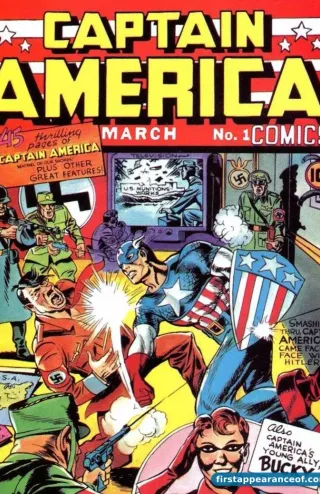
Captain America Comics #1 (1941). Bucky is alongside Cap on the cover, both punching Adolf Hitler. Cap throws the punch; Bucky has his fists raised behind him.

1st Appearance and 1st Cover

First Appearance of Bucky

Captain America Comics #1

March 1941 · Marvel · Golden Age

Joe Simon and Jack Kirby's WWII-era teenage sidekick. The character whose death stayed dead for forty years and whose return became one of the strongest Marvel revivals of the 21st century.

Key Issue

Created by Joe Simon · Jack Kirby

By Atomm Updated

The first appearance (1st app) of Bucky is Captain America Comics #1 (March 1941), created by Joe Simon and Jack Kirby. Bucky Barnes is the teenage Army camp mascot who discovers Steve Rogers's secret identity and becomes Captain America's sidekick. Same issue debuts Cap and Red Skull. The character was killed off in retroactive Marvel continuity in Avengers #4 (1964) and stayed dead for forty years until Ed Brubaker revived him as the Winter Soldier in Captain America #1 Vol. 5 (January 2005). Sebastian Stan plays Bucky/Winter Soldier in the MCU starting with Captain America: The First Avenger (2011) and continues through The Falcon and the Winter Soldier (2021) and Thunderbolts (2025).

Quick Facts

Debut
Captain America Comics #1 (March 1941)
Real name
James Buchanan Barnes
Creators
Joe Simon (writer, co-creator), Jack Kirby (artist, co-creator)
Publisher
Timely Comics (later Marvel)
First enemy
Red Skull (in the same issue)
First ally
Captain America
Team affiliations
Invaders, All-Winners Squad, Young Allies, Thunderbolts (post-Brubaker era)

First Appearance

  1. Captain America Comics #1 cover
    First Appearance First Cover March 1941

    Captain America Comics #1

    By Joe Simon, Jack Kirby

    Joe Simon and Jack Kirby created Cap and Bucky as a pair. Bucky is a teenage US Army camp mascot who discovers Cap's secret identity and becomes his sidekick. Same issue debuts Captain America and Red Skull. Cap punches Hitler on the cover, which the book printed and shipped two months before Pearl Harbor; Simon and Kirby took an explicitly anti-Nazi stance when the US was still officially neutral. Bucky was killed off in retroactive 1960s Marvel continuity (Avengers #4, 1964) and stayed dead for forty years until Ed Brubaker revived him as the Winter Soldier in Captain America #1 Vol. 5 (2005).

    Read the full breakdown

Creation Story

Joe Simon and Jack Kirby created Bucky as Captain America’s sidekick in early 1941. The structural reasoning was commercial: Robin had launched the previous year in Detective Comics #38 (April 1940) and the teen-sidekick pattern was demonstrably working. Simon’s pitch was a teenage Army camp mascot named after baseball player Bucky Harris. Kirby designed the visual: a small frame next to Cap’s, blue mask, red harness with the Stars-and-Stripes color palette echoing Cap’s costume.

The cover of Captain America Comics #1 (Cap punching Hitler, Bucky alongside) was a 1941 political statement. The United States was officially neutral in March 1941; Pearl Harbor was nine months away. Simon and Kirby published a cover featuring an American superhero punching a sitting head of state. The book sold; the political stance held; Cap and Bucky became the foundational anti-Nazi superhero pairing of the Golden Age. Bucky’s role was to be the kid sidekick whose presence in the war made the war stakes visible to a teenage readership.

Bucky disappeared from publication when the Timely line collapsed at the end of the 1940s. Stan Lee tried briefly to revive Cap and Bucky in the 1950s with limited success. The retroactive 1964 framing in Avengers #4 established that Bucky had died in 1945 during a rocket explosion. The framing was a Lee and Kirby decision; they wanted Steve Rogers to wake up in 1964 with grief intact, and Bucky’s death was the load-bearing emotional weight. The choice meant that for forty years, Bucky was the Marvel character whose death stayed dead. Most readers in the 1980s and 1990s assumed Bucky was a permanent absence in the Marvel Universe.

Ed Brubaker’s Captain America run in 2005 reversed that assumption. The Winter Soldier reveal in CA #1 Vol. 5 (January 2005) was unusual for Marvel: a major dead character returning in a way that did not feel like an editorial reset. Brubaker’s framing kept the original death intact (Bucky was on the rocket; the rocket exploded) while explaining the survival (the Soviets recovered Bucky’s body, restored him with cybernetic limbs, brainwashed him into a covert assassin). The reveal was structurally sound; it gave Bucky a sixty-year history as the Winter Soldier, which gave the modern character a life independent of the Golden Age sidekick framing.

Sebastian Stan’s MCU portrayal across nine films and series from 2011 to the present is the definitive screen Bucky. The 2014 Russo brothers film Captain America: The Winter Soldier adapted Brubaker’s 2005 storyline directly and is considered one of the strongest Marvel Studios films. Stan’s continued involvement (Falcon and the Winter Soldier in 2021, Thunderbolts in 2025) has kept the character at the center of MCU continuity longer than most Phase-1-vintage characters.

The Bucky-as-Captain America run in the comics from 2007 to 2011 is the strongest extended Bucky-led storyline. Brubaker’s writing kept the character morally weighted by his Winter Soldier past while letting him operate as the active Captain America. The mantle handed back to Steve Rogers in 2011 with Bucky returning to his own identity, which has been the framing ever since.

First Appearance and First Cover: Captain America Comics #1

The book hit stands in December 1940 with a March 1941 cover date. 64 pages. Cover price was 10 cents. The cover by Joe Simon and Jack Kirby shows Captain America punching Adolf Hitler in the jaw while Hitler’s surrounding Nazi officers scramble. Bucky is in the lower-right corner of the cover, fists up, in his blue-mask costume. The composition is unusual in placing the sidekick on the same cover as the hero’s first appearance; most Golden Age sidekick debuts came in the second issue rather than the first.

Print run was substantial for a 1941 launch, but the cover stunt (punching Hitler before US entry into WWII) drew enough attention that the print numbers may have been underestimated relative to the eventual demand. Simon and Kirby received hate mail and threats; the book sold out fast. Survival in high grade is rare. CGC 9.0 and above is in single-digit census numbers. Mid-grade copies (CGC 4.0 to 6.0) are the more common collector entry.

Inside the issue, Steve Rogers’s origin runs in the first chapter. The second chapter introduces Bucky. He is a Camp Lehigh mascot who walks in on Rogers changing into the Captain America costume. Cap, faced with a security breach, recruits Bucky as his sidekick on the spot. The framing is improvisational and consistent with how Golden Age sidekicks generally got introduced (Robin in Detective Comics #38 was similarly grafted on through circumstance). The third chapter has Cap and Bucky fight the Red Skull, who debuts in the same issue.

For pricing, Captain America Comics #1 is a top-tier Golden Age key. The 9.0-and-above tier is seven-figure territory. Mid-grade copies are six figures. The book is foundational to Marvel’s existence (Cap is the company’s longest-running character) and is one of the highest-value Timely Comics issues alongside Marvel Comics #1.
Key subsequent appearances

After the debut, these are the issues collectors and historians reach for next.

  1. 1964

    The Avengers #4

    Lee and Kirby. Cap is thawed out from the iceberg and tells the Avengers about Bucky's death during the war. The retroactive 1964 framing established Bucky as the rare Golden Age character whose death stayed canonical. The death backstory is what made Bucky's eventual 2005 return so consequential.

  2. 2005

    Captain America #1 (Vol. 5)

    Ed Brubaker writes; Steve Epting pencils. The Winter Soldier debut issue. Brubaker's revival of Bucky as a brainwashed Soviet assassin became one of the most influential Marvel storylines of the 2000s. The arc rewrote Bucky's Golden Age death (he survived the rocket explosion, was recovered by the Soviets, was put into cryogenic storage between missions for sixty years).

  3. 2007

    Captain America #25 (Vol. 5)

    Brubaker. Steve Rogers is shot and killed (or apparently killed; he comes back). Bucky takes the Captain America mantle in subsequent issues. The mantle-passing run continued through 2011 when Steve returned to active duty.

  4. 2007

    Civil War: Captain America #34

    Bucky's first full issue as Captain America. Brubaker scripts the transition. The handover is the most consequential mantle-passing event in modern Captain America continuity.

In adaptations

Film, TV, animation, and game appearances.

  1. 2011

    Captain America: The First Avenger

    Film

    Starring:Sebastian Stan

    Joe Johnston directs. Stan's first MCU appearance. Bucky in WWII alongside Steve Rogers.

  2. 2014

    Captain America: The Winter Soldier

    Film

    Starring:Sebastian Stan

    The Russo brothers. Stan's first appearance as the Winter Soldier. The film adapts Brubaker's 2005 storyline directly. Considered one of the strongest Marvel Studios films.

  3. 2021

    The Falcon and the Winter Soldier

    Film

    Starring:Sebastian Stan

    Disney+ series. Stan's first lead role with Bucky. The series follows Bucky's recovery from the brainwashing that defined the Winter Soldier era.

  4. 2025

    Thunderbolts

    Film

    Starring:Sebastian Stan

    Marvel Studios. Stan plays Bucky on the Thunderbolts team alongside other antiheroes. Confirmed as ensemble lead going forward.

Frequently asked questions

The questions readers and collectors ask most.

What is Bucky's first appearance?

Captain America Comics #1 (March 1941), Joe Simon and Jack Kirby. Same issue debuts Cap and Red Skull. Bucky is on the cover alongside Cap, both punching Hitler. There is no precursor issue. The character was built whole-cloth as Cap's sidekick.

Did Bucky stay dead?

For forty years. The retroactive 1964 framing in Avengers #4 (Lee and Kirby) established that Bucky had died in 1945 during a rocket explosion that also threw Steve Rogers into the iceberg. The death stuck through every era of Marvel publishing until Ed Brubaker brought him back in Captain America #1 Vol. 5 (2005) as the Winter Soldier. The forty-year discipline is unusual for Marvel; only Uncle Ben and (until 2005) Bucky stayed reliably dead. Brubaker's revival reframed the death rather than reversing it: Bucky survived the rocket explosion, was recovered by the Soviets, was put into cryogenic storage between covert missions for sixty years.

Is Captain America Comics #1 valuable?

Yes, top-tier Golden Age. CGC 9.0 and above is in the seven figures. Mid-grade copies (CGC 4.0 to 6.0) are six-figure books. The book is the foundational Captain America issue and one of the highest-value Timely Comics keys. The cover (Cap punching Hitler) is one of the most-recognized images in superhero comics history. Restoration is common at every grade and warrants verification.

Did Bucky take over as Captain America?

Yes, from 2007 to 2011. Steve Rogers was shot and apparently killed in Captain America #25 (Vol. 5) by Ed Brubaker. Bucky took over the Captain America name and shield in Captain America #34 (October 2007). The Bucky-as-Cap run continued through 2011 when Steve returned to active duty. The 2014 film Captain America: The Winter Soldier adapted Brubaker's revival storyline; the eventual Bucky-as-Cap framing in the comics has not been adapted directly to film, but the Falcon and the Winter Soldier series (2021) explored related material.

Who created Bucky?

Joe Simon and Jack Kirby co-created Bucky in Captain America Comics #1. Simon scripted; Kirby pencilled and designed. The character's visual (the blue mask, the red harness, the small stature relative to Cap) is Kirby's. Simon's choice to give Cap a teenage sidekick was a 1941 commercial calculation; teen sidekicks were a Golden Age commercial pattern (Robin had launched the year before in Detective Comics #38). Bucky's longevity past the Golden Age, including his 2005 return as the Winter Soldier, is largely a Brubaker construction layered over the Simon-Kirby foundation.