Creation Story
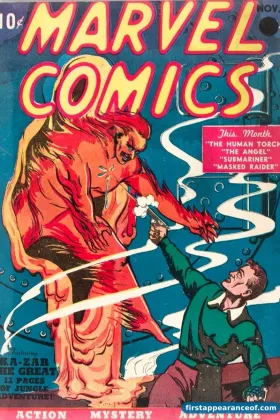
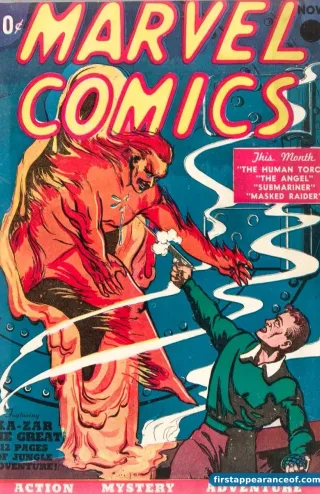
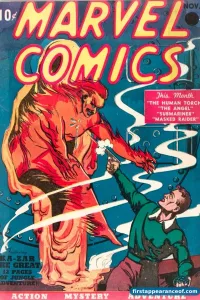
Carl Burgos was nineteen years old when he created the Human Torch for Timely Comics in 1939. The pitch was straightforward: an android who burst into flame on contact with oxygen. The science was incoherent (which Burgos did not particularly care about) but the visual was new. Most superhero books at the time were direct riffs on Superman, who had launched in Action Comics #1 the previous year. Burgos’s Human Torch was the first major superhero with a clearly different power set and a clearly different visual register. The character was on fire from the cover of Marvel Comics #1 onward.
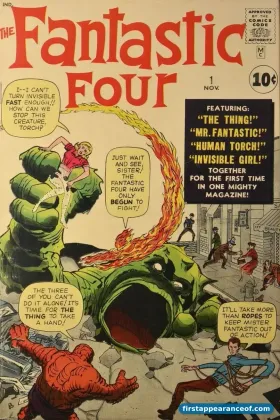
Timely Comics published Marvel Comics #1 in October 1939. The book retitled to Marvel Mystery Comics with issue #2. Both the Human Torch and the Sub-Mariner (Bill Everett’s character, debuting in the same issue) became foundational Timely heroes. The publisher was a small operation owned by Martin Goodman, the same Martin Goodman who would still be running the company twenty-two years later when Stan Lee and Jack Kirby launched Fantastic Four #1.
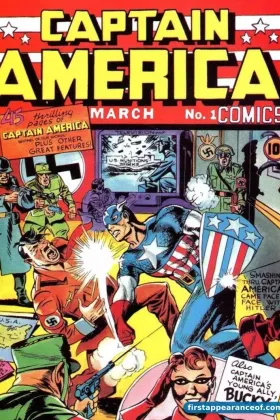
The original Human Torch was paired with a sidekick (Toro, a young human with mutant flame powers) in Human Torch Comics #2 (1940), which was a standard Golden Age move; Captain America had Bucky, Batman had Robin, the Human Torch needed Toro. Toro was unusual in being a flame-powered hero who was not an android; the explanation in the original stories was that his parents had been exposed to fire and the trait passed to him. The rationalization is a Golden Age handwave.
The character ran continuously through the Timely Golden Age and disappeared with the rest of the line around 1949 when superhero comics broadly collapsed. Stan Lee tried briefly to revive the Timely heroes in the 1950s with limited success. The character did not return permanently until the Silver Age, when Lee and Kirby’s Fantastic Four #1 reused the Human Torch name for Johnny Storm in 1961. Lee then brought back the original Hammond Torch in Fantastic Four Annual #4 (1966), explicitly to bridge the two eras and acknowledge that there were two Human Torches in Marvel continuity.
Roy Thomas’s Invaders run in the 1970s gave Hammond his most sustained extended modern treatment. The Invaders is set during World War II and includes Captain America, Sub-Mariner, Bucky, the Human Torch, and Toro fighting Axis forces. Thomas’s research-driven WWII setting gave the Golden Age Timely characters a coherent shared history that they had not had during the original 1939-1949 run. Most modern continuity treats the Invaders run as the canonical extended-history version of the Golden Age Marvel Universe.
The character has had no significant live-action adaptation. The 1944 Republic serial The Captain America did not include him. The 2011 Captain America: The First Avenger had him as a minor visual cameo (an android in a glass tube at the World Expo) but did not develop him as a character. The MCU has not announced plans to introduce the Hammond Torch.
First Appearance and First Cover: Marvel Comics #1
The book hit stands in August 1939 with an October 1939 cover date. 64 pages. Cover price was 10 cents. The cover by Frank R. Paul (an established pulp-magazine illustrator, hired by Timely for the launch) shows the Human Torch in flame escaping from a glass cylinder. The composition is unsettling and unforgettable. Paul’s draftsmanship is more realist than what would become the standard superhero comic style; the Torch on this cover looks like a horror illustration as much as a superhero one. Carl Burgos’s interior art is in the rougher 1939 cartoonist style.
Print run was probably modest (Timely was a small operation, and 1939 superhero books were not yet a proven market). Survival is poor. Most copies that exist today are reader copies in the 2.0 to 5.0 range. CGC 9.0 and above is in single-digit census numbers. The book is one of the rarest high-grade pre-Action Comics #1-tier Golden Age keys.
The story inside has Professor Phineas Horton creating the Human Torch in his lab. Horton displays the android to a panel of scientists, who declare the flame-on-contact trait to be unstable and dangerous. Horton seals the android in a glass tube. The tube cracks. The Human Torch escapes. The first issue’s plot involves the Torch encountering a gambling ring run by Anthony Sardo and learning to control his flame powers. Burgos’s writing is functional 1939 pulp; the visual storytelling is where the issue earns its place in history.
For pricing, Marvel Comics #1 is a top-tier Golden Age book. The 9.0-and-above tier is in seven-figure territory and has been since 2019. Mid-grade copies in CGC 4.0 to 6.0 are six figures. Restoration is common at every grade and warrants verification before any major purchase. The book is one of the foundational pieces of comic history; the price reflects that.