Who are the Invaders
The Invaders are Marvel’s World War II super-team, and the strange thing about them is that they did not exist during World War II. Writer Roy Thomas, the company’s resident keeper of Golden Age lore, assembled them in the 1970s out of heroes Timely Comics had published in the 1940s: Captain America and his sidekick Bucky, the original android Human Torch and his partner Toro, and the Sub-Mariner. The team is a piece of retroactive history, a 1970s book about a war that Marvel’s heroes had fought thirty years earlier in print but never under this banner.
Thomas coined the name first and built the team second. It surfaced in a 1969 flashback before he gave it a book of its own in 1975, and the gap between those two dates is the whole first-appearance question for the team. The name reportedly stuck because Stan Lee liked the sound of it, and Thomas worked it into the pitch for a wartime title.
What the Invaders gave Marvel was a way to tell new stories in a closed era. Because the books are set during the war, Thomas could introduce wartime characters, Union Jack, Spitfire, Baron Blood, and complicate continuity that had been fixed for decades, without touching the present-day Marvel Universe. It is nostalgia used as a sandbox.
First Use of the Name: The Avengers #71
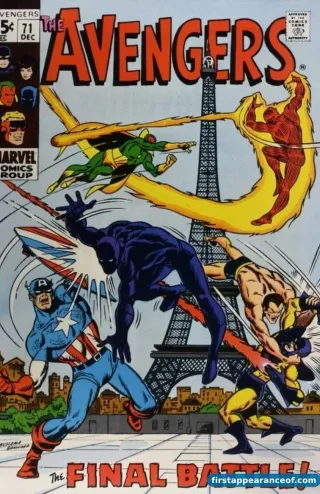
The word “Invaders” first appears in The Avengers #71, cover-dated December 1969, written by Roy Thomas and drawn by Sal Buscema. The issue is a time-travel story: the present-day Avengers are thrown into 1941 occupied France, where they encounter a wartime teaming of Captain America, the android Human Torch, and the Sub-Mariner battling the Nazis. Thomas labels that trio “the Invaders,” and the name is born.
It is a concept debut rather than a team debut. There is no ongoing unit here, no full roster, and no origin, just three Golden Age heroes glimpsed in a flashback and given a collective name for the first time. For collectors, that makes Avengers #71 the technical first the way a last-page cameo is a first: the name starts here, but the team people read about would not arrive for another six years.
First Full Team Appearance: Giant-Size Invaders #1
The team proper debuts in Giant-Size Invaders #1, cover-dated June 1975, by Roy Thomas, penciller Frank Robbins, and inker Vince Colletta. This is where the five-member lineup assembles for the first time. Captain America, Bucky, the Human Torch, Toro, and the Sub-Mariner come together to stop the Nazi super-soldier Master Man after he attacks a British battleship, and Winston Churchill formally names them “the Invaders.” The issue doubles as the team’s origin.
Giant-Size Invaders #1 is the Bronze Age key for the team. It is the first full appearance, the first time the roster operates as a named unit, and the launch point for everything the series did afterward. If a collector wants the one Invaders book that matters, this is it, the same way a first full appearance outranks a name-only cameo elsewhere in any first-appearance archive.
First Ongoing Series: The Invaders #1
The ongoing series followed almost immediately. The Invaders #1, cover-dated August 1975, picks up two months after the Giant-Size try-out with the same creative team of Thomas, Robbins, and Colletta. The series ran until 1979, reaching 41 issues plus an annual, and it became Thomas’s main vehicle for expanding Marvel’s wartime roster.
Most of the team’s lasting additions come from this run rather than the debut. Union Jack and the vampire villain Baron Blood both first appear in The Invaders #7 (1976), and Jacqueline Falsworth gains super-speed and takes the Spitfire identity across The Invaders #11 and #12 (1976). The ongoing is where the Invaders stopped being a three-hero flashback and became a real ensemble.
The Invaders versus the All-Winners Squad
It is easy to confuse the Invaders with the All-Winners Squad, and the difference matters. The All-Winners Squad is the genuine Golden Age team: it appeared in All Winners Comics #19 (1946) and #21 (1947), published in the 1940s and using much of the same membership. The Invaders are the later invention, a 1970s team retroactively dropped into the war years.
So the heroes overlap, but the teams do not. The All-Winners Squad is a real post-war Golden Age book. The Invaders are Bronze Age comics wearing Golden Age clothes. Anyone tracing first appearances should keep the two straight: the 1940s team is the All-Winners Squad, and the team Roy Thomas named is the Invaders.
Notable issues
- The Avengers #71 (1969): first use of the name “the Invaders,” in a wartime flashback by Roy Thomas and Sal Buscema.
- Giant-Size Invaders #1 (1975): first full team appearance and origin. The team is named by Churchill and fights Master Man. The key issue.
- The Invaders #1 (1975): launch of the ongoing series.
- The Invaders #7 (1976): first appearances of Union Jack and Baron Blood.
- The Invaders #11 and #12 (1976): Jacqueline Falsworth gains super-speed and becomes Spitfire.
For collectors
The Invaders are a two-book story at the front end, and the ranking is clear. Giant-Size Invaders #1 (1975) is the key: the first full team, the origin, and the launch of the whole concept. The Avengers #71 (1969) is the name-coining book, the technical first that collectors chase the way they chase any first-name cameo, valued for the milestone rather than the story. After those two, the demand is for story keys: The Invaders #7 carries the first Union Jack and Baron Blood. None of the later issues approaches the Giant-Size debut, and the team’s connection to the Avengers and to Captain America keeps interest in that 1975 origin steady.